India Recalls Diplomats’ Families from Bangladesh: A Precaution or a Precursor?
In a move that has sent ripples through the diplomatic community, the Government of India has officially advised the families and dependents of all its officials stationed in Bangladesh to return home immediately. This unprecedented step is a direct response to a sharp and dangerous escalation in anti-India sentiment and protests across the country, raising serious questions about the safety of Indian nationals and the future of a once-thriving bilateral relationship .
The decision, while framed as a precautionary measure, underscores a significant deterioration in the security environment. All Indian missions—including the High Commission in Dhaka and posts in Chattogram, Khulna, Rajshahi, and Sylhet—remain fully operational, but they are now effectively designated as ‘non-family postings’ . This isn’t just a logistical change; it’s a stark signal from New Delhi about its assessment of the ground situation.
Table of Contents
- What Triggered This Security Advisory?
- The Current Situation in Bangladesh: A Tinderbox of Tensions
- What Does This Mean for India-Bangladesh Relations?
- Are Indian Missions Still Operational?
- Conclusion: A Relationship at a Crossroads
- Sources
What Triggered This Security Advisory?
The immediate catalyst for this advisory appears to be the violent aftermath of the killing of a prominent Bangladeshi youth leader, Sharif Osman Hadi, in Dhaka. Hadi was known for his critical stance against India, and his death in mid-December 2025 ignited a wave of large-scale, often violent, anti-India protests across the nation [[13], [14]].
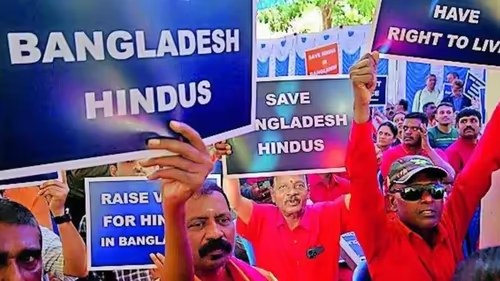
These protests have not been isolated incidents. They have been compounded by a broader context of political instability following the demise of the long-standing Sheikh Hasina government, which had been a key pillar of the strong India-Bangladesh partnership . The resulting power vacuum and law-and-order challenges have created an environment where targeted violence, particularly against minority Hindu communities, has surged, drawing intense scrutiny from Indian authorities [[18], [17]].
The Current Situation in Bangladesh: A Tinderbox of Tensions
Bangladesh is currently navigating a period of profound political turbulence. With parliamentary elections on the horizon, the political climate has become increasingly volatile . The anti-India rhetoric has been weaponized by various factions, leading to a dangerous conflation of national politics with hostility towards India and its citizens.
This has created a genuine sense of fear among the Indian community in Bangladesh, including students and business professionals, who now worry about their safety and future . The Indian government’s decision to recall families is a direct acknowledgment of these legitimate fears and a clear message that it will not risk the lives of its citizens’ loved ones in an unpredictable environment.
What Does This Mean for India recalls diplomats families Bangladesh?
This move is far more than a simple security protocol. It represents a major strategic recalibration in India’s approach to its eastern neighbor . For years, India and Bangladesh enjoyed what many described as a “golden era” of cooperation, marked by significant progress on trade, connectivity, and security collaboration .
The current situation, however, marks a sharp departure from that era. By making all its posts in Bangladesh “non-family,” India is effectively downgrading the level of normalcy and trust in the relationship. It signals to Dhaka that until the security of Indian interests and personnel can be guaranteed, the relationship will operate under a cloud of caution. This is a powerful diplomatic tool, demonstrating that India is willing to take concrete steps to protect its people, even if it means straining a crucial bilateral partnership.
Are Indian Missions Still Operational?
Yes, absolutely. It is crucial to understand that this is a measure focused solely on the safety of dependents. The Indian government has been clear that all its diplomatic and consular missions across Bangladesh remain fully functional .
Here’s a quick overview of India’s diplomatic presence in Bangladesh:
- High Commission: Dhaka
- Deputy High Commissions: Chattogram, Khulna, Rajshahi, and Sylhet
Citizens in Bangladesh requiring consular assistance should continue to contact their nearest Indian mission. The core work of diplomacy—engaging with the host government, supporting trade, and assisting citizens—continues, albeit in a more constrained and security-conscious environment.
Conclusion: A Relationship at a Crossroads
The decision for India to recall its diplomats’ families from Bangladesh is a sobering development. It is a direct consequence of a deteriorating security landscape fueled by political instability, violent protests, and a rise in anti-India sentiment. While the missions remain open, the human element of diplomacy has been withdrawn, signaling a significant loss of confidence.
This situation is being treated as temporary, with the Indian government stating it will be reassessed based on the evolving ground realities . However, the path back to the “golden era” of relations will require a concerted effort from the new leadership in Dhaka to restore order, protect minorities, and unequivocally guarantee the safety of all Indian nationals on its soil. Until then, the shadow of this security advisory will loom large over one of India’s most important neighborhood relationships.
Sources
- Times of India: Government advises kin of Indian officials in Bangladesh to return
- Ministry of External Affairs, India: Official Statements (Referenced in multiple news reports)
- International Crisis Group: Bangladesh in Flux: Elections, Extremists, and Regional Stability
- Carnegie Endowment for International Peace: After the “Golden Era”: Getting Bangladesh-India Ties Back on Track [[14], [19]]