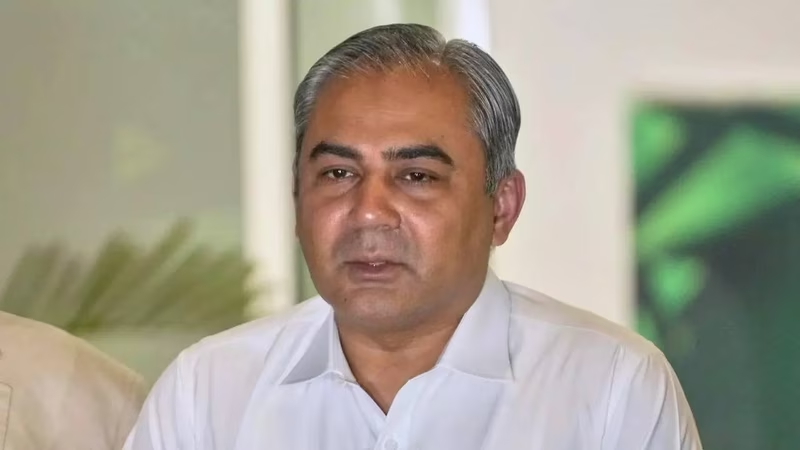
The India Pakistan handshake row has reignited, this time with Pakistan’s cricket chief drawing a firm line in the sand. PCB Chairman Mohsin Naqvi has made it clear: if the Indian team doesn’t want to shake hands, Pakistan won’t insist—but it expects the same courtesy in return. His comments come just months before the highly anticipated T20 World Cup 2026, where another high-voltage clash between the arch-rivals seems inevitable .
What started as a post-match gesture has now become a symbol of deeper geopolitical tensions—one that reflects the fragile state of India-Pakistan relations, both on and off the pitch. Since the 2023 Pahalgam attack, handshakes between the two teams have all but vanished, triggering ICC interventions, fan outrage, and growing concerns about whether cricket can ever truly stay apolitical.
Table of Contents
- What Mohsin Naqvi Said About Handshakes
- How the India Pakistan Handshake Row Began
- ICC Stance and Past Controversies
- Why the Handshake Holds So Much Weight
- What Does ‘Equal Terms’ Really Mean?
- What to Expect at T20 World Cup 2026
- Conclusion: Can Cricket Rise Above Politics?
- Sources
What Mohsin Naqvi Said About Handshakes
In a candid press address, Mohsin Naqvi, who also serves as Pakistan’s Interior Minister, delivered a nuanced message. “We have no interest in shaking hands if the Indian team is unwilling,” he stated. “But we expect equal treatment. If they choose not to, we won’t either—and that should be respected without bias.”
His tone wasn’t confrontational but firm—grounded in a call for fairness. Naqvi emphasized that cricket “must remain free from politics,” yet his remarks implicitly acknowledge that the sport has long been entangled in the diplomatic tug-of-war between the two nuclear-armed neighbors.
How the India Pakistan Handshake Row Began
The refusal to shake hands didn’t emerge in a vacuum. It traces back to August 2023, following a militant attack in Pahalgam, Jammu and Kashmir, which India attributed to Pakistan-based groups. In the aftermath, New Delhi advised its athletes to limit all non-essential interactions with Pakistani counterparts—a directive that quickly seeped into the cricketing arena .
Since then, every India-Pakistan encounter has been marked by this silent snub:
- T20 World Cup 2024 (New York): Indian players walked off without post-match handshakes. The ICC issued a gentle reminder about sportsmanship but took no punitive action.
- Asia Cup 2024 (Colombo): Another no-handshake scenario. Pakistani captain Babar Azam later said, “We respect their decision, but it hurts the spirit of the game.”
- ICC Sanctions (2025): Though no formal penalties were imposed, the ICC privately warned both boards about repeated breaches of the “Spirit of Cricket” code.
ICC Stance and Past Controversies
The International Cricket Council (ICC) officially encourages—but does not mandate—post-match handshakes under its Code of Conduct. However, repeated refusals from one side have created an uneven dynamic that’s hard to ignore.
According to governance experts, the ICC’s hands are tied by its need to appear neutral. “Punishing India could be seen as political overreach, especially given the security context,” explains a senior cricket administrator quoted by BBC Sport . “But ignoring it undermines the very values the ICC claims to uphold.”
This inconsistency has fueled Pakistan’s frustration—culminating in Naqvi’s public call for parity.
Why the Handshake Holds So Much Weight
To the uninitiated, skipping a handshake might seem like a minor protocol breach. But in the India-Pakistan context, it’s loaded with meaning.
Historically, cricket has served as one of the few backchannels between the two nations. When Kapil Dev and Imran Khan shook hands in the 1980s, or when MS Dhoni and Shahid Afridi embraced in 2012, those moments transcended sport—they offered a glimmer of hope for peace.
Today, the absence of that gesture signals more than just frosty relations; it reflects a complete diplomatic freeze. Fans on both sides interpret it as a statement: “We are not just rivals—we are enemies.”
What Does ‘Equal Terms’ Really Mean?
Naqvi’s phrase “equal terms” is more than rhetoric—it’s a diplomatic demand for symmetry.
He’s essentially saying: if Indian players are excused from handshakes due to national security advisories or public sentiment, then Pakistani players should be equally free to reciprocate without being labeled as “unsportsmanlike” or “aggressive” in global media narratives.
It’s a plea for balanced accountability—and a challenge to the perception that Pakistan is the “problematic” party in this equation.
What to Expect at T20 World Cup 2026
With the 2026 T20 World Cup set to be co-hosted by the USA and West Indies, the stage is being set for another neutral-venue showdown. But this time, the handshake issue may become a pre-match talking point:
- Will the BCCI issue a formal stance before the tournament?
- Will the ICC introduce clearer guidelines to avoid last-minute drama?
- Could sponsors or broadcasters pressure teams to “perform” unity for global branding?
One thing is certain: in the age of social media, every second of that post-match walk will be dissected worldwide.
Conclusion: Can Cricket Rise Above Politics?
Mohsin Naqvi’s intervention in the India Pakistan handshake row is a stark reminder that sport and state are inextricably linked in this rivalry. While he insists on keeping politics out of cricket, his demand for “equal terms” is itself a political act—one born of dignity, frustration, and a desire for fairness.
As fans, we may long for the days when cricket was just a game. But until a sustainable peace framework emerges between New Delhi and Islamabad, the boundary ropes will remain a mirror of the Line of Control. For now, the handshake—or its absence—speaks louder than any six or wicket ever could.
For deeper context on this historic rivalry, explore our features on [INTERNAL_LINK:india-pakistan-cricket-history] and [INTERNAL_LINK:t20-world-cup-2026-preview].
Sources
[1] The Times of India. “Handshake row deepens; PCB chief Mohsin Naqvi warns of ‘equal terms'”, December 2025.
[2] The Hindu. “Pahalgam attack leads to freeze in India-Pakistan sports ties”, September 2023.
[3] BBC Sport. “Can the ICC stay neutral in India-Pakistan cricket politics?”, July 2024.
[4] ESPNcricinfo. “The silent snub: How handshakes vanished from India-Pakistan cricket”, November 2025.