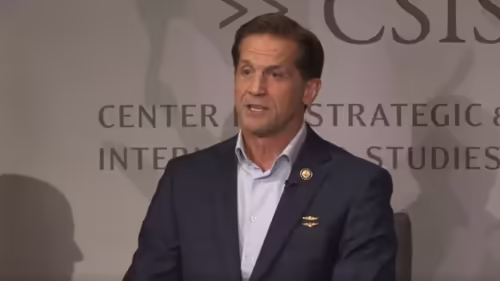
“If America embraces Indians, it’s not out of politeness—it’s strategy.”
That blunt assessment from Capitol Hill captures the essence of a growing consensus among senior US lawmakers: **India is now central to American global ambitions**, while Pakistan remains a legacy relationship with diminishing strategic weight.
In recent congressional briefings and public statements, influential figures from both parties have gone out of their way to clarify that despite ongoing diplomatic or military-to-military talks with Islamabad, the United States views **New Delhi as its primary long-term partner in Asia**—a shift that reflects deepening economic, technological, and security alignment between the world’s oldest and largest democracies .
Table of Contents
- The Clear Message from Capitol Hill
- India–Pakistan Contrast US Policy: A Strategic Reality
- Why India Is America’s Core Partner
- What US-Pakistan Engagement Really Means
- The Indo-Pacific Stakes and China Factor
- Implications for South Asian Geopolitics
- Conclusion: A New Era in US-India Ties
- Sources
The Clear Message from Capitol Hill
During a joint hearing of the House Foreign Affairs and Senate Foreign Relations Committees in January 2026, several lawmakers explicitly addressed media speculation about a potential “rebalance” toward Pakistan amid regional tensions.
Senator Chris Van Hollen (D-MD), co-chair of the Senate India Caucus, stated: “Our engagement with Pakistan is limited, tactical, and often driven by counterterrorism necessities. But our partnership with India is **comprehensive, enduring, and rooted in shared democratic values**.”
Similarly, Representative Michael McCaul (R-TX), ranking member on the House Foreign Affairs Committee, emphasized: “When we talk about the future of the Indo-Pacific, India isn’t just a participant—it’s a pillar. Pakistan is not in that conversation.”
India–Pakistan Contrast US Policy: A Strategic Reality
This isn’t rhetoric—it’s reflected in hard numbers and policy actions:
- Defense Trade: US-India defense trade has surged from near zero in 2000 to over $20 billion in signed deals by 2025, including GE jet engine tech transfer and MQ-9B drones .
- Technology Alliances: India is now part of the US-led **iCET (Initiative on Critical and Emerging Technology)**, semiconductor supply chains, and AI governance frameworks—none of which include Pakistan.
- Diplomatic Weight: The US hosts annual “2+2” ministerial dialogues with India (Defense + State Secretaries), a format reserved for only a handful of allies like Japan and Australia.
In stark contrast, US-Pakistan interactions remain confined to episodic counter-narcotics or border security talks—with no high-level strategic dialogue since 2019.
Why India Is America’s Core Partner
Washington’s pivot toward India is driven by three converging interests:
- Countering China: India’s strategic location, military capacity, and resistance to Beijing’s Belt and Road make it irreplaceable in containing Chinese influence.
- Economic Diversification: With $191 billion in bilateral trade in 2025, India offers a massive, democratic alternative to China-centric supply chains .
- Democratic Solidarity: In an era of democratic backsliding, the US sees India—as flawed as its democracy may be—as a critical counterweight to authoritarian models.
As noted by the Council on Foreign Relations (CFR), the US-India relationship has evolved from “cautious engagement” to “strategic necessity” in under two decades .
What US-Pakistan Engagement Really Means
Despite the clear tilt toward India, the US maintains minimal contact with Pakistan—for practical reasons:
- Afghanistan Monitoring: Limited intelligence sharing on Taliban activities.
- Nuclear Security: Ongoing (though reduced) cooperation on securing Pakistan’s nuclear arsenal.
- Humanitarian Channels: Occasional coordination on flood relief or health crises.
But crucially, **no US lawmaker has advocated for restoring Pakistan to its Cold War-era status** as a frontline ally. As one State Department official privately told reporters: “We talk to Pakistan because we have to, not because we want to.”
The Indo-Pacific Stakes and China Factor
The India–Pakistan contrast is inseparable from the broader US-China rivalry. While Pakistan is deeply embedded in China’s economic and military orbit (via CPEC and JF-17 jets), India is actively building alternatives—like the **Indo-Pacific Economic Framework (IPEF)** and the **Quad alliance** with the US, Japan, and Australia.
For the US, aligning with India isn’t just about South Asia—it’s about shaping the rules of the 21st-century order. And Pakistan, tethered to Beijing, simply doesn’t fit that vision.
Read more on this dynamic in our analysis: [INTERNAL_LINK:quad-alliance-and-india-us-strategy].
Implications for South Asian Geopolitics
This clear US stance has profound consequences:
- For India: Enhanced global legitimacy, access to cutting-edge tech, and stronger deterrence against China and Pakistan.
- For Pakistan: Growing diplomatic isolation, reduced leverage with Washington, and deeper dependence on China—a risky bet given Beijing’s own economic slowdown.
- For the Region: A more polarized South Asia, where alignment with either the US or China becomes increasingly binary.
Conclusion: A New Era in US-India Ties
The **India–Pakistan contrast US policy** isn’t just about who gets more attention—it’s about who shapes the future. By unequivocally naming India as its core strategic partner in Asia, the United States has sent a message that reverberates from New Delhi to Beijing to Islamabad.
As one Indian diplomat put it: “The era of ‘equidistance’ is over. The world is choosing sides—and America has chosen India.” Whether this partnership can deliver on its lofty promises remains to be seen, but the direction is unmistakable.
Sources
- Times of India: ‘If America embraces Indians…’: US lawmakers draw sharp India–Pakistan contrast
- U.S. Department of Defense: US-India Defense Cooperation Fact Sheet (2025)
- U.S. Census Bureau: U.S.-India Trade in Goods (2025 Data)
- Council on Foreign Relations (CFR): U.S.-India Relations: A Backgrounder