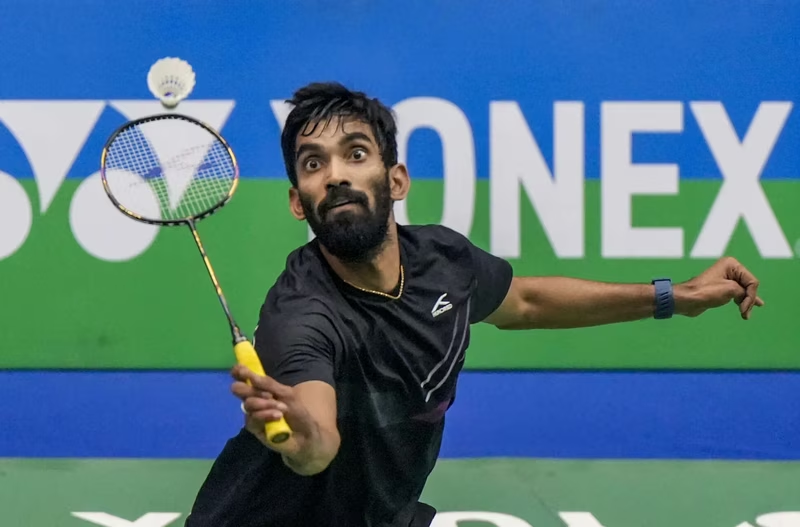
The India Open badminton tournament has found itself in the eye of a minor storm after Danish player Mia Blichfeldt voiced concerns about the venue conditions in New Delhi. But homegrown stars aren’t backing down. Former world No. 1 Kidambi Srikanth has firmly defended the event, stating that while no tournament is perfect, the issues raised were minor and not unique to India. His comments were echoed by Olympic silver medalist P.V. Sindhu, who praised the competition as a crucial trial run ahead of the upcoming World Championships.
This clash of perspectives—between international critique and domestic reassurance—has sparked a broader conversation about expectations, standards, and the realities of hosting elite-level sports events in diverse global environments. Let’s break down what’s really happening at the India Open, why it matters, and what it reveals about the evolving landscape of international badminton.
Table of Contents
- The Criticism: Mia Blichfeldt’s Concerns
- Srikanth’s Response: ‘Every Country Has Its Challenges’
- Sindhu and Other Players Back the Event
- What Are the Actual Venue Conditions?
- Why the India Open Matters on the Global Stage
- Conclusion: Balancing Perspectives in International Sport
- Sources
The Criticism: Mia Blichfeldt’s Concerns
Danish shuttler Mia Blichfeldt, a top-20 player known for her aggressive baseline game, reportedly raised concerns about the playing environment at the KD Jadhav Indoor Hall in New Delhi. While she didn’t specify exact technical flaws, her remarks suggested discomfort with factors like air quality, lighting, or court surface—common pain points in indoor arenas across developing nations .
Her comments, though measured, quickly gained traction online, especially among fans who’ve long debated whether Indian venues meet international standards. In a sport where millimeters and milliseconds matter, even subtle environmental inconsistencies can affect performance—and confidence.
Srikanth’s Response: ‘Every Country Has Its Challenges’
Enter Kidambi Srikanth, India’s former world No. 1 and a veteran of countless international tournaments. Speaking to reporters, Srikanth dismissed the notion that the India Open was somehow uniquely problematic. “Every country has its own challenges,” he said calmly. “I didn’t face any major issues during my matches. Minor things happen everywhere—you adapt.”
His stance reflects a pragmatic, experience-based perspective. Having competed from Tokyo to Copenhagen to Kuala Lumpur, Srikanth understands that no venue is flawless. Drafts in European halls, humidity in Southeast Asia, altitude in South America—all present variables players must manage. To him, labeling the India Open as substandard based on isolated feedback seems unfair and disproportionate.
Sindhu and Other Players Back the Event
Olympic and World Championship medalist P.V. Sindhu added weight to Srikanth’s view. “The facilities have been good,” she said. “It’s a great opportunity to test our strategies before the World Championships. The crowd, the energy—it’s all part of the preparation.”
Other international players offered more nuanced takes. Some acknowledged minor quirks—like inconsistent shuttlecock speed due to dry indoor air—but stopped short of calling them deal-breakers. A few even praised the organization, hospitality, and enthusiastic local support. This mixed but largely balanced feedback suggests that while room for improvement exists, the tournament isn’t the outlier some critics imply.
What Are the Actual Venue Conditions?
The KD Jadhav Indoor Hall, named after India’s first Olympic wrestling medalist, has hosted the India Open since 2019. It meets BWF (Badminton World Federation) certification standards for Super 750 events, which includes requirements for:
- Court dimensions and markings
- Lighting intensity (minimum 750 lux)
- Air circulation and temperature control
- Player amenities (doping control, medical rooms, warm-up areas)
That said, Delhi’s winter climate—characterized by low humidity and occasional smog—can impact shuttlecock behavior and player respiration. Organizers typically use humidifiers and air purifiers, but these systems aren’t always foolproof. Still, similar issues arise in Beijing, Jakarta, and even Paris under certain weather conditions.
For context, the BWF itself has not issued any formal complaints about the venue, and the tournament continues without disruption—a strong indicator that operational standards are being met.
Why the India Open Matters on the Global Stage
Beyond the current controversy, the India Open plays a vital role in the global badminton ecosystem. As a BWF Super 750 event, it offers significant ranking points and prize money, attracting nearly all top players. It’s also a key platform for Indian athletes to compete on home soil—a rare advantage in a sport dominated by East and Southeast Asian nations.
Moreover, hosting such a high-profile event signals India’s growing commitment to elite badminton. From Saina Nehwal’s breakthrough to Lakshya Sen’s rise, the sport has seen a renaissance in the country. Events like the India Open fuel grassroots interest, inspire young talent, and strengthen India’s bid for future World Tour Finals or even World Championships. Dismissing it over minor gripes risks undermining this progress.
For more on India’s badminton evolution, see our deep dive on [INTERNAL_LINK:rise-of-indian-badminton].
Conclusion: Balancing Perspectives in International Sport
The debate around the India Open isn’t really about one hall or one player’s comfort—it’s about expectations in a globalized sport. International athletes deserve professional conditions, and organizers must continuously improve. But it’s equally important to recognize that perfection is elusive, and cultural or environmental differences shouldn’t be mistaken for negligence.
Kidambi Srikanth’s calm rebuttal—“every country has its challenges”—isn’t just a defense; it’s a call for empathy and realism. As India strives to become a consistent host of world-class events, constructive feedback is welcome. But blanket criticism, divorced from context, does little to advance the sport we all love.