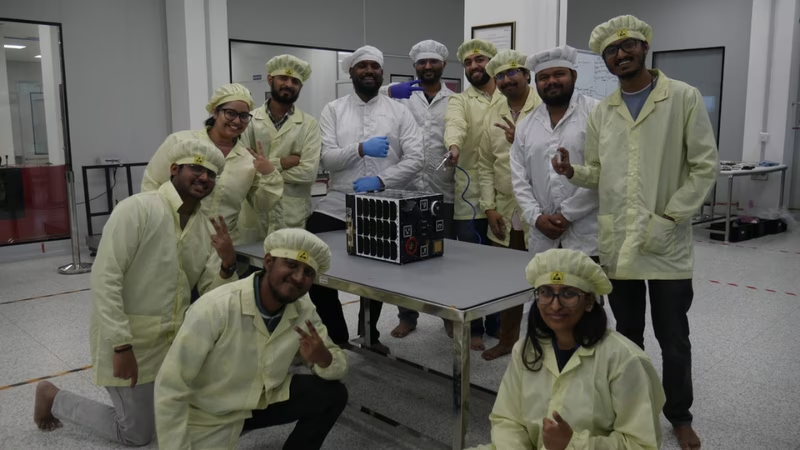
Imagine a satellite running low on fuel millions of kilometers from Earth. Instead of becoming useless space junk, it gets a visit from a robotic tanker that tops off its tank—extending its life by years or even enabling it to travel deeper into space. This isn’t science fiction anymore. It’s the future of space operations, and India is racing to make it a reality.
Following closely on the heels of China’s successful demonstration of on-orbit re-fuelling capabilities, the Indian Space Research Organisation (ISRO) is preparing for a landmark mission that could position the country among an elite group of spacefaring nations mastering this complex technology . This isn’t just about keeping satellites alive—it’s about securing strategic autonomy, reducing costs, and laying the groundwork for ambitious missions like Chandrayaan-4 and human spaceflight beyond low Earth orbit.
Table of Contents
- What Is On-Orbit Re-Fuelling and Why It Matters
- India’s Mission: The Path to Docking and Refuelling
- The China Factor: Spurring India’s Pace
- Technical Challenges of Space Refuelling
- Strategic and Economic Impact for India
- Conclusion: India on the Brink of a Space Milestone
- Sources
What Is On-Orbit Re-Fuelling and Why It Matters
On-orbit re-fuelling refers to the process of transferring propellant from one spacecraft (a “servicer” or “tanker”) to another while both are in orbit. This requires ultra-precise autonomous rendezvous, docking, and fluid transfer systems operating in the harsh vacuum of space.
The benefits are transformative:
- Extended Satellite Lifespan: Most satellites die not because their instruments fail, but because they run out of fuel for station-keeping. Refuelling can add 5–10 years to their operational life.
- Deep Space Missions: Future lunar or Mars missions could use orbital depots as “gas stations,” allowing smaller launch vehicles to send payloads that are later refuelled for the final leg of the journey.
- Cost Reduction: Building and launching new satellites costs hundreds of millions. Refuelling is far cheaper.
- Space Debris Mitigation: Servicer vehicles can also de-orbit dead satellites, helping clean up Earth’s increasingly cluttered orbital environment.
India’s Mission: The Path to Docking and Refuelling
While ISRO hasn’t publicly named the specific mission, experts believe it involves a pair of experimental satellites designed to test proximity operations, soft docking, and eventually, fluid transfer . This builds directly on the success of the SpaDeX (Space Docking Experiment) mission, which demonstrated key rendezvous and docking technologies in late 2024 .
The next logical step is integrating a fluid transfer mechanism—likely using non-toxic, storable propellants like green monopropellants. Mastering this would make India only the second country after China to achieve full on-orbit refuelling capability, leapfrogging even some traditional space powers .
The China Factor: Spurring India’s Pace
China’s National Space Administration (CNSA) successfully demonstrated on-orbit refuelling during its Tianzhou cargo missions to the Tiangong space station. More recently, it has tested robotic refuelling of defunct satellites, signaling clear military and commercial intent .
This rapid advancement has acted as a catalyst for India. With both nations vying for leadership in Asia’s space race, ISRO’s push into on-orbit re-fuelling is as much about strategic deterrence as it is about scientific progress. As one former ISRO scientist noted, “In space, autonomy equals security. If you can service your own assets, you don’t depend on anyone else” .
Technical Challenges of Space Refuelling
Achieving reliable on-orbit refuelling is extraordinarily difficult. Key hurdles include:
- Precision Docking: Two spacecraft must approach each other at relative speeds of centimeters per second without colliding.
- Seal Integrity: Fuel lines must connect in a vacuum without leaking—a major engineering challenge.
- Propellant Management: Liquids behave unpredictably in microgravity; special tanks and pumps are needed to ensure smooth transfer.
- Autonomy: Due to communication delays, the entire sequence must be automated with zero room for error.
ISRO has been methodically tackling these through incremental missions, a hallmark of its cost-effective, risk-averse philosophy.
Strategic and Economic Impact for India
Success in this domain would have profound implications:
- National Security: Military satellites could be refuelled and repositioned during conflicts, enhancing surveillance and communication resilience.
- Commercial Opportunities: NewSpace India Limited (NSIL) could offer satellite servicing to global clients, creating a high-value export market.
- Gaganyaan & Beyond: On-orbit refuelling is essential for India’s planned space station (Bharatiya Antariksha Station) and crewed lunar missions.
For a deeper look at India’s space economy, explore our feature on [INTERNAL_LINK:india-newspace-industry-growth].
Conclusion: India on the Brink of a Space Milestone
India’s upcoming mission represents far more than a technical experiment—it’s a declaration of intent. By pursuing on-orbit re-fuelling, ISRO is not just catching up with China; it’s positioning India as a self-reliant, forward-looking space power capable of shaping the future of orbital operations. If successful, this mission will mark one of the most significant leaps in India’s space journey since the Mars Orbiter Mission—and it’s happening right now.
Sources
- Times of India: After China, today’s mission could help India get closer to on-orbit re-fuelling
- ISRO Official Website: Indian Space Research Organisation
- NASA Technology Transfer Program: Robotic Refueling Mission (RRM)
- SpaceNews: China demonstrates satellite refueling capability
- The Hindu: ISRO plans space docking experiment