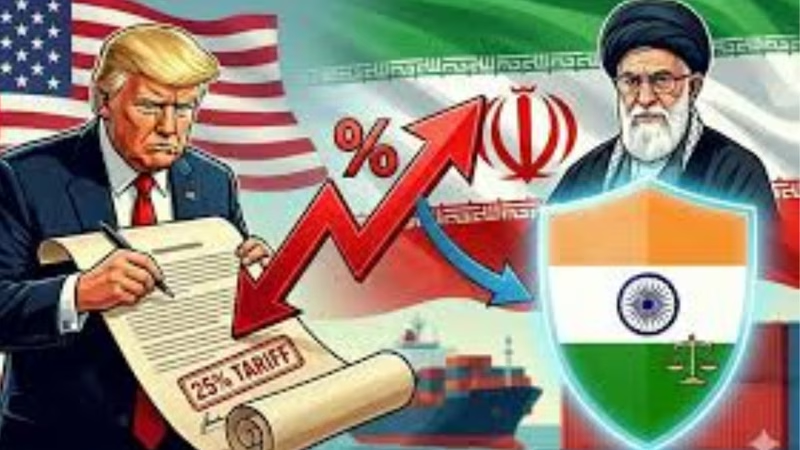
In the complex chess game of global geopolitics, few moves are as delicate as the one India is currently making. With renewed discussions around former President Donald Trump’s hardline Iran policies—including crippling economic sanctions—New Delhi is caught between a rock and a hard place. On one side lies its long-standing energy and infrastructure partnership with Tehran; on the other, its indispensable strategic alliance with Washington. The result? A high-wire diplomatic tightrope with no safety net .
This isn’t just about oil or ports—it’s about sovereignty, security, and survival in an increasingly polarized world order. As U.S. political discourse flirts with re-imposing maximum pressure on Iran, India’s response could redefine its role in the Indo-Pacific and beyond.
Table of Contents
- The Trump-Era Iran Sanctions Revisited
- Why India Iran US Sanctions Matter to New Delhi
- Chabahar Port: The Linchpin of India’s Iran Strategy
- Energy Security and Oil Imports
- Walking the Diplomatic Tightrope: India’s Balancing Act
- Future Scenarios and Strategic Options
- Conclusion: Navigating a Multipolar World
- Sources
The Trump-Era Iran Sanctions Revisited
During his presidency, Donald Trump withdrew the U.S. from the 2015 Joint Comprehensive Plan of Action (JCPOA)—the Iran nuclear deal—and unleashed a wave of “maximum pressure” sanctions. These measures targeted not just Iranian entities but also any foreign company or nation doing business with them, under the principle of “secondary sanctions” .
While the Biden administration eased some restrictions, the legal framework remains. Now, with Trump potentially returning to office in 2026, there’s growing anxiety in capitals worldwide—including New Delhi—that these sanctions could be fully reinstated or even expanded. For India, which has carefully rebuilt ties with Iran over the past decade, this is a major red flag.
Why India Iran US Sanctions Matter to New Delhi
The stakes for India are exceptionally high. The India Iran US sanctions dilemma touches three core pillars of Indian national interest:
- Energy Security: Iran was once India’s third-largest oil supplier before sanctions forced a near-total halt in imports.
- Strategic Connectivity: The Chabahar port project is India’s gateway to Afghanistan and Central Asia, bypassing Pakistan.
- Regional Influence: A strong Iran partnership countersbalance Chinese expansion in the region, especially via the Gwadar port just 150 km away .
Losing access to any of these would be a strategic setback of historic proportions.
Chabahar Port: The Linchpin of India’s Iran Strategy
Perhaps the most visible symbol of India-Iran cooperation is the Chabahar port. Operated by India Ports Global Limited (IPGL), this deep-sea port in southeastern Iran is more than infrastructure—it’s a geopolitical lifeline.
Through Chabahar, India can:
- Ship humanitarian aid and goods to landlocked Afghanistan without relying on Pakistani routes.
- Access the International North-South Transport Corridor (INSTC), linking to Russia and Europe.
- Counter China’s $62 billion China-Pakistan Economic Corridor (CPEC) and its control of Gwadar port .
While the U.S. granted a rare waiver for Chabahar development in 2018, that exemption is fragile. Any escalation in U.S.-Iran tensions could see it revoked overnight—jeopardizing billions in investment and years of diplomatic effort.
Energy Security and Oil Imports
Before 2019, Iran supplied India with roughly 200,000 barrels of crude oil per day—accounting for nearly 10% of its total imports . Payments were often settled through a rupee-rial mechanism, avoiding U.S. dollar transactions. But when Trump’s sanctions kicked in, India was forced to cut imports to zero to avoid U.S. penalties.
Today, with global oil prices volatile and India’s energy demand soaring, the temptation to restart Iranian imports is real. Yet, doing so without U.S. approval risks triggering CAATSA-like sanctions—a scenario New Delhi cannot afford, especially as it deepens defense ties with America through the Quad alliance.
Walking the Diplomatic Tightrope: India’s Balancing Act
India’s strategy has been one of quiet pragmatism. Rather than taking sides, New Delhi emphasizes “strategic autonomy”—a doctrine that allows it to engage with both Washington and Tehran without formal alignment. Key tactics include:
- Maintaining low-profile, non-military trade with Iran.
- Using diplomatic channels to seek continued U.S. waivers for Chabahar.
- Avoiding public criticism of either the U.S. or Iran to preserve bilateral goodwill.
As [INTERNAL_LINK:india-middle-east-policy] experts note, this approach has worked so far—but it’s becoming harder to sustain as great-power competition intensifies.
Future Scenarios and Strategic Options
Looking ahead, India faces three potential paths:
- Full Alignment with U.S.: Abandon Iran ties entirely. This secures the American partnership but cedes influence in West Asia and Central Asia to China.
- Defiant Engagement with Iran: Risk U.S. sanctions to deepen ties with Tehran. Economically and militarily unsustainable.
- Calibrated Neutrality: Continue limited, essential cooperation with Iran (like Chabahar) while expanding U.S. ties in defense and tech. This is India’s current—and most viable—path .
Conclusion: Navigating a Multipolar World
The India Iran US sanctions conundrum is more than a foreign policy challenge—it’s a test of India’s ability to thrive in a fragmented world order. By refusing to be forced into binary choices, New Delhi is crafting a third way: one that prioritizes national interest over ideological blocs. Whether this delicate balance holds will depend not just on diplomacy, but on India’s growing economic and strategic heft on the global stage.
Sources
- Times of India: India faces diplomatic tightrope after Trump’s Iran curbs
- U.S. Department of State: U.S. Relations With Iran
- Ministry of External Affairs, India: India-Iran Bilateral Relations
- International Energy Agency (IEA): India Energy Profile