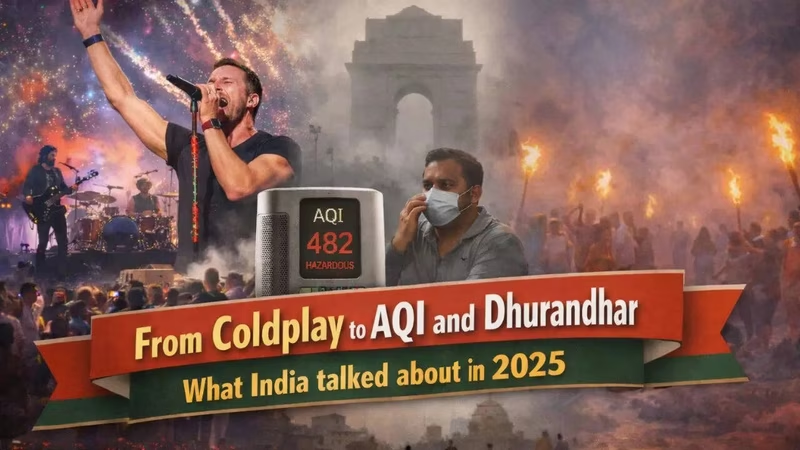
2025 didn’t just happen to India—it shook it, healed it, and redefined it. From the sacred banks of the Ganges to the smog-choked streets of Delhi, from the shock of a celebrity stabbing to the roar of military retaliation, the year unfolded like a screenplay written by fate itself: chaotic, emotional, and deeply human.
As we close the chapter on India in 2025, one thing is clear: this was not a year of quiet progress. It was a year of extremes—where spiritual grandeur collided with administrative failure, where policy ambition met public skepticism, and where national resilience was tested again and again. Let’s unpack the moments that didn’t just trend online but left indelible marks on the national psyche.
Table of Contents
- The Maha Kumbh and the Stampede Tragedy
- Operation Sindoor: India’s Decisive Counter-Terror Response
- Zero Income Tax Up to ₹12 Lakh: Bold Move or Populist Gamble?
- Saif Ali Khan Stabbing: A Celebrity Attack That Shook the Nation
- Culture and Climate: Coldplay, Dhurandhar, and Delhi’s Air Crises
- Conclusion: What 2025 Reveals About India’s Future
- Sources
The Maha Kumbh and the Stampede Tragedy
The year began with millions gathering at the Maha Kumbh in Prayagraj—the largest peaceful assembly on Earth. Pilgrims came seeking salvation; many found community, faith, and renewal. But in February, euphoria turned to horror when a stampede at the Sangam killed over 40 people and injured hundreds.
Initial reports pointed to overcrowding and poor crowd management. The tragedy sparked national outrage, with opposition leaders demanding accountability from the Uttar Pradesh government. Yet it also revealed India’s extraordinary capacity for collective grief and volunteer-driven relief—a duality that defined much of the year.
Operation Sindoor: India’s Decisive Counter-Terror Response
In late spring, terrorists struck again—this time in Pahalgam, Jammu and Kashmir, killing 13 civilians in a brazen daylight attack. The public demanded action. And within 72 hours, India responded with Operation Sindoor.
In a meticulously planned cross-border strike, Indian Special Forces targeted multiple terror launch pads in Pakistan-occupied Kashmir, neutralizing high-value operatives linked to the Pahalgam massacre. The operation, confirmed by defense sources but not officially detailed by the government, was widely praised as swift, surgical, and unambiguous.
Unlike past responses, Operation Sindoor signaled a new doctrine: no attack on civilians would go unanswered—and retaliation would be immediate. For deeper analysis, see our coverage on [INTERNAL_LINK:indias-evolving-counter-terror-strategy].
Zero Income Tax Up to ₹12 Lakh: Bold Move or Populist Gamble?
Budget 2025 dropped a bombshell: individuals earning up to ₹12 lakh annually would pay zero income tax under a new optional regime. The move, framed as “putting money back in the hands of the middle class,” ignited fierce debate.
Proponents hailed it as economic empowerment. Critics warned of revenue shortfalls—estimating a ₹2.3 lakh crore hole in the exchequer, according to the Department of Economic Affairs. Yet, early data suggests increased consumer spending and formalization of small businesses, hinting at potential long-term gains.
Saif Ali Khan Stabbing: A Celebrity Attack That Shook the Nation
In a moment that blurred the line between entertainment and real-life thriller, Bollywood star Saif Ali Khan was brutally stabbed inside his Mumbai home by an intruder. The nation watched in disbelief as security footage leaked online, showing the actor fighting back before being rushed to the hospital.
While Khan survived, the incident exposed shocking lapses in high-profile residential security and sparked panic among celebrities. The attacker, reportedly mentally unstable, had no terror links—but the randomness of the violence left a chilling impression on urban India.
Culture and Climate: Coldplay, Dhurandhar, and Delhi’s Air Crises
Amid the chaos, joy found its way in. Coldplay’s India tour drew over 300,000 fans across Mumbai and Delhi, becoming the biggest international concert event in the country’s history. The band’s eco-conscious staging—solar-powered sets, reusable cups—set a new benchmark for sustainable entertainment.
At the movies, the 2025 biopic Dhurandhar, based on the life of legendary wrestler Khashaba Dadasaheb Jadhav, became a sleeper hit, reviving interest in India’s sporting heritage.
Yet, environmental despair loomed large. Delhi’s AQI repeatedly breached 500 in November, entering the “severe+” category. Schools shut, flights diverted, and citizens wore masks indoors. The crisis reignited calls for a National Clean Air Mission with enforceable targets.
Conclusion: What 2025 Reveals About India’s Future
India in 2025 was a mirror—reflecting both its soaring potential and its systemic vulnerabilities. The year proved that the nation can mobilize millions in devotion, respond with military precision to terror, and innovate in policy. But it also showed that poor governance can turn sacred gatherings fatal, and that air quality remains a silent emergency.
As we step into 2026, the lessons of 2025 are clear: ambition must be matched with execution, and national pride must be backed by public safety. Because in a country of 1.4 billion dreams, every life—and every breath—matters.
Sources
- Times of India: From Coldplay to AQI and Dhurandhar — What India talked about in 2025
- Ministry of Defence, India: Official Statements on Counter-Terror Ops
- Department of Economic Affairs: Budget 2025 Analysis
- Central Pollution Control Board: Delhi AQI Data 2025