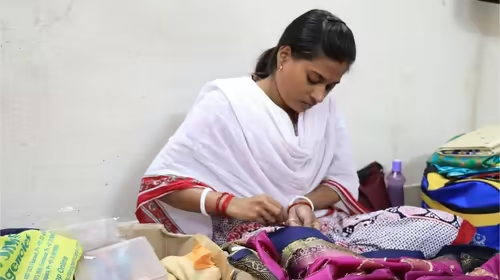
For decades, the hands that wove India’s legendary textiles remained unseen—nameless, faceless, and often underpaid. But something is quietly changing. Take Rukmini, a kantha embroidery artisan from a small village in West Bengal. Until recently, her world was confined to her courtyard and the rhythmic stitch of her needle. Then came an invitation she never imagined: a plane ticket to Delhi, not as a laborer, but as a recognized artist. Her first flight wasn’t just a personal milestone—it was a powerful symbol of the India handloom revolution now unfolding across the country .
Table of Contents
- Who Is Rukmini—and Why Her Flight Matters
- The Invisible Hands Behind India’s ₹80,000 Crore Saree Industry
- Indian Silk House Agencies: The Quiet Catalyst
- Beyond Fair Trade: Documenting Dignity
- How Consumers Can Join the Handloom Revolution
- Conclusion: Weaving a New Narrative
- Sources
Who Is Rukmini—and Why Her Flight Matters
Rukmini spent most of her life stitching intricate kantha patterns on old saris, transforming them into quilts and garments for local markets. Like millions of artisans, she was part of a vast, uncredited supply chain. But when Indian Silk House Agencies (ISHA) began working with her community, everything changed. ISHA didn’t just buy her work—they documented her story, credited her name on product tags, and invited her to showcase her craft at a national exhibition in Delhi. For Rukmini, stepping onto that airplane was more than travel; it was validation. It was proof that her skill had value beyond utility—it was art .
The Invisible Hands Behind India’s ₹80,000 Crore Saree Industry
India’s handloom sector is a colossal economic force, valued at over ₹80,000 crore annually and employing more than 4.3 million weavers—the second-largest employment provider after agriculture . Yet, despite its scale, the human stories behind each thread have long been erased. Artisans like Rukmini were treated as cogs in a machine, their identities lost in the global rush for “ethnic” fashion. This anonymity allowed exploitation to thrive, with middlemen capturing most of the profit while artisans struggled to make ends meet .
Indian Silk House Agencies: The Quiet Catalyst
Founded on decades of fair dealings in the silk trade, Indian Silk House Agencies has emerged as a quiet but powerful force for change. Their mission goes beyond commerce: they aim to restore dignity to the maker. By visiting villages, recording artisan biographies, and linking them directly to urban and international markets, ISHA cuts out exploitative layers. Their model ensures that when you buy a kantha stole or a handwoven tussar silk saree, you know exactly who made it—and that they were paid fairly .
Beyond Fair Trade: Documenting Dignity
What sets ISHA apart isn’t just ethical pricing—it’s storytelling. Every garment comes with a QR code or a woven label bearing the artisan’s name, photograph, and village. This simple act transforms the consumer experience. You’re no longer just buying a shirt; you’re supporting Rukmini’s daughter’s education or helping fund a new loom in her community. This transparency builds trust and fosters emotional connection—a radical departure from fast fashion’s disposable culture .
Key pillars of their approach include:
- Direct Sourcing: Eliminating 3–4 layers of intermediaries.
- Artisan Archives: Creating digital and physical records of each creator’s craft journey.
- Capacity Building: Offering design inputs and quality training without compromising traditional techniques.
- Market Access: Showcasing artisans at national exhibitions and e-commerce platforms with full attribution .
How Consumers Can Join the Handloom Revolution
The India handloom revolution isn’t just for NGOs or policymakers—it’s for all of us. Every purchase is a vote. Here’s how you can be part of this movement:
- Ask “Who Made My Clothes?” Support brands that disclose artisan names and origins.
- Choose Quality Over Quantity: Invest in one authentic handloom piece instead of five mass-produced imitations.
- Visit Craft Fairs: Events like Dastkar or state emporiums offer direct access to weaver collectives.
- Educate Yourself: Learn about regional weaves—like Baluchari, Chanderi, or Muga silk—and their cultural significance .
Organizations like the Office of the Development Commissioner for Handicrafts, under the Ministry of Textiles, also provide verified directories of authentic handloom products and cooperatives—a trusted resource for conscious buyers [INTERNAL_LINK:ethical-fashion-india-guide].
Conclusion: Weaving a New Narrative
Rukmini’s first flight is more than a feel-good story—it’s a blueprint for systemic change. The India handloom revolution is not about charity; it’s about justice, visibility, and economic agency. By honoring the maker as much as the craft, initiatives like Indian Silk House Agencies are proving that tradition and modernity can coexist—ethically and beautifully. As consumers, we hold the power to turn every saree, every shirt, into a statement of solidarity. The next time you admire a handloom piece, remember: behind every thread is a human being with a name, a story, and a right to be seen.
Sources
- Times of India: “Do you know who made your shirt? The story of the first flight of a kantha artisan…”
- Web Search Result: “Ethical fashion brands in India that credit artisans”
- Web Search Result: “Indian Silk House Agencies mission and model”
- Ministry of Textiles, Government of India: “Handloom Sector Statistics”
- Web Search Result: “Challenges faced by Indian handloom weavers”
- Web Search Result: “Guide to Indian handloom weaves and their origins”