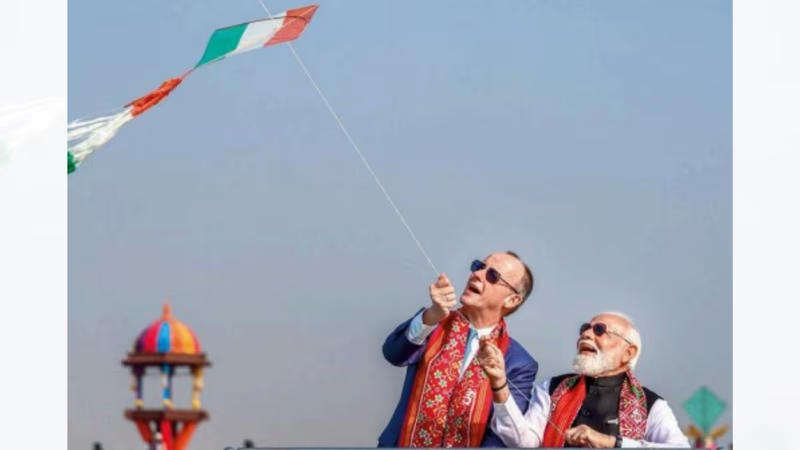
On January 12–13, 2026, as German Chancellor Olaf Scholz wrapped up his high-stakes visit to New Delhi, India and Germany didn’t just shake hands—they rewrote the playbook on strategic alliances. With **India Germany relations** entering a bold new chapter, the two democracies inked 27 wide-ranging agreements that span defence manufacturing, semiconductor ecosystems, critical mineral sourcing, and digital innovation .
This isn’t just diplomatic window dressing. It’s a calculated geopolitical realignment—one that positions both nations as counterweights in an increasingly fragmented global order. For businesses, policymakers, and citizens alike, these developments signal profound shifts in trade flows, tech sovereignty, and national security strategies.
Table of Contents
- Historic Outcomes of the 2026 Summit
- India-Germany Defence Cooperation Takes Off
- Critical Tech Alliance: Semiconductors and Beyond
- Trade and Investment: A New Economic Corridor
- Why This Matters for Global Geopolitics
- What Comes Next for India Germany Relations?
- Conclusion: A Partnership Built for the Future
- Sources
Historic Outcomes of the 2026 Summit
Celebrating 75 years of diplomatic ties, the January 2026 summit marked the most consequential meeting between Indian and German leadership in decades. Prime Minister Narendra Modi and Chancellor Scholz oversaw the signing of 27 joint documents—a record haul covering everything from green hydrogen to AI governance .
Among the key deliverables were four foundational agreements focused on critical and emerging technologies, including semiconductors and critical minerals—resources vital for everything from electric vehicles to next-gen defence systems . This signals a shift from transactional engagement to deep, structural interdependence.
India-Germany Defence Cooperation Takes Off
Perhaps the most groundbreaking development was the formalization of a bilateral defence industrial roadmap. Both nations issued a Joint Declaration of Intent on Strengthening Bilateral Defence Industrial Cooperation, paving the way for co-development and co-production of military hardware .
For India, this is a strategic win. Long reliant on Russian arms, New Delhi is now actively diversifying its defence suppliers. Germany—home to giants like Rheinmetall and Hensoldt—offers advanced capabilities in artillery, radar systems, and naval engineering. Crucially, this partnership could accelerate India’s ‘Make in India’ defence ambitions by enabling local manufacturing under technology transfer agreements.
Unlike past collaborations limited to training or spare parts, this new framework emphasizes joint innovation—a model that aligns with India’s push for defence self-reliance.
Critical Tech Alliance: Semiconductors and Beyond
In today’s tech-driven world, semiconductors are the new oil. Recognizing this, India and Germany have launched a dedicated semiconductor supply chain partnership. The agreement aims to secure raw materials (like gallium and germanium), foster R&D collaboration, and build resilient fabrication ecosystems .
This move directly responds to global supply chain shocks and U.S.-China tech decoupling. By teaming up, both nations aim to reduce dependency on East Asian foundries and create an alternative, democratic-led semiconductor corridor.
Beyond chips, the two countries also pledged cooperation in:
- Critical minerals processing—essential for batteries and renewables
- Quantum computing and AI ethics
- Digital public infrastructure—building on India’s UPI and Germany’s GAIA-X cloud initiative
Trade and Investment: A New Economic Corridor
While not a full free trade agreement (that remains under EU-India negotiations), the bilateral trade relationship is getting a turbo boost. German companies announced over €5 billion in new investments across renewable energy, automotive, and pharmaceuticals .
Notably, Germany has also eased visa norms for Indian business travelers and skilled professionals—a practical step that will facilitate deeper people-to-people and corporate ties . As PM Modi noted during the India-Germany CEOs Forum, “The world’s two major democratic economies will deepen cooperation in critical and emerging technologies” to drive inclusive growth .
Why This Matters for Global Geopolitics
The strengthening of India Germany relations isn’t happening in a vacuum. It’s part of a broader realignment among democratic nations seeking to balance economic pragmatism with strategic autonomy.
For Germany, India offers a stable, high-growth market and a reliable partner in the Indo-Pacific. For India, Germany represents access to cutting-edge European technology without the political strings often attached to U.S. or Chinese partnerships. Together, they form a powerful axis that champions rules-based order, supply chain resilience, and democratic values in tech governance.
What Comes Next for India Germany Relations?
The roadmap is clear: implementation. Joint working groups on semiconductors, defence offsets, and green tech are expected to convene quarterly. A bilateral innovation fund may soon be established to support startups in dual-use technologies.
Observers should also watch for deeper coordination in multilateral forums like the G20 and the Indo-Pacific Oceans Initiative. As [INTERNAL_LINK:india-eu-strategic-partnership] evolves, the Germany-India dyad could become its most dynamic engine.
Conclusion: A Partnership Built for the Future
The 2026 India-Germany summit wasn’t just about signing documents—it was about building a shared future. From tanks to transistors, the two nations are weaving a partnership rooted in mutual respect, technological ambition, and democratic solidarity. In an age of great-power competition, this alliance offers a compelling third way: one where prosperity and principle go hand in hand.
Sources
- Times of India: India, Germany to boost ties in defence, trade, critical tech
- Government of India: India–Germany Joint Statement (January 2026)
- Press Information Bureau: Visit of the Chancellor of the Federal Republic of Germany to India
- Election Commission of India: Model Code of Conduct Guidelines (for general reference on democratic norms)