Introduction: A New Economic Order Dawns
For decades, the global economic narrative has been dominated by Western powers. But a seismic shift is underway, and the data is now undeniable. According to the International Monetary Fund’s (IMF) latest World Economic Outlook, India GDP growth 2026 is projected to be so robust that the nation will overtake the United States as the world’s second-largest engine of global expansion. This isn’t just a statistic; it’s a fundamental reordering of the world’s economic landscape.
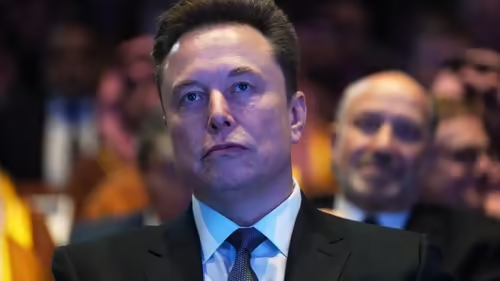
Tech visionary and world’s richest man, Elon Musk, has already weighed in on this historic development, sharing the IMF data with his massive following and declaring, “The balance of power is changing.” His simple yet powerful statement has ignited a global conversation about the rise of Asia and the future of the global economy.
Table of Contents
- IMF Data: India vs. US in Global GDP Growth
- Elon Musk’s Reaction: “The Balance of Power is Changing”
- Why Is India GDP Growth 2026 So Strong?
- What This Means for the Global Economy
- Conclusion: A New Chapter for India and the World
- Sources
IMF Data: India vs. US in Global GDP Growth
The January 2026 update of the IMF’s World Economic Outlook paints a clear picture. While the US remains an economic powerhouse, its contribution to the *marginal* growth of the global economy—the new wealth being created each year—is being surpassed by India’s explosive momentum [[17]].
Here’s the breakdown of the top contributors to global real GDP growth in 2026, based on the IMF’s projections:
| Rank | Country | Contribution to Global Real GDP Growth (2026) |
|---|---|---|
| 1 | China | 26.6% |
| 2 | India | 17.0% |
| 3 | United States | 9.9% |
This means that China and India together are expected to drive a staggering 43.6% of all new global economic output in 2026 [[22]]. In stark contrast, the US, while still a major player, will account for less than half of India’s contribution. This data confirms that the center of economic gravity is decisively shifting towards Asia.
Elon Musk’s Reaction: “The Balance of Power is Changing”
Elon Musk, known for his sharp insights into global trends, didn’t just passively observe this data. He actively shared an IMF-based chart highlighting the top contributors to global GDP growth and accompanied it with a now-famous tweet: “The balance of power is changing” [[9]].
Musk’s comment resonated because it captured the essence of the data in a single, profound sentence. It’s not merely about one country growing faster than another; it’s about a structural transformation of the international order. His endorsement of this trend lends significant credibility and brings mainstream attention to what economists have been forecasting for years.
Why Is India GDP Growth 2026 So Strong?
Several key factors are fueling India’s remarkable ascent:
- Robust Domestic Demand: A young, growing population with rising disposable income is creating a massive internal market for goods and services, making the economy less reliant on external shocks.
- Manufacturing Boom: Initiatives like “Make in India” have successfully attracted foreign direct investment and spurred domestic manufacturing, turning the country into a global production hub.
- Strong Services Sector: India’s world-class IT and business process outsourcing sectors continue to be a major export and employment driver.
- Upwardly Revised Forecasts: The IMF itself has shown confidence in India’s trajectory, recently revising its FY2026 GDP growth forecast upwards to 7.3% from an earlier estimate of 6.6%, citing a stronger-than-expected economic performance [[4]].
What This Means for the Global Economy
This shift has profound implications:
- Rise of the Global South: India’s success story is a beacon for other emerging economies, signaling a move away from a Western-centric economic model.
- New Investment Frontiers: Global investors are increasingly looking to India as a primary destination for capital, seeking to tap into its high-growth potential.
- Geopolitical Rebalancing: Economic power translates into geopolitical influence. India’s growing clout will inevitably reshape international alliances and trade dynamics.
Conclusion: A New Chapter for India and the World
The IMF’s data and Elon Musk’s commentary are more than just headlines; they are a definitive marker of a new era. The projection that India GDP growth 2026 will outpace the US in terms of contribution to the global economy is a testament to the nation’s resilient and dynamic economic model. This is not a temporary blip but a long-term trend driven by demographics, policy, and a burgeoning entrepreneurial spirit. As we move forward, the world will need to adapt to this new reality where the engines of global prosperity are increasingly located in the East. For more on how this impacts global markets, see our analysis on [INTERNAL_LINK:global-markets-2026].
Sources
- Times of India. “IMF data shows India above America in the list of ‘Top 10 Contributors to Global Real GDP Growth for the year 2026’; Elon Musk responds.” https://timesofindia.indiatimes.com/…
- International Monetary Fund. “World Economic Outlook Update, January 2026.” https://www.imf.org/…
- Firstpost. “China, India, US…… ‘the balance of power is changing’: Musk.” https://www.firstpost.com/…
- Visual Capitalist. “Who’s Powering Global Economic Growth in 2026?” https://www.visualcapitalist.com/…
- The Hindu. “IMF upgrades India’s 2025-26 growth to 7.3% from earlier estimate of 6.6%.” https://www.thehindu.com/…