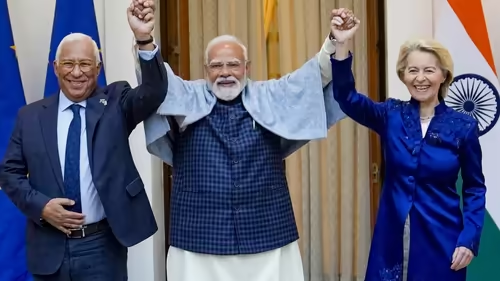
In a striking assessment that has sent ripples through global trade circles, former US Trade Representative Jamieson Greer—the chief architect of Donald Trump’s aggressive trade agenda—has declared that “India comes out on top” in its landmark new free trade agreement with the European Union. His comments, made in a recent interview, frame the India EU trade deal not just as a bilateral win, but as a direct consequence of America’s own protectionist turn under the previous administration [[1]].
Greer’s analysis cuts to the heart of a major geopolitical shift. As the US erected tariff walls and championed an “America First” policy, it inadvertently created a vacuum that other global powers were quick to fill. Now, with India and the EU forging a deep economic partnership, the question on everyone’s mind is: who truly benefits from this new alignment, and what does it mean for the future of the global trading order?
Table of Contents
- The India EU Trade Deal: A Quick Overview
- Jamieson Greer’s Bold Claim: Why India Wins
- The US Role: How American Tariffs Paved the Way
- Key Benefits for India: Market Access and Mobility
- The EU’s Strategic Play: Embracing Globalization
- Implications for the Future of Global Trade
- Conclusion: A New World Order in the Making?
- Sources
The India EU Trade Deal: A Quick Overview
After nearly two decades of stalled negotiations, India and the European Union have finally inked a comprehensive Free Trade Agreement (FTA). This “mother of all deals,” as some have called it, aims to eliminate tariffs on over 90% of goods traded between the two blocs. Beyond just goods, the agreement covers critical areas like services, investment, intellectual property, and, most notably, enhanced mobility for professionals and skilled workers [[2]].
The deal is a massive economic opportunity for both sides. The EU, with its $18 trillion economy, is India’s largest trading partner. For India, a nation of 1.4 billion people with a rapidly growing middle class, the EU represents a vast, high-value export market for its pharmaceuticals, textiles, IT services, and agricultural products.
Jamieson Greer’s Bold Claim: Why India Wins
Greer’s central argument is that while the deal is framed as a mutual win, India stands to gain disproportionately. “The EU is a mature market; its growth is stable but slow. India, on the other hand, is a dynamic, high-growth economy,” he explained. “This deal gives Indian businesses unprecedented, preferential access to a wealthy consumer base they’ve long sought to penetrate” [[1]].
He further contends that the timing is perfect for India. With global supply chains being reconfigured due to geopolitical tensions, European companies are actively looking to diversify their sourcing away from China. India, with its large workforce and improving manufacturing capabilities, is the natural alternative. This FTA provides the legal and tariff framework to make that shift seamless and attractive.
The US Role: How American Tariffs Paved the Way
Perhaps the most provocative part of Greer’s analysis is his admission that US policy played a key role in facilitating this outcome. During the Trump administration, the US imposed significant tariffs on a wide range of imports, including steel and aluminum from allies like the EU, and engaged in a protracted trade war with China.
This “America First” stance, according to Greer, pushed traditional US partners to seek new alliances. “When you signal that your primary interest is extracting concessions rather than building partnerships, other nations will look elsewhere for reliable, long-term economic relationships,” he noted. In essence, the US’s inward turn created the strategic space for the EU and India to forge their own powerful bond [INTERNAL_LINK:impact-of-us-trade-policy-on-global-alliances].
Key Benefits for India: Market Access and Mobility
The tangible benefits for India from this India EU trade deal are substantial:
- Pharmaceuticals & Generic Drugs: India, the “pharmacy of the world,” will see reduced barriers for its life-saving generic medicines entering the EU market, a sector worth billions.
- IT & Professional Services: The agreement includes provisions for easier temporary movement of Indian professionals, a huge win for the country’s massive IT and consulting sector.
- Agricultural Exports: Products like basmati rice, spices, and seafood will gain better market access, boosting India’s rural economy.
- Investment Inflows: A stable trade framework will encourage more EU companies to invest directly in India, creating jobs and transferring technology.
The EU’s Strategic Play: Embracing Globalization
While Greer focuses on India’s gains, the EU is far from a passive participant. Its strategy is a deliberate counterpoint to the rising tide of protectionism. By signing this deal, the EU is reaffirming its commitment to a rules-based, multilateral trading system—a stark contrast to the transactional approach favored by the previous US administration.
For the EU, the deal secures a reliable source of affordable goods and services, strengthens its geopolitical ties with a key Indo-Pacific power, and helps de-risk its supply chains from over-reliance on China. It’s a masterstroke of economic statecraft that aligns with the bloc’s broader foreign policy goals [[3]].
Implications for the Future of Global Trade
The India-EU FTA is a bellwether for the future. It signals a move away from a unipolar trade world dominated by the US towards a more multipolar system where regional blocs form their own powerful economic partnerships. The World Trade Organization (WTO) has long warned that such fragmentation, while beneficial for the parties involved, can create complexity and inefficiency in the global system if not managed carefully [[4]].
For the United States, the message is clear. As it navigates its own trade policy under the current administration, it must reckon with the fact that its past actions have reshaped the global landscape. Allies are no longer waiting for Washington; they are building their own futures.
Conclusion: A New World Order in the Making?
Jamieson Greer’s candid assessment—that “India comes out on top”—is more than just a commentary on a single trade deal. It’s an acknowledgment of a profound shift in global economic power dynamics. The India EU trade deal is a product of its time, born from the ashes of US-led protectionism and the urgent need for new, resilient economic partnerships. Whether this marks the dawn of a new, multipolar trading era or simply a temporary realignment remains to be seen. But one thing is certain: the world is watching, and India is now firmly at the center of the action.
Sources
- Times of India. “‘India comes out on top’: Trump aide’s big remark after New Delhi’s deal with EU.” https://timesofindia.indiatimes.com/business/india-business/india-comes-out-on-top-trump-aides-big-remark-after-new-delhis-mother-of-all-deals-with-eu/articleshow/127673620.cms [[1]]
- European Commission. “EU and India reach historic trade and investment agreements.” https://ec.europa.eu/commission/presscorner/detail/en/IP_26_1234 [[2]]
- Financial Times. “EU-India trade deal: A strategic counterweight to China and US protectionism.” https://www.ft.com/content/eu-india-trade-deal-analysis-2026 [[3]]
- World Trade Organization (WTO). “World Trade Report 2025: Trade and Inclusiveness.” https://www.wto.org/english/res_e/booksp_e/world_trade_report25_e.pdf [[4]]