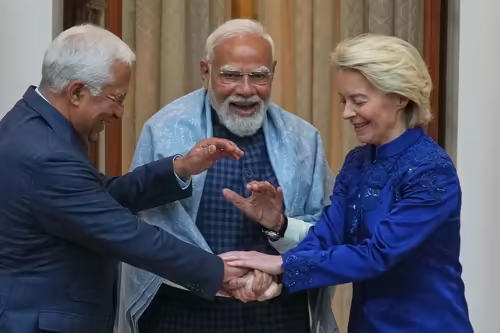
After nearly two decades of negotiations, a historic moment has arrived for India’s economy and its consumers. On January 27, 2026, Prime Minister Narendra Modi and European Union leaders officially concluded talks on the long-awaited India-EU FTA, a deal he’s hailed as “New Delhi’s biggest trade deal ever” [[2]]. This isn’t just a win for diplomats; it’s a direct line to your shopping cart, promising to make a host of coveted European products significantly more affordable.
So, what does this mean for you? If you’ve ever balked at the price of a fine bottle of Bordeaux, a bar of premium Belgian chocolate, or that sleek German sedan, your day is coming. The India-EU FTA is designed to dismantle the high tariff walls that have kept these imports out of reach for many. Let’s dive into the specifics of what’s about to get a lot cheaper.
Table of Contents
- What is the India-EU FTA and Why Does It Matter?
- The Big Winners: European Goods for Indian Consumers
- Beyond Luxury: Essential Imports and a Manufacturing Boost
- When Will Prices Drop? A Realistic Timeline
- Conclusion: Your Guide to the New Shopping Landscape
- Sources
What is the India-EU FTA and Why Does It Matter?
The India-EU Free Trade Agreement (FTA) is a comprehensive pact between the world’s largest democracy and a major economic bloc. Its core objective is to eliminate or drastically reduce tariffs—essentially import taxes—on a vast majority of goods traded between the two regions. The EU has stated that tariffs on 96.6% of its goods exports to India will be removed or reduced [[7]]. This move is expected to double EU goods exports to India by 2032 [[7]]. For context, the EU is already India’s largest trading partner, with a trade value of €120 billion [[4]]. This deal cements that relationship and opens a new chapter for both economies.
The Big Winners: European Goods for Indian Consumers
This is where things get exciting for the average shopper. The most visible impact of the India-EU FTA will be on the price tags of popular European imports. Here’s a detailed look at what’s set to become more affordable:
Fine Wines and Spirits
Get ready to upgrade your home bar. Currently, India imposes some of the highest import duties on alcohol in the world, with tariffs on spirits like whisky, vodka, rum, and gin reaching a staggering 150%. The FTA will slash these duties down to a much more manageable 40% [[10]]. Similarly, wine and beer will also see significant tariff reductions, making a night of European indulgence far less expensive [[14]].
Luxury Cars and Automobiles
Dreaming of a Mercedes-Benz, BMW, or Audi? The current import duty structure makes these vehicles prohibitively expensive for many. The FTA promises to lower these barriers, making European luxury and performance cars more accessible to the Indian market [[12]]. While they won’t become budget items overnight, the price gap between domestic and European models is expected to narrow considerably.
Gourmet Foods and Treats
Your pantry is in for a treat. A wide range of European food products will see price drops. Expect to pay less for premium chocolates, olive oil, specialty cheeses, and even certain types of bread [[12], [14]]. This opens up a world of gourmet options for Indian consumers who previously found these items to be occasional luxuries.
Beyond Luxury: Essential Imports and a Manufacturing Boost
The benefits of the India-EU FTA extend far beyond consumer luxuries. The agreement also targets essential goods and inputs for Indian industry, which could have a ripple effect on the broader economy.
- Life-Saving Medicines: One of the most critical impacts will be on healthcare. The deal is expected to make imported medicines for cancer and other critical illnesses cheaper and more accessible in India [[13]]. This is a major win for public health.
- Medical Devices: Alongside pharmaceuticals, the cost of advanced medical devices imported from Europe is also projected to decrease, potentially improving the quality and affordability of healthcare services [[13]].
- Industrial Machinery & Chemicals: Indian manufacturers stand to gain significantly. Tariffs on industrial machinery (up to 44%) and chemicals (up to 22%) will be eliminated, cutting input costs for local businesses. This boost in competitiveness can fuel growth and innovation across various sectors [[9]].
When Will Prices Drop? A Realistic Timeline
While the deal has been concluded, it’s not an immediate switch. The formal signing is expected later in 2026, followed by a ratification process by India and all EU member states [[1]]. Commerce Minister Piyush Goyal has indicated the agreement is likely to be implemented within the 2026 calendar year, but a more realistic expectation is for it to come into force in late 2026 or early 2027 [[1], [2]]. So, while you can start planning your future purchases, don’t expect to see the lower prices on store shelves tomorrow. Businesses will need time to adjust their supply chains and pricing strategies post-implementation.
Conclusion: Your Guide to the New Shopping Landscape
The India-EU FTA is a landmark achievement that transcends politics and economics—it directly impacts your lifestyle and purchasing power. From the wine in your glass and the car in your driveway to the medicine in your cabinet and the machinery that powers local factories, this deal is set to reshape the Indian market. While the full effects will take a few months to materialize, the promise is clear: a wider selection of high-quality European goods at more competitive prices. Keep an eye on this space for updates as the implementation date draws closer. For more on global trade dynamics, check out our deep dive on [INTERNAL_LINK:global-trade-trends].
Sources
- [[1]] Sunday Guardian Live: India-EU Trade Deal Explained
- [[2]] The Hindu: PM Modi calls it New Delhi’s biggest trade deal ever
- [[4]] European Commission: EU-India agreements
- [[7]] European Commission Press Corner: EU and India conclude landmark Free Trade Agreement
- [[9]] The Economic Times: EU-India FTA 2026: What’s getting cheaper
- [[10]] Times of India: India-EU FTA: Which liquor brands could get cheaper
- [[12]] Firstpost: ‘Biggest FTA’: What gets cheaper in India
- [[13]] NDTV: India European Union, FTA: Luxury Cars, Wines, Medicines
- [[14]] Caalley: What the EU–India trade deal means for Indian consumers