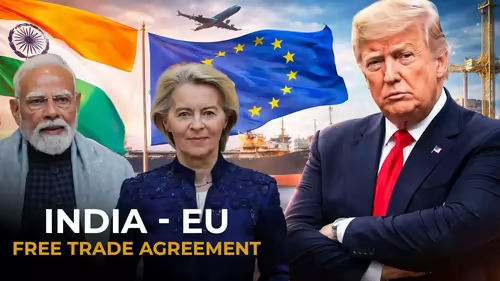
Global trade is entering a new era of uncertainty—and opportunity. With former U.S. President Donald Trump threatening to slap a staggering 50% tariff on Indian goods if re-elected, New Delhi is racing to secure its economic future. Enter the India-EU FTA—dubbed by insiders as the “mother of all trade deals.” Once operational, this landmark agreement could grant **93% of India’s exports** duty-free entry into the European Union, a market of over 450 million high-spending consumers [[1]]. But can it truly offset the looming blow from Washington?
Table of Contents
- Why the India-EU FTA Matters Now More Than Ever
- What the India-EU FTA Actually Delivers
- Trump’s Tariff Threat: A Real Danger for India
- Can the EU Deal Really Offset US Losses?
- What This Means for Indian Consumers and Businesses
- Conclusion: A Strategic Hedge, Not a Perfect Solution
- Sources
Why the India-EU FTA Matters Now More Than Ever
For years, the India-EU FTA negotiations were stuck in diplomatic limbo. But with rising protectionism in the U.S. and growing geopolitical tensions, both sides have fast-tracked talks. The urgency is clear: India needs to diversify its export markets. The U.S. remains one of India’s largest trading partners, with bilateral trade exceeding $191 billion in 2023 [[2]]. A sudden 50% tariff would cripple key sectors like textiles, pharmaceuticals, and IT services. The EU deal isn’t just about growth—it’s about survival in an increasingly fragmented global economy.
What the India-EU FTA Actually Delivers
The agreement promises transformative benefits for both sides:
- For Indian exporters: Around 93% of tariff lines will see immediate or phased duty-free access to the EU market. This includes critical sectors like gems & jewelry, leather goods, processed foods, and auto components [[1]].
- For Indian consumers: Expect lower prices on premium European imports—think German luxury cars, French wines, Italian fashion, and Swiss watches—as import duties are slashed or eliminated [[3]].
- For services and investment: The deal includes robust provisions for digital trade, intellectual property, and mutual recognition of professional qualifications, opening doors for India’s vast services sector [[4]].
Trump’s Tariff Threat: A Real Danger for India
During his 2024 campaign, Trump has repeatedly vowed to impose “universal baseline tariffs” of up to 60%, with specific threats targeting countries like India and China. His previous administration had already placed India on the “Priority Watch List” for intellectual property issues and removed it from the Generalized System of Preferences (GSP) program in 2019, costing Indian exporters an estimated $190 million annually [[5]]. A 50% blanket tariff would be catastrophic—especially for MSMEs that lack the scale to absorb such shocks. This makes the India-EU FTA not just desirable, but essential.
Can the EU Deal Really Offset US Losses?
Let’s be realistic: the EU and U.S. markets are not interchangeable. The U.S. imported $78.3 billion worth of goods from India in 2023, while the EU imported $62.1 billion [[2]]. However, the EU market offers higher per-capita spending power and greater regulatory alignment in sectors like green tech and pharma. While the India-EU FTA won’t fully replace lost U.S. revenue overnight, it provides a crucial strategic hedge. It signals to global investors that India is open for business—even amid American volatility. As [INTERNAL_LINK:india-trade-diversification-policy] experts note, reducing overreliance on any single market is smart economics.
What This Means for Indian Consumers and Businesses
Beyond macroeconomics, the deal has tangible impacts:
- Consumers: A Mercedes-Benz or a bottle of Bordeaux could become significantly more affordable. Reduced duties may also spur competition, driving down prices across premium segments.
- Exporters: Small manufacturers in Tirupur (textiles) or Moradabad (brassware) could finally access EU shelves without being priced out by tariffs.
- Challenges: Indian dairy and agriculture sectors fear competition from subsidized EU products. Safeguards and transition periods will be critical to protect vulnerable domestic industries [[6]].
Conclusion: A Strategic Hedge, Not a Perfect Solution
The India-EU FTA is a game-changer—but not a magic bullet. It won’t erase the damage of Trump’s proposed tariffs, but it dramatically reduces India’s vulnerability. By locking in preferential access to the world’s second-largest economy, India is building a more resilient, diversified trade architecture. In an age of economic nationalism, this deal is less about ideology and more about insurance. And right now, that insurance policy looks invaluable.
Sources
- [[1]] The Times of India. “India-EU FTA: Can ‘mother of all trade deals’ offset impact of Trump’s tariffs? Explained.” https://timesofindia.indiatimes.com/…
- [[2]] Ministry of Commerce and Industry, Government of India. “India’s Foreign Trade Statistics 2023.”
- [[3]] European Commission. “EU-India Trade and Investment Relations.” https://trade.ec.europa.eu/…
- [[4]] Observer Research Foundation. “Understanding the India-EU FTA Negotiations.”
- [[5]] USTR. “2023 Special 301 Report.” https://ustr.gov/…
- [[6]] Centre for WTO Studies, IIFT. “Impact Assessment of India-EU FTA on Domestic Sectors.”