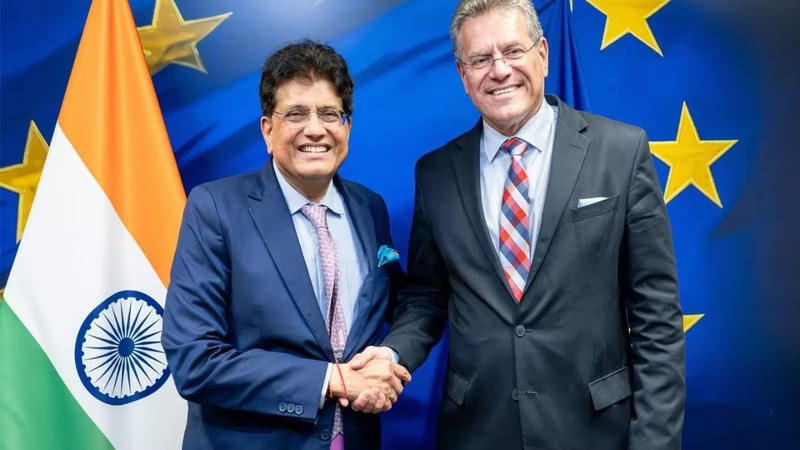
Imagine a trade corridor stretching from Mumbai to Munich—where Indian pharmaceuticals fill European shelves, German engineering powers Indian factories, and digital services flow freely across continents. That vision is no longer science fiction. After 17 years of stop-and-go talks, the India-EU FTA (Free Trade Agreement) is closer than ever to becoming reality.
With both sides intensifying negotiations in early 2026 and political momentum building on both ends, experts say a deal could be finalized by late 2026 or early 2027. If successful, it would create one of the world’s most dynamic trade partnerships—linking a $3.7 trillion economy (India) with a $18 trillion bloc (EU).
But why does this matter to you? Whether you’re a farmer in Punjab, a software engineer in Bengaluru, or a small business owner importing machinery, the India-EU FTA could directly impact your bottom line, job prospects, and access to global markets.
Table of Contents
- What Is the India-EU FTA?
- Why Now? Timing and Geopolitical Shifts
- Key Sectors That Will Benefit from the India-EU FTA
- Challenges and Sticking Points
- What This Means for Indian Consumers and Businesses
- Conclusion: A Strategic Leap Forward
- Sources
What Is the India-EU FTA?
The India-EU Free Trade Agreement—officially known as the Broad-based Trade and Investment Agreement (BTIA)—aims to eliminate tariffs on over 90% of goods, reduce non-tariff barriers, and open markets for services, investment, and government procurement.
First launched in 2007, talks stalled in 2013 over disagreements on issues like data security, intellectual property, and visa rules for Indian professionals. But the geopolitical landscape has shifted dramatically since then. With supply chain diversification becoming a global priority post-pandemic, and Europe seeking alternatives to over-reliance on China, India has emerged as a trusted democratic partner.
Recent high-level visits—including Prime Minister Narendra Modi’s trip to Brussels and European Commission President Ursula von der Leyen’s 2024 India tour—have injected fresh urgency into the process .
Why Now? Timing and Geopolitical Shifts
Three major forces are accelerating the India-EU FTA:
- De-risking from China: The EU wants to reduce dependency on Chinese manufacturing. India, with its “Make in India” push and young workforce, offers a viable alternative.
- Green and digital transitions: Both sides see collaboration in renewables, EVs, and AI as critical—and trade rules can enable faster tech transfer.
- Strategic alignment: On issues from climate to maritime security, India and the EU increasingly see eye-to-eye, creating trust beyond commerce.
As the European Commission states, “India is not just a market—it’s a partner in shaping a rules-based global order” .
Key Sectors That Will Benefit from the India-EU FTA
Not all industries will gain equally. Here’s a breakdown of the biggest winners:
1. Pharmaceuticals & Generic Drugs
India supplies 40% of Europe’s generic medicines. The FTA could slash remaining tariffs and streamline regulatory approvals, boosting exports worth over $15 billion annually.
2. Information Technology & Digital Services
Indian IT firms like TCS, Infosys, and Wipro serve hundreds of EU clients. Easier movement for skilled professionals and mutual recognition of certifications could expand this $50+ billion sector.
3. Textiles & Apparel
With EU tariffs on Indian garments ranging from 8–12%, removal could revive exports of cotton, silk, and handloom products—supporting millions of artisans.
4. Automotive & Auto Components
Indian manufacturers of EV parts, tires, and engines stand to gain as European automakers seek diversified suppliers amid green transition mandates.
5. Agriculture (Selective)
While sensitive items like dairy remain protected, niche Indian products—basmati rice, spices, tea, and mangoes—could see duty-free access, opening premium European markets.
Challenges and Sticking Points
Despite progress, hurdles remain:
- Data localization: The EU demands strong GDPR-style privacy; India’s new Digital Personal Data Protection Act is still being tested.
- Geographical Indications (GIs): The EU wants protection for 250+ GIs (like Champagne, Parmesan); India seeks reciprocity for Darjeeling Tea, Alphonso Mango, etc.
- Visa liberalization: India continues to push for easier short-term visas for IT professionals—a long-standing pain point.
Negotiators are reportedly close to compromise, with phased implementation likely for contentious areas.
What This Means for Indian Consumers and Businesses
For businesses, the FTA means:
- Lower-cost imports of capital goods (e.g., German machinery, French aerospace parts)
- New export opportunities without tariff penalties
- Stronger investor confidence due to stable trade rules
For consumers, expect:
- More affordable European wines, cosmetics, and luxury goods
- Higher-quality imported components in electronics and cars
- Greater choice in organic and specialty foods
[INTERNAL_LINK:how-ftas-impact-indian-economy] Crucially, increased competition may also push domestic firms to innovate—raising overall quality standards.
Conclusion: A Strategic Leap Forward
The India-EU FTA is more than a trade deal—it’s a strategic realignment with profound economic and geopolitical implications. By deepening ties with Europe, India strengthens its position as a global manufacturing and services hub while gaining access to high-value markets.
If implemented wisely—with safeguards for vulnerable sectors and support for MSMEs to compete—the agreement could add up to 1.5% to India’s GDP over the next decade, according to World Bank estimates .
In an era of fragmentation, the India-EU partnership offers a rare beacon of cooperation. And for India, it’s a chance to prove that democracy and development can go hand in hand on the world stage.