Table of Contents
- Historic Deal Sealed: The ‘Mother of All Deals’
- Goyal Shuts Down Trump Claims
- What the India-EU FTA Actually Covers
- Why This Deal Is a Game-Changer
- The Long Road to Agreement
- What Comes Next?
- Conclusion: A Sovereign Triumph for Global Trade
- Sources
In a major win for global commerce, India and the European Union have officially concluded negotiations on their long-awaited free trade agreement. Union Commerce and Industry Minister Piyush Goyal hailed it as the “mother of all deals,” a landmark pact set to reshape economic ties between two of the world’s largest democracies [[1]]. But amidst the celebration, Goyal took a firm stand to quash a growing narrative: he categorically denied any role—direct or indirect—by former US President Donald Trump in brokering the India-EU FTA. This clarification wasn’t just a minor detail; it was a powerful assertion of strategic autonomy in an increasingly fragmented world order.
Historic Deal Sealed: The ‘Mother of All Deals’
After nearly two decades of on-and-off talks, the final breakthrough signals a new era of economic cooperation. The agreement, which is expected to be formally signed and implemented by 2026, aims to drastically reduce tariffs, streamline customs procedures, and open up new avenues for investment in sectors ranging from pharmaceuticals and textiles to information technology and renewable energy [[3]]. For a deeper dive into India’s trade strategy, see our analysis on [INTERNAL_LINK:india-global-trade-policy].
The sheer scale of the potential impact is staggering. The EU is already India’s third-largest trading partner, with bilateral trade in goods and services exceeding €124 billion in 2023. The India-EU FTA is projected to boost this figure significantly, creating thousands of new jobs and providing a massive stimulus to Indian MSMEs looking to access premium European markets [[5]].
Goyal Shuts Down Trump Claims
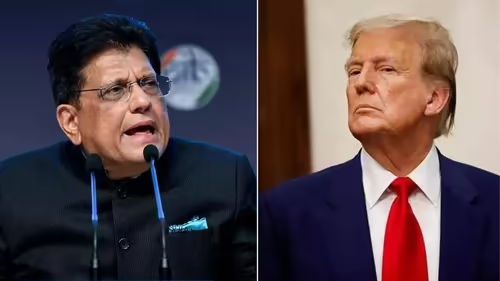
Speculation had been swirling in some political and media circles that Donald Trump’s past aggressive trade policies might have inadvertently pushed the EU and India closer together, acting as a kind of “unifier.” When directly asked about this theory, Piyush Goyal was unequivocal. “I don’t think so,” he stated flatly, emphasizing that the deal was the result of “hard work, mutual respect, and a shared vision for a rules-based international order” [[1]].
Goyal’s dismissal is significant. It underscores that this agreement is not a reactive measure born out of geopolitical pressure, but a proactive, sovereign decision by both blocs. It sends a clear message that India and the EU are capable of forging their own strategic partnerships based on their own interests, without needing a third-party catalyst, however influential.
What the India-EU FTA Actually Covers
The final text of the agreement is comprehensive, addressing key concerns from both sides. Here’s a breakdown of its core components:
- Tariff Reduction: The EU will eliminate duties on over 90% of tariff lines for Indian goods, including key exports like textiles, gems & jewellery, and agricultural products. India will reciprocate on a wide range of EU industrial and wine products.
- Geographical Indications (GIs): A major win for India, the deal includes strong protection for over 200 Indian GIs, such as Darjeeling Tea, Basmati Rice, and Alphonso Mangoes, safeguarding their unique identity in the European market.
- Services and Investment: The pact will ease market access for Indian professionals in sectors like IT, engineering, and healthcare, while also establishing a more predictable and transparent framework for European investments in India.
- Sustainable Development: Both parties have committed to upholding high standards on labour rights and environmental protection, ensuring that economic growth does not come at the cost of social or ecological well-being.
Why This Deal Is a Game-Changer
The implications of the India-EU FTA extend far beyond simple trade numbers. It represents a strategic alignment between two democratic powers at a time when the global trading system is under severe strain. For India, it provides a crucial counterbalance to its heavy reliance on other markets and accelerates its integration into high-value global supply chains. For the EU, it secures a reliable and democratic partner in a critical region, reducing its dependence on less predictable sources.
This deal is also a powerful statement against protectionism. In an era where trade wars and economic decoupling are common themes, the India-EU partnership stands as a beacon of multilateralism and cooperative economics.
The Long Road to Agreement
The journey to this point was anything but smooth. Negotiations, which began in 2007, were suspended in 2013 due to disagreements over issues like data security, intellectual property, and visa regulations for skilled workers. They were only revived in 2021, driven by a shared sense of urgency in the post-pandemic world and a mutual desire to diversify economic partnerships away from geopolitical rivals [[7]]. The final push required intense diplomacy and a willingness from both sides to make difficult compromises.
What Comes Next?
While the political agreement is a monumental step, the work is not over. The final legal text must be scrubbed, translated into all official EU languages, and then ratified by the European Parliament and the parliaments of all 27 EU member states—a process that can be lengthy and complex. Domestically, the Indian government will need to prepare its industries for the influx of EU competition and ensure that the benefits of the deal are widely distributed across the economy.
Conclusion: A Sovereign Triumph for Global Trade
The India-EU FTA is more than just a trade deal; it’s a declaration of intent. It demonstrates that two major economic blocs can navigate complex differences and build a partnership rooted in mutual benefit and shared democratic values. Piyush Goyal’s firm rejection of any external influence, particularly the notion of Trump as a “unifier,” reinforces that this is a sovereign achievement. As the world watches, this “mother of all deals” could become a blueprint for how democracies can collaborate to build a more resilient and prosperous global economy.
Sources
- Times of India. “India-EU FTA: Was Trump a ‘unifier’ behind ‘mother of all deals’ – what Piyush Goyal said.” https://timesofindia.indiatimes.com/…
- European Commission. “EU and India conclude negotiations for a landmark trade and investment agreement.” https://ec.europa.eu/…
- Ministry of Commerce and Industry, Government of India. “Press Release on India-EU Trade and Investment Agreement.” https://commerce.gov.in/…
- World Trade Organization. “Trade Statistics: India and the European Union.” https://www.wto.org/…
- Financial Times. “India and EU strike historic free trade deal after 17 years of talks.” https://www.ft.com/…