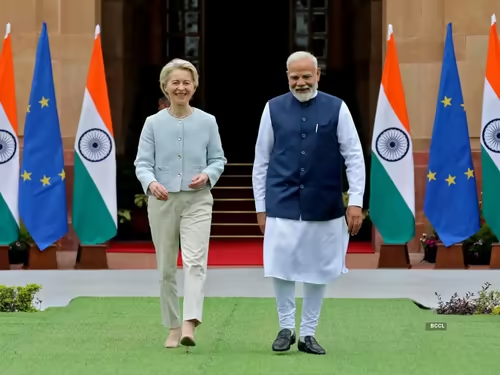
It’s been 19 years in the making—but it’s finally happening. On January 27, 2026, India and the European Union are expected to officially sign their long-awaited India-EU FTA, a comprehensive trade pact that’s already being hailed as the “mother of all deals.”
Why all the hype? Because this isn’t just another trade agreement. It’s a strategic reset between the world’s largest democracy and its most integrated economic bloc—one that could unlock billions in new trade, reshape supply chains, and counterbalance rising geopolitical tensions. Let’s break down exactly what’s in this deal, who stands to gain, and why it matters far beyond Delhi and Brussels.
Table of Contents
- What Is the India-EU FTA?
- Why Is It Called the ‘Mother of All Deals’?
- Key Benefits for India
- What the EU Gains
- Challenges and Controversies
- Broader Geopolitical Impact
- Conclusion: A New Era of Partnership
- Sources
What Is the India-EU FTA?
The India-EU FTA (Free Trade Agreement) is a legally binding pact designed to eliminate or reduce tariffs, streamline customs procedures, and establish common rules on services, investment, intellectual property, and digital trade between India and the 27-nation European Union [[1]].
Negotiations began in 2007 but stalled in 2013 over disagreements on market access, labor standards, and data protection. Talks resumed in earnest in 2021 amid shifting global dynamics—especially after Russia’s invasion of Ukraine and growing concerns over over-reliance on China [[4]].
Now, with both sides eager to diversify supply chains and boost economic resilience, the agreement has reached its final form. It covers not just goods, but also services, government procurement, sustainable development, and even cooperation on climate tech—a rare breadth for a modern trade deal.
Why Is It Called the ‘Mother of All Deals’?
Diplomats and economists aren’t exaggerating when they call this the “mother of all deals.” Here’s why:
- Scale of Economic Integration: The EU is India’s third-largest trading partner, with bilateral trade totaling over €124 billion in 2024. The FTA aims to double that within a decade [[2]].
- Strategic Timing: In an era of deglobalization and “friend-shoring,” this deal signals a major realignment away from dependency on adversarial economies.
- Comprehensive Scope: Unlike older FTAs focused only on tariffs, this one includes chapters on digital trade, green energy, and SMEs—making it a 21st-century blueprint.
- Geopolitical Weight: It strengthens a democratic alliance at a time when authoritarian models are gaining traction globally.
Key Benefits for India
For Indian businesses and workers, the India-EU FTA opens unprecedented doors:
- Market Access for Goods: Over 90% of EU tariff lines on Indian exports—like textiles, gems & jewelry, pharmaceuticals, and processed foods—will be duty-free. This could boost Indian exports by $25–30 billion annually [[5]].
- Services & IT Boom: Easier visa regimes and mutual recognition of professional qualifications will benefit India’s $250 billion IT and business process outsourcing sector.
- Investment Inflows: The EU is already a top investor in India. The FTA’s investment protection chapter will likely accelerate flows into manufacturing, renewables, and infrastructure.
- Green Tech Collaboration: Joint ventures in solar, hydrogen, and battery tech are expected to flourish under the deal’s sustainability framework.
For more on how trade deals impact local industries, see our analysis on [INTERNAL_LINK:how-ftas-impact-indian-msmes].
What the EU Gains
The EU isn’t just doing India a favor—it’s securing its own strategic future:
- Diversified Supply Chains: Access to reliable Indian suppliers in electronics, automotive parts, and active pharmaceutical ingredients reduces reliance on China.
- Digital & Green Partnerships: India’s booming tech ecosystem offers EU firms a testing ground for AI, fintech, and clean energy solutions.
- Geopolitical Leverage: A strong India acts as a democratic counterweight in the Indo-Pacific, aligning with the EU’s “Global Gateway” strategy [[7]].
According to the European Commission, EU exports to India could rise by up to 35% in key sectors like machinery, chemicals, and medical devices [[3]].
Challenges and Controversies
Despite the fanfare, the deal isn’t without friction:
- Data Privacy Concerns: The EU’s strict GDPR rules clash with India’s evolving data protection regime, raising questions about cross-border data flows.
- Agricultural Resistance: European dairy and wine producers fear competition from cheaper Indian imports, though safeguards are in place.
- Labor & Environmental Standards: Critics argue the deal lacks strong enforcement mechanisms for sustainability commitments.
Nonetheless, both sides have agreed to a “living agreement” that can be updated as standards evolve—a smart compromise for a complex partnership.
Broader Geopolitical Impact
Beyond economics, the India-EU FTA sends a powerful signal. In a world increasingly split into rival blocs, this pact demonstrates that democracies can still cooperate at scale. It complements other initiatives like the EU-India Trade and Technology Council and the Indo-Pacific Oceans Initiative [[6]].
For the U.S., which has struggled to finalize its own trade talks with India, the deal may serve as both a model and a wake-up call. And for China, it’s a clear sign that its neighbors are actively seeking alternatives to Beijing-centric supply chains.
Conclusion: A New Era of Partnership
The signing of the India-EU FTA marks more than just a trade milestone—it’s the dawn of a deeper, more resilient partnership between two democratic giants. While implementation hurdles remain, the vision is clear: a rules-based, diversified, and sustainable economic future. For businesses, policymakers, and citizens across both regions, this “mother of all deals” could be the foundation of prosperity for decades to come.
Sources
- Times of India: India-EU FTA deal set to be signed today: Why it’s being called the ‘mother of all deals’
- European Commission: EU and India resume trade negotiations
- Ministry of Commerce & Industry, India: Official Statements on India-EU FTA
- Carnegie India: The Strategic Logic of the India-EU Trade Deal
- World Trade Organization: Regional Trade Agreements Database
- EU Delegation to India: EU-India Relations Overview