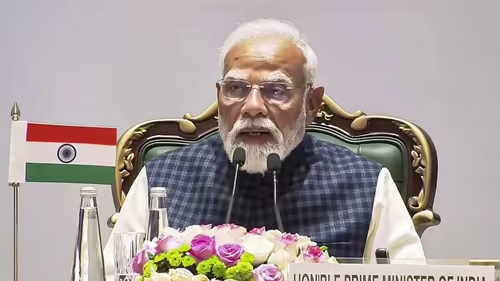
In a world rattled by geopolitical fractures and economic headwinds, a major announcement from New Delhi on January 27, 2026, offered a glimmer of hope. Prime Minister Narendra Modi and European leaders declared the conclusion of negotiations for a historic India-EU FTA, a move hailed as a cornerstone for future prosperity. But beyond the celebratory headlines lies a complex narrative, one where Modi’s signature “double engine” political slogan is now being repurposed as an economic lifeline in a time of “turmoil in the global environment” [[9]].
Table of Contents
- What is the India-EU FTA?
- Modi’s “Double Engine” Pitch: A New Economic Mantra?
- Who Really Wins? The Impact on Labor-Intensive Sectors
- The Road Ahead: Challenges and Opportunities
- Conclusion: A Pact of Promise and Pressure
- Sources
What is the India-EU FTA?
This isn’t just another trade deal. The India-EU FTA is being billed as the “biggest” and most comprehensive agreement India has ever negotiated [[9]]. After years of stalled talks, the final push was made during the 16th India-EU Summit in New Delhi, culminating in the formal conclusion of negotiations on January 27, 2026 [[4]].
The core of the agreement is market access. For Indian exporters, it’s a game-changer: over 99% of India’s current export value to the EU will eventually enter the 27-nation bloc duty-free [[25]]. This dismantles significant tariff barriers that have long hindered Indian goods, particularly in Europe’s highly regulated markets.
For the EU, the deal promises to double its goods exports to India by 2032, with tariffs eliminated or reduced on 96.6% of its products [[8]]. While the legal text is now undergoing a “legal scrubbing,” the political commitment is firm, with a formal signing expected before India’s fiscal year-end on March 31, 2026 [[6]].
Modi’s “Double Engine” Pitch: A New Economic Mantra?
PM Modi’s choice of the term “double engine” is deeply strategic. Traditionally, this phrase has been a potent political slogan for his party, referring to the synergy of having the same party in power at both the central and state levels to drive development [[10]]. By invoking it in the context of the India-EU FTA, he’s attempting to reframe the narrative.
He’s suggesting that the partnership between India and the EU can act as a dual-powered engine, providing a counterbalance to the prevailing “turmoil in the global environment” [[9]]. This framing positions the deal not just as a commercial transaction, but as a geopolitical anchor—a source of stability and shared prosperity in an otherwise chaotic world. It’s a powerful message aimed at both domestic and international audiences, promising a reliable path forward amidst uncertainty.
Who Really Wins? The Impact on Labor-Intensive Sectors
The true test of this agreement’s success will be its impact on the ground, especially for India’s vast workforce. The government and industry bodies are particularly optimistic about the benefits for labor-intensive sectors, which are crucial for job creation.
Here’s a breakdown of the key sectors poised to gain:
- Textiles & Apparel: A major employer, this sector faces high EU tariffs (up to 12%). The FTA will remove these, making Indian garments far more competitive [[20]].
- Gems & Jewellery: India is a global hub for diamond cutting and polishing. Duty-free access will solidify its position in the lucrative European luxury market [[16]].
- Agriculture & Marine Products: From spices to seafood, these products will see a significant reduction in tariffs, opening new avenues for farmers and fishermen [[25]].
- Leather Goods: Another key employment generator, the leather industry is expected to see a major boost from improved market access [[25]].
Industry leaders have welcomed the deal as a “game-changer” that will deliver “tangible gains for labour-intensive sectors and MSMEs” [[17]]. The Confederation of Indian Industry (CII) and FICCI have echoed this sentiment, highlighting the potential for massive job creation and export growth [[17]].
The Road Ahead: Challenges and Opportunities
While the outlook is largely positive, the path ahead isn’t without its bumps. Some analysts caution that while the FTA presents immense opportunities, it also brings challenges for certain domestic industries that may face increased competition from high-quality EU imports, particularly in sectors like automobiles and premium spirits [[19]].
Furthermore, the success of the deal hinges on more than just tariff removal. Non-tariff barriers, regulatory standards, and logistical efficiencies will be critical. Indian exporters will need to upgrade their quality and compliance to meet stringent EU norms. This is where strategic support from the government, perhaps through a new form of “double engine” coordination between central ministries and state export promotion councils, will be essential [INTERNAL_LINK:export-promotion-strategies].
For a deeper dive into the EU’s official stance on its trade relationship with India, you can refer to the European Commission’s dedicated page.
Conclusion: A Pact of Promise and Pressure
The historic India-EU FTA is a monumental achievement in international trade. It offers a powerful antidote to global economic instability and unlocks unprecedented opportunities for Indian businesses, especially in vital labor-intensive sectors. PM Modi’s “double engine” framing is a bold attempt to sell this complex agreement as a simple, reliable engine for national growth. The coming months and years will reveal whether this engine can deliver on its immense promise, transforming the lives of millions of workers and cementing a new era of Indo-European partnership. The world will be watching closely.
Sources
- Times of India. (2026). Turmoil in global environment: PM Modi’s ‘double engine’ pitch after India-EU ‘historic’ FTA. Retrieved from https://timesofindia.indiatimes.com/business/india-business/turmoil-in-global-environment-pm-modis-double-engine-pitch-after-india-eu-historic-fta/articleshow/127619774.cms
- The Hindu. (2026). PM Modi calls it New Delhi’s biggest trade deal ever. Retrieved from https://www.thehindu.com/business/Economy/india-european-union-summit-live-updates-on-january-27/article70555085.ece
- European Commission. (2026). EU and India conclude landmark Free Trade Agreement. Retrieved from https://ec.europa.eu/commission/presscorner/detail/en/ip_26_184
- VisaHQ. (2026). India and European Union Clinch Long-Awaited Free Trade Deal. Retrieved from https://www.visahq.com/news/2026-01-26/in/india-and-european-union-clinch-long-awaited-free-trade-deal-paving-way-for-mobility-chapter/
- Fortune India. (2026). Labour-intensive sectors gain as India-EU FTA removes tariffs on $33 billion exports. Retrieved from https://www.fortuneindia.com/business-news/labour-intensive-sectors-gain-as-india-eu-fta-removes-tariffs-on-33-billion-exports/129770
- Times of India. (2026). New Delhi, EU seal historic FTA: How ‘mother of all deals’ will change your shopping list. Retrieved from https://timesofindia.indiatimes.com/business/india-business/india-european-union-free-trade-agreement-what-gets-cheaper-bilateral-pact-highlights/articleshow/127610962.cms