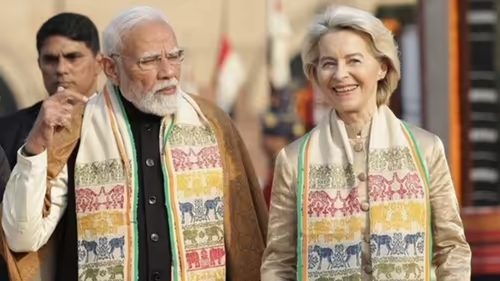
It was more than just a fashion statement. When Prime Minister Narendra Modi and European Commission President Ursula von der Leyen stood side-by-side in New Delhi, both draped in identical, earthy-toned Eri silk scarves, the world took notice. This wasn’t a coincidence—it was a carefully crafted piece of diplomatic theater that perfectly encapsulated the spirit of their historic meeting. The visual harmony of their attire mirrored the alignment of two major global powers, culminating in the long-awaited India-EU Free Trade Agreement, a deal so significant it’s being hailed as the ‘mother of all deals.’
Table of Contents
- The Power of a Scarf: Decoding the Eri Silk Symbolism
- The India-EU Free Trade Agreement: What’s in the ‘Mother of All Deals’?
- Economic Impact and Key Sectors Set to Benefit
- A Strategic Partnership Beyond Just Trade
- Why Now? The Timing of the Deal
- Conclusion: A New Chapter in Global Trade
- Sources
The Power of a Scarf: Decoding the Eri Silk Symbolism
The choice of Eri silk was no accident. Often called ‘peace silk’ or ‘ahimsa silk,’ Eri is produced in a way that doesn’t harm the silkworm, aligning with principles of sustainability and ethical production—values central to the modern European Union. Originating primarily from Assam and other northeastern states of India, Eri silk represents India’s rich, diverse, and eco-conscious textile heritage [[11]].
By gifting and wearing this specific fabric, PM Modi sent a clear message: India is ready to be a responsible, sustainable partner on the global stage. For Ursula von der Leyen to accept and wear it publicly was a powerful gesture of respect and shared values, transforming a simple accessory into a potent symbol of mutual trust and a new era of cooperation.
The India-EU Free Trade Agreement: What’s in the ‘Mother of All Deals’?
After nearly two decades of on-and-off negotiations, the India-EU Free Trade Agreement has finally been finalized. This isn’t just another trade pact; it’s a comprehensive framework designed to create one of the world’s largest free trade zones, connecting a market of 1.4 billion Indians with the EU’s 450 million consumers [[18]].
The agreement aims to eliminate or significantly reduce tariffs on a vast array of goods, from Indian textiles, pharmaceuticals, and agricultural products to European machinery, automobiles, and wine. But it goes far beyond tariffs. The deal includes robust chapters on:
- Services and Investment: Creating a more predictable and open environment for businesses from both sides.
- Intellectual Property Rights (IPR): Establishing stronger protections for innovations and creative works.
- Sustainable Development: Embedding commitments to environmental protection and labor rights within the trade framework.
- Geographical Indications (GIs): Protecting iconic products like Darjeeling tea, Basmati rice, and Scotch whisky from imitation.
Economic Impact and Key Sectors Set to Benefit
The economic ripple effects of this agreement are expected to be massive. Analysts predict a significant boost to bilateral trade, which already stood at over €124 billion in 2024 [[23]].
Winners in India
Indian exporters are poised for a major windfall. Key sectors include:
- Textiles and Apparel: With its rich heritage in fabrics like Eri silk, India can now access the premium EU market with reduced barriers.
- Pharmaceuticals: Known as the ‘pharmacy of the world,’ Indian generic drug manufacturers will find a more streamlined path to European patients.
- Information Technology: The deal is expected to ease market access for Indian IT services and professionals.
Winners in the EU
European industries also stand to gain substantially:
- Renewable Energy Tech: As India pushes for its green energy transition, EU companies are well-positioned to supply critical technology.
- Automobiles and Machinery: High-quality European engineering products will become more competitive in the Indian market.
- Agriculture and Food: European cheeses, wines, and processed foods will find a growing, affluent consumer base in India.
A Strategic Partnership Beyond Just Trade
This agreement is about much more than economics. In an increasingly fragmented and multipolar world, the India-EU partnership serves as a crucial counterbalance. Both entities share a deep commitment to a rules-based international order, democracy, and multilateralism [[24]].
The deal strengthens their hand in global forums and sends a strong signal about their intent to shape the future of global trade on their own terms, emphasizing not just profit, but also sustainability, fairness, and security. This is a direct response to the rise of protectionism and a reaffirmation of their shared vision for a connected world.
Why Now? The Timing of the Deal
The successful conclusion of the India-EU Free Trade Agreement in early 2026 comes at a pivotal moment. Global supply chains are being reconfigured, and nations are seeking reliable, like-minded partners. For the EU, India represents a stable, democratic, and rapidly growing alternative to other manufacturing hubs. For India, the EU offers a sophisticated market, advanced technology, and a powerful ally in its quest for a greater global role. The political will on both sides, demonstrated by the personal rapport between Modi and von der Leyen, finally provided the necessary push to overcome the final hurdles.
Conclusion: A New Chapter in Global Trade
The image of Modi and von der Leyen in their matching Eri silk scarves is more than a viral moment; it’s a visual manifesto for a new kind of global partnership. The India-EU Free Trade Agreement is a landmark achievement that promises to reshape trade flows, boost economies, and reinforce a shared set of democratic and sustainable values. It’s a deal that proves that even in complex times, diplomacy, mutual respect, and a shared vision can weave together a prosperous future for billions.
Sources
- Times of India: Threads of partnership: EU President Ursula and PM Modi twin in Eri silk scarf
- European Commission: EU and India conclude negotiations on landmark Free Trade Agreement
- Ministry of Commerce and Industry, Government of India: Official Statements on India-EU Trade Relations
- World Trade Organization (WTO): Regional Trade Agreements Database
- [INTERNAL_LINK:india-eu-strategic-partnership] – Our in-depth analysis on the broader geopolitical implications.