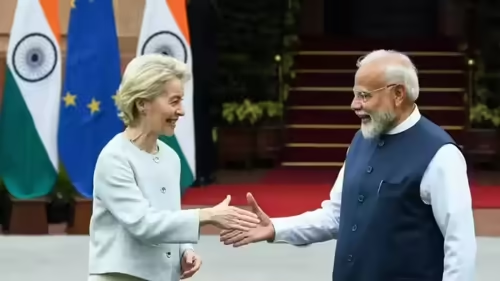
Imagine paying less for your next smartphone, your favorite European car, or even that bottle of Italian wine. That’s the promise of the India-EU Free Trade Agreement (FTA), a deal that’s been in the works for over a decade and is finally set to be signed on January 27, 2026, in New Delhi . But is it all sunshine and savings, or are there hidden complexities beneath the surface?
According to the Global Trade Research Initiative (GTRI), this isn’t just another trade deal—it’s a strategic alignment of two economic powerhouses with perfectly complementary strengths . The question on everyone’s mind is whether this pact will deliver on its promise to cut costs and boost trade for the average citizen, or if it’s primarily a corporate windfall.
Table of Contents
- What is the India-EU Free Trade Agreement?
- Why Now? The Perfect Storm for a Deal
- The Core Benefit: How the India-EU Free Trade Agreement Cuts Costs
- Sectors Poised to Boom (and Those on Alert)
- Beyond Tariffs: The Hidden Impacts on You
- Conclusion: A New Chapter in Global Trade
- Sources
What is the India-EU Free Trade Agreement?
At its heart, the India-EU Free Trade Agreement is a comprehensive pact designed to slash tariffs and dismantle non-tariff barriers on a vast array of goods and services traded between the world’s largest democracy and its second-largest trading partner. In FY2025 alone, their bilateral goods trade already crossed a staggering $136 billion . This agreement aims to supercharge that figure.
Think of it as a massive economic bridge connecting two continents. India, with its prowess in labor-intensive production, IT services, textiles, and pharmaceuticals, meets the EU, a global leader in capital goods, advanced technology, machinery, and luxury products . The GTRI emphasizes that this synergy is key—it’s about expanding the overall trade pie, not just fighting over slices of the existing one .
Why Now? The Perfect Storm for a Deal
After years of stalled negotiations, the timing for this deal feels almost fated. Both sides are seeking to diversify their supply chains away from geopolitical hotspots. The EU sees India as a critical “partner of choice” in a volatile world, while India is aggressively pursuing its “Atmanirbhar Bharat” (self-reliant India) vision through strategic global partnerships, not isolation .
This FTA would mark India’s ninth such agreement in just four years, showcasing a dramatic shift towards an accelerated FTA strategy in an era of rising global protectionism . For the EU, it’s a chance to secure a long-term foothold in one of the world’s fastest-growing major economies.
The Core Benefit: How the India-EU Free Trade Agreement Cuts Costs
The most direct and tangible benefit for both producers and consumers lies in the reduction of tariffs. Here’s how it breaks down:
- Lower Input Costs for Indian Manufacturers: Indian companies that rely on high-quality European machinery, components, or technology will see their input costs drop significantly. This can lead to more competitive pricing for their own finished goods, both domestically and for export .
- Cheaper European Goods for Indian Consumers: From German automobiles and French wines to Italian fashion and Swedish furniture, the prices of many premium European imports are expected to fall, giving Indian consumers more choice and better value .
- Boost for Indian Exports: Indian sectors like textiles, pharmaceuticals, processed foods, and gems & jewellery will gain much easier and cheaper access to the massive EU market of over 450 million affluent consumers .
In essence, the India-EU Free Trade Agreement is designed to create a virtuous cycle of lower costs, increased competition, and greater innovation, which should ultimately trickle down to the end-user.
Sectors Poised to Boom (and Those on Alert)
Not all industries will celebrate equally. The agreement is a double-edged sword, creating clear winners and potential losers.
Winners
- Information Technology & Services: Easier market access and a more predictable regulatory environment could lead to a surge in contracts and investments .
- Pharmaceuticals: India’s “pharmacy of the world” stands to gain immensely from streamlined regulations and reduced barriers in the EU market.
- Textiles & Apparel: Labor-intensive Indian textile exporters are expected to see a significant boost in orders from European fashion houses .
- Automobiles (Components): While finished European cars may become cheaper, Indian auto component manufacturers could see a boom in supplying parts to EU-based assembly lines.
Sectors on Alert
Some domestic industries are understandably nervous. The deal includes sensitive lists where full tariff elimination is being negotiated. Key areas of concern include:
- Indian Dairy & Agriculture: Fears of a flood of cheap, subsidized European dairy products impacting local farmers.
- Finished Automobiles: While components benefit, the domestic passenger vehicle market could face stiffer competition from European brands once tariffs are lowered .
It’s worth noting that India has been firm in its negotiations, resisting EU demands to eliminate tariffs on more than 95% of goods, instead pushing for a figure closer to 90% to protect its sensitive sectors .
Beyond Tariffs: The Hidden Impacts on You
The ripple effects of this pact go far beyond just the price tag on a product. Here’s what else to watch for:
- Increased Foreign Direct Investment (FDI): A more stable and open trade regime is a magnet for long-term European capital, which can fuel job creation and infrastructure development across India .
- Stronger Investment Frameworks: The agreement is likely to introduce more robust and predictable rules for investors, encouraging long-term capital flows into manufacturing and services .
- Geopolitical Shifts: This deal is a strategic move to reduce economic dependence on a few key nations, offering both India and the EU greater autonomy in a complex global landscape .
For the everyday consumer, this could translate into not just cheaper goods, but also higher quality standards, more innovation, and a wider variety of choices in the marketplace.
Conclusion: A New Chapter in Global Trade
The impending India-EU Free Trade Agreement is far more than a simple trade deal; it’s a strategic recalibration of two major global players. While the immediate promise of lower costs and boosted trade is compelling, the true test will lie in its implementation and its ability to balance the interests of large corporations with the needs of small businesses, farmers, and the average consumer. If managed well, this pact has the potential to be a cornerstone of a more resilient and diversified global economy for decades to come. Keep an eye on the official announcement at the India-EU Summit on January 27th—it’s a date that could reshape our economic future.
Sources
- Global Trade Research Initiative (GTRI). “India–EU FTA Explained.” https://www.gtrinstitute.org/ [[10], [11], [13], [15]]
- European Council. “EU-India summit, 27 January 2026.” https://www.consilium.europa.eu/en/meetings/international-summit/2026/01/27/
- Times of India. “How India-EU trade pact will cut costs, boost trade — explained.” https://timesofindia.indiatimes.com/business/india-business/how-india-eu-trade-pact-will-cut-costs-boost-trade-explained/articleshow/127463669.cms
- European Parliament. “EU-India free trade agreement.” https://www.europarl.europa.eu/factsheets/en/sheet/167/eu-india-free-trade-agreement