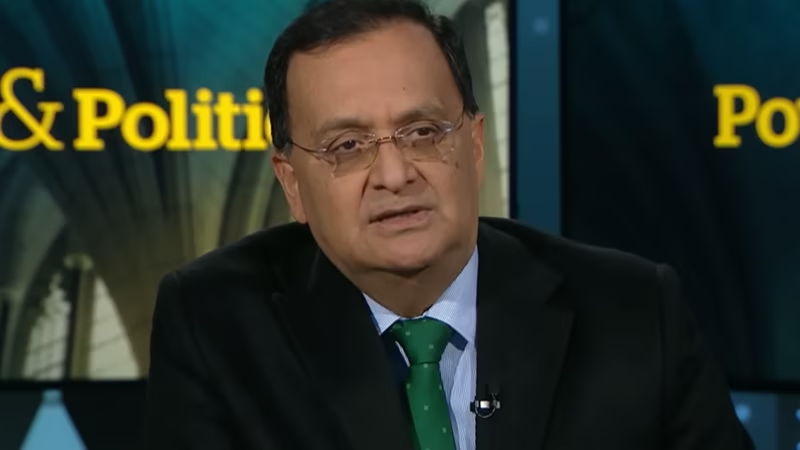
In a moment that has sent shockwaves through the diplomatic corridors of Ottawa and New Delhi, India’s High Commissioner to Canada, Dinesh Patnaik, has delivered a blistering indictment of Canada’s decades-long failure to act against Khalistani terrorism. His stark message is clear: for forty years, India has sounded the alarm, and for forty years, Canada has largely turned a deaf ear.
This isn’t just a routine diplomatic spat; it’s a fundamental crisis of trust that threatens to derail a crucial bilateral relationship and embolden violent extremist networks on foreign soil. The envoy’s remarks come at a time when tensions between the two nations are already fraught, following the 2023 killing of alleged Khalistani separatist Hardeep Singh Nijjar in British Columbia—a case that has become a flashpoint in their strained ties .
Table of Contents
- The 40-Year Warning: A History of Neglect
- Envoy Patnaik’s Scathing Indictment
- Why Canada’s Inaction on Khalistani Terrorism Matters
- The Path Forward: Repairing a Fractured Relationship
- Conclusion: A Call for Concrete Action
- Sources
The 40-Year Warning: A History of Neglect
The roots of this conflict run deep, tracing back to the 1980s—the era of the Air India Flight 182 bombing, the deadliest terrorist attack in Canadian history. India has consistently pointed to this tragedy as a grim reminder of the lethal potential of the Khalistani movement. Yet, despite repeated warnings from Indian authorities about the activities of pro-Khalistan groups operating from Canadian soil, successive Canadian governments have been accused of treating the issue with a mix of political caution and willful blindness .
While Canada’s Public Safety department did list Khalistani extremism as a threat in its 2018 annual report, critics argue that this acknowledgment has rarely translated into decisive action against the movement’s more vocal and aggressive elements . The result is a perceived safe haven for individuals and organizations that, from India’s perspective, actively promote violence and secession.
Envoy Patnaik’s Scathing Indictment
High Commissioner Dinesh Patnaik’s recent comments cut straight to the heart of the matter. He didn’t mince words, stating that New Delhi has been warning its Canadian counterparts about the dangers of terrorism on their soil for four decades, only to be met with systemic inaction . His frustration is palpable, framing Canada’s stance not as a mere policy difference but as a profound failure of responsibility.
Patnaik emphasized that this isn’t just an abstract security concern for India. The “violent Khalistan rhetoric” emanating from certain quarters in Canada directly undermines the trust necessary for a healthy partnership, impacting everything from trade to intelligence sharing . His message is a direct challenge to Canadian leadership: acknowledge the problem in its full scope and take concrete, measurable steps to dismantle the infrastructure of hate.
Why Canada’s Inaction on Khalistani Terrorism Matters
The implications of this diplomatic rift extend far beyond the two nations involved. Here’s why this issue is critical:
- Erosion of Bilateral Trust: A strong India-Canada relationship is vital for global stability, trade, and democratic cooperation. Persistent inaction on a core security issue for one partner is a recipe for long-term estrangement.
- Empowerment of Extremist Networks: A permissive environment allows extremist ideologies to flourish, recruit, and potentially plan activities that could have international repercussions. This is a direct threat to global counter-terrorism efforts.
- Economic Consequences: As Patnaik hinted, the cloud of extremism can deter investment and complicate economic partnerships. Businesses thrive on predictability and security, both of which are undermined by this ongoing crisis .
- A Test for Democratic Values: How a liberal democracy like Canada handles violent separatist movements within its own borders is a test of its commitment to the rule of law and its ability to protect all its citizens from hate-driven agendas.
The Path Forward: Repairing a Fractured Relationship
All is not lost. Both nations have expressed a desire to move towards a “new chapter” in their ties . However, turning this aspiration into reality requires more than just diplomatic niceties. For India, the path forward is clear: it demands tangible, verifiable action from Canada.
This could involve a more robust application of its own anti-terrorism laws, increased scrutiny of fundraising activities linked to extremist groups, and a consistent public stance against any form of violent separatism. The framework for cooperation on countering terrorism and violent extremism already exists between the two countries ; the challenge now is to breathe real life into it.
Prime Minister Carney’s formal acceptance of an invitation to visit India in early 2026 presents a crucial opportunity for high-level dialogue and a potential reset . But without addressing the core grievance of Khalistani terrorism, any such reset will be built on shaky ground.
Conclusion: A Call for Concrete Action
The Indian envoy’s 40-year warning is a stark and urgent call to action. It’s a reminder that diplomatic relationships are built on mutual respect and a shared commitment to security. Canada’s historical inaction on the issue of Khalistani extremism is no longer a footnote in their bilateral history; it has become the central obstacle to their future. The ball is now firmly in Canada’s court to demonstrate, through concrete deeds and not just words, that it is a reliable and responsible partner in the global fight against terrorism. The health of the India-Canada relationship, and the safety of their citizens, may well depend on it.
Sources
- Times of India: ’40 years of warnings’: Indian envoy flays Canada over inaction on terrorism – watch
- Various news reports on Dinesh Patnaik’s statements (e.g., Times Now, The Hindu) ,
- Public Safety Canada’s 2018 Report on Terrorism Threats
- Joint statements on India-Canada cooperation ,
- Reports on the India-Canada diplomatic rift from 2023 onwards , ,