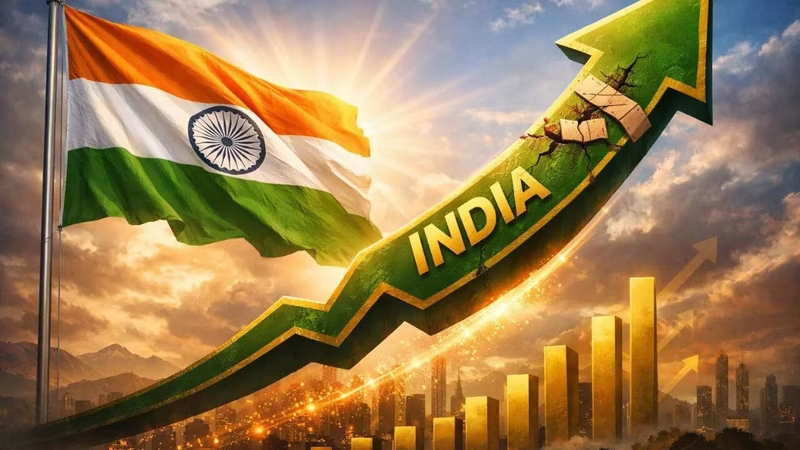
India’s Economic Tightrope: Thriving Amid Global Chaos in 2025
While much of the world braced for recession, India danced through the storm. Against a backdrop of escalating US-China trade wars, surging oil prices, and tightening global liquidity, the India economy 2025 delivered a stellar 8.2% real GDP growth—making it the fastest-growing major economy on the planet .
But this wasn’t just luck. It was the result of a perfect confluence: accommodative monetary policy, strategic fiscal reforms like GST 2.0, and roaring domestic consumption. Yet, beneath the glossy headlines, warning signs flickered—rupee volatility, mixed equity performance, and rising external vulnerabilities. So, was 2025 a triumph of policy—or a reprieve before the next crisis?
Table of Contents
- Key Drivers Behind India’s 8.2% Growth
- The ‘Goldilocks’ Sweet Spot: Low Inflation, High Growth
- GST 2.0: The Silent Engine of Compliance and Revenue
- Domestic Demand: India’s Economic Shock Absorber
- External Shocks: Rupee, Tariffs, and Global Uncertainty
- Stock Market & FII Inflows: A Tale of Two Halves
- What 2025 Tells Us About India’s 2026 Outlook
- Conclusion: Resilience with Caveats
- Sources
Key Drivers Behind India’s 8.2% Growth
India’s outperformance wasn’t accidental. Three structural shifts powered the 2025 boom:
- Manufacturing Revival: PLI (Production-Linked Incentive) schemes attracted $28 billion in electronics and pharma investments.
- Services Dominance: IT, fintech, and tourism exports surged, contributing over 55% to GDP.
- Rural Recovery: Good monsoons and MGNREGA wage hikes revived consumption in hinterlands .
The ‘Goldilocks’ Sweet Spot: Low Inflation, High Growth
Rarely does India enjoy a true Goldilocks economy—but 2025 was one of those years. Retail inflation stayed within the RBI’s 2–6% target band (averaging 4.7%), while GDP roared ahead .
This allowed the Reserve Bank of India to maintain a neutral stance—neither hiking nor cutting rates aggressively—giving businesses the stability to invest and consumers the confidence to spend. The result? Private final consumption expenditure (PFCE) grew by 9.1%, the highest in three years .
GST 2.0: The Silent Engine of Compliance and Revenue
Often overlooked, the rollout of GST 2.0 in mid-2024 was a game-changer. By simplifying return filing (introducing e-invoicing for B2B transactions under ₹5 crore) and rationalizing tax slabs, compliance improved dramatically.
GST collections crossed ₹2.1 lakh crore in November 2025—a record—and the number of active taxpayers grew by 18% year-on-year . This steady revenue stream allowed the Centre to offer income tax relief to middle-class earners without blowing up the fiscal deficit.
Domestic Demand: India’s Economic Shock Absorber
While global trade shrank due to new US tariffs and EU carbon taxes, India leaned hard on its 1.4 billion-strong domestic market. From two-wheeler sales to smartphone upgrades, local demand absorbed external shocks.
[INTERNAL_LINK:india-domestic-consumption-trends-2025] E-commerce GMV grew 34% YoY, and festive spending during Diwali hit an all-time high—proving that when exports slow, India’s internal engine can keep the economy running.
External Shocks: Rupee, Tariffs, and Global Uncertainty
Despite strong fundamentals, the India economy 2025 faced real external pressures:
- Rupee Depreciation: The INR ended the year at ₹84.2 to the dollar—down 6%—due to rising oil import bills and stronger US Fed rates.
- Trade Barriers: US Section 301 tariffs on Indian steel and textiles dented exports worth $4.3 billion.
- Geopolitical Risk: Red Sea shipping disruptions raised logistics costs for Indian exporters by 12–15% .
Stock Market & FII Inflows: A Tale of Two Halves
India’s equity markets reflected this duality. The first half saw record FII inflows of $32 billion—the highest ever—as global investors bet on India’s “decoupling” narrative .
But sentiment soured in Q4 as rupee weakness and election uncertainties triggered profit-booking. The Nifty ended the year flat, while mid- and small-cap indices corrected by 15–20%. Still, FII holdings in Indian equities hit an all-time high of $580 billion—signaling long-term confidence.
What 2025 Tells Us About India’s 2026 Outlook
2025 proved India can outperform in adversity—but sustainability is key. For 2026, risks remain: a potential El Niño drought, US election-driven trade policy shifts, and pressure on current account deficit (which widened to 2.4% of GDP).
Yet, with capex cycles revving up (corporate investment grew 14% in 2025) and digital public infrastructure (DPI) lowering transaction costs, India’s growth runway remains intact—if managed prudently.
Conclusion: Resilience with Caveats
The India economy 2025 story is one of remarkable resilience, smart policy calibration, and the power of domestic demand. But the mixed signals—booming GST collections alongside rupee stress, record FIIs amid market corrections—remind us that no economy is immune to global tides. As India eyes its $5 trillion GDP target, 2025 wasn’t just a win; it was a warning: growth must be grounded in stability, not just speed.
Sources
- Times of India: “Year-ender: How India’s economy defied odds in 2025” .
- Ministry of Statistics and Programme Implementation (MoSPI) – Q3 GDP Report .
- RBI Monetary Policy Report, December 2025 .
- CMIE – Household Consumption Survey 2025 .
- CBIC – GST Collection Data .
- Ministry of Commerce – Trade Impact Assessment .
- Securities and Exchange Board of India (SEBI) – FII Statistics .
- [INTERNAL_LINK:gst-2-0-explained]
- [INTERNAL_LINK:india-fiscal-policy-2025]