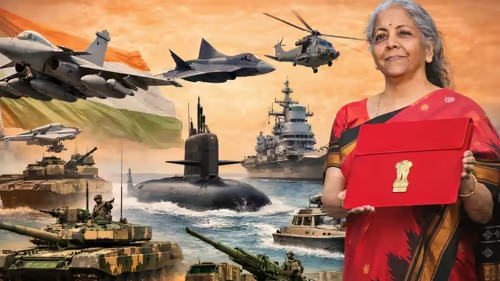
In a world where strategic assertiveness is the new currency of power, India has just made a colossal statement. The defence budget 2026 has been unveiled with a jaw-dropping allocation of ₹7.85 lakh crore—a 15% jump from the previous year. This isn’t just a number; it’s a clear, unambiguous signal that New Delhi is doubling down on its military capabilities in the face of evolving regional threats.
But what does this massive financial muscle translate to on the ground, in the skies, and under the sea? Let’s cut through the noise and dive into the concrete plans that will reshape India’s armed forces.
Table of Contents
- What’s Driving the Defence Budget 2026 Surge?
- Key Pillars of India’s Military Modernization
- Project 75(I): Six Advanced Submarines for a Blue-Water Navy
- Rafale-M Jets: The Navy’s New Flying Fist
- The Rise of Indigenous Unmanned Systems
- Conclusion: A New Era for Indian Defence
- Sources
What’s Driving the Defence Budget 2026 Surge?
The timing is no coincidence. Coming on the heels of heightened tensions and a renewed focus on self-reliance, this budget is a direct response to the complex security challenges India faces. A significant chunk of this allocation—₹2.19 lakh crore—is earmarked specifically for capital expenditure, which means buying new hardware and technology, not just paying salaries [[1]].
This strategic shift prioritizes long-term capability over short-term maintenance. It’s about building a future-ready force that can deter adversaries and project power far beyond its shores. For context, this modernization fund itself is larger than the entire defence budgets of many nations.
Key Pillars of India’s Military Modernization
The government’s plan is multi-pronged, targeting critical gaps in air, land, and maritime domains. Here’s a breakdown of the major allocations that paint a picture of the future Indian military:
- Aircraft & Aero Engines: ₹63,733.94 Crore
- Other Equipment (Modernization): ₹82,217.82 Crore
- Naval Fleet: ₹25,023.63 Crore
- Research & Development: A significant boost to fuel indigenous innovation [[6]].
This structured investment shows a clear intent to move away from piecemeal acquisitions towards a holistic, integrated modernization drive. [INTERNAL_LINK:defence-manufacturing-in-india] is clearly at the heart of this strategy.
Project 75(I): Six Advanced Submarines for a Blue-Water Navy
One of the most critical and long-pending projects is finally getting the financial green light it needs. The Project 75(I) aims to induct six state-of-the-art diesel-electric attack submarines equipped with Air-Independent Propulsion (AIP) systems, allowing them to stay submerged for much longer durations.
With an estimated cost of around ₹90,000 crore, this project is a cornerstone of India’s ambition to build a formidable blue-water navy capable of sustained operations in the Indian Ocean Region [[11]]. Negotiations with Germany for their HDW Class 214 design are in their final stages, with a deal expected to be signed by March 2026 [[19]].
These submarines will replace aging vessels and provide the Indian Navy with a potent, stealthy underwater deterrent, crucial for securing vital sea lanes of communication.
Rafale-M Jets: The Navy’s New Flying Fist
While the Air Force’s Rafales have already proven their mettle, the Navy was in dire need of a modern carrier-borne fighter to operate from the INS Vikrant. That gap is now being filled with the recent finalization of a landmark deal for 26 Rafale-M jets from France.
Valued at approximately ₹63,000 crore, this acquisition, concluded in April 2025, is a game-changer for the Indian Navy’s strike capabilities [[22]]. The Rafale-M is a highly versatile, multi-role fighter that can perform air defence, deep strike, and reconnaissance missions, giving the Navy a powerful and credible edge over potential adversaries in the maritime domain [[23]].
The Rise of Indigenous Unmanned Systems
Beyond big-ticket platforms, the budget also fuels India’s push for homegrown defence tech. A prime example is the development and deployment of indigenous unmanned interceptor crafts.
In December 2025, the DRDO handed over a cutting-edge, indigenous Waterjet Propulsion System designed specifically for high-speed naval interceptor craft to the armed forces [[29]]. This technology is a key enabler for a new generation of fast, agile boats that can respond rapidly to threats in coastal and littoral waters.
Furthermore, the Navy’s 15-year roadmap explicitly calls for 100 Next Generation Fast Interceptor Crafts (NGFIC), highlighting the strategic importance of these platforms [[36]]. This focus on unmanned and autonomous systems is a smart, cost-effective way to enhance surveillance and interdiction capabilities without risking human lives.
Conclusion: A New Era for Indian Defence
The defence budget 2026 is more than just a financial document; it’s a strategic blueprint for India’s future. By allocating a record sum and directing it towards critical modernization projects like Project 75(I) submarines, Rafale-M jets, and indigenous unmanned systems, the government is sending a strong message of resolve and preparedness.
This aggressive push for modernization, coupled with a focus on domestic manufacturing, promises to transform the Indian military into a more lethal, agile, and self-reliant force, ready to meet the security challenges of the 21st century head-on.
Sources
- [[1]] Press Information Bureau (PIB): Record Rs 2.19 lakh crore allocated under Capital Head
- [[6]] Alpha Defense: Defence Budget 2026-27 : Detailed Analysis
- [[11]] Wikipedia: Project-75 (India) submarine acquisition project
- [[19]] Times of India: India, Germany close to signing $8 bn P75I submarine deal
- [[22]] The Hindu: India, France conclude inter-governmental agreement for 26 Rafale-M jets
- [[23]] Press Information Bureau (PIB): Rafale-Marine: Enhancing India’s Naval Strength
- [[29]] Testbook: In December 2025, Seven indigenous technologies…
- [[36]] Naval News: India Unveils 15-Year Technology and Capability Roadmap for Navy