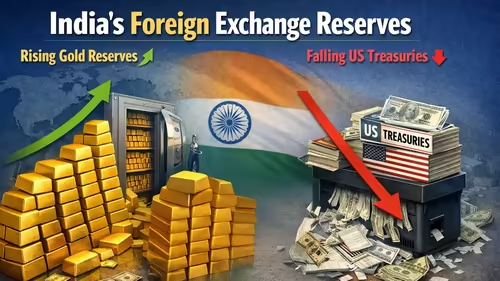
For years, the US dollar has been the undisputed king of global finance—a safe haven, a transaction currency, and the bedrock of central bank reserves. But a quiet revolution is brewing in the vaults of the Reserve Bank of India (RBI). In a bold strategic shift, India has been steadily selling off its US government bonds and replacing them with one of the oldest stores of value known to man: gold. This move, which has brought India’s US Treasury holdings to their lowest level in five years, is more than just a financial adjustment—it’s a clear signal of a deliberate, long-term plan for India decoupling from dollar dominance . And it’s a story that every investor, policymaker, and financially savvy citizen needs to understand.
Table of Contents
- The Strategic Shift: India Decoupling from Dollar
- Why Is the RBI Selling US Treasuries?
- The Gold Rush: Building a Fortress of Reserves
- How India’s Move Compares to China and Others
- What This Means for the Global Economy (and You)
The Strategic Shift: India Decoupling from Dollar
The data is stark. According to the US Treasury Department, India’s holdings of US government debt have plummeted to around $170 billion, a significant drop from previous highs . While this is still a substantial sum, it pales in comparison to China’s nearly $683 billion stash, and more importantly, it represents a conscious reduction by the RBI . This isn’t panic selling; it’s a methodical, multi-year strategy. By diversifying away from a single currency—especially one that can be weaponized through sanctions or whose value can be eroded by US fiscal policy—India is building a more resilient and sovereign financial future. This strategic pivot is a textbook example of India decoupling from dollar dependency in an increasingly multipolar world.
Why Is the RBI Selling US Treasuries?
There are several compelling reasons behind this move. First, the geopolitical landscape has changed dramatically. The freezing of Russia’s foreign reserves after its invasion of Ukraine served as a wake-up call to many nations, including India. It demonstrated that holding assets in a foreign currency, especially in a country that might be politically opposed to you, carries inherent risks . Second, the US’s own fiscal trajectory, marked by massive deficits and a growing national debt, has raised questions about the long-term stability of the dollar. Third, the RBI is likely seeking better returns and lower volatility. While US Treasuries are safe, they offer relatively low yields, especially when adjusted for inflation. Gold, on the other hand, has historically been a strong hedge against economic uncertainty and currency devaluation .
The Gold Rush: Building a Fortress of Reserves
As the RBI sells dollars, it’s not just sitting on cash. It’s been on a historic gold-buying spree. Over the past two years, India has added hundreds of tonnes to its official gold reserves, making it one of the top buyers globally . This isn’t just about investment; it’s about sovereignty. Gold is a physical asset that cannot be frozen, sanctioned, or digitally erased. It’s universally accepted and has maintained its value for millennia. By building this “fortress” of gold, the RBI is creating a powerful backstop for the Indian rupee and ensuring that the nation’s wealth is anchored in something tangible and independent of any single country’s political whims. For a deeper dive into how central banks manage their reserves, you can explore the resources on the official website of the Bank for International Settlements (BIS).
How India’s Move Compares to China and Others
India is not alone in this trend, but its approach is distinct. China, the largest holder of US debt, has also been gradually reducing its exposure, though from a much higher base . Other BRICS nations like Russia have gone even further, almost entirely exiting US Treasuries. India’s strategy appears more measured and pragmatic. It’s not aiming for a complete divorce from the dollar—which remains essential for global trade—but rather a strategic diversification to mitigate risk. This balanced approach reflects India’s unique position as a major emerging economy that seeks to protect its interests without fully antagonizing the current global financial order. You can read more about the evolving role of the BRICS bloc in our analysis on [INTERNAL_LINK:brics-new-reserve-currency].
What This Means for the Global Economy (and You)
The implications of India decoupling from dollar are far-reaching. On a macro level, if more countries follow suit, it could accelerate the long-discussed (but slow-moving) process of de-dollarization, potentially leading to a more fragmented global financial system. For the average Indian citizen, this move is a sign of prudent financial management by the central bank. A stronger, more diversified reserve base helps stabilize the rupee, which in turn can help control inflation and keep import costs in check. For investors, it underscores the importance of looking beyond traditional assets and considering hard assets like gold as a core part of a long-term portfolio.
Key Reasons Behind India’s Reserve Strategy
- Geopolitical Risk Mitigation: Avoiding the fate of frozen foreign assets.
- Portfolio Diversification: Reducing over-reliance on a single currency.
- Inflation Hedge: Gold acts as a store of value during economic turmoil.
- Sovereign Wealth Protection: Building a reserve of an asset no foreign power can control.
Conclusion
India’s quiet sell-off of US bonds and its aggressive gold accumulation are not mere market maneuvers. They represent a fundamental recalibration of the nation’s financial strategy in an uncertain world. The goal of India decoupling from dollar is not to reject the greenback outright, but to build a more resilient, independent, and secure economic foundation for the future. This is a masterclass in long-term, strategic financial planning that prioritizes national interest above all else. As global dynamics continue to shift, India’s actions may well be seen as a blueprint for other emerging economies seeking to navigate the complexities of 21st-century finance.
Sources
- Times of India: Selling US bonds, buying gold: How India is decoupling from the dollar
- US Department of the Treasury: Major Foreign Holders of Treasury Securities
- World Gold Council: Official Gold Reserves Data