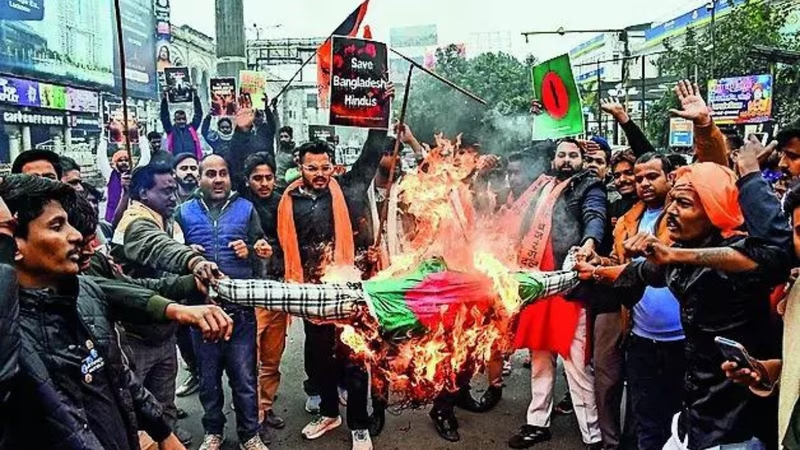
A diplomatic storm is brewing between India and Bangladesh over the murder of radical Islamist leader Sharif Osman Hadi—and at its center are explosive allegations that the Hadi killers have fled across the border into India. But Indian security agencies aren’t just denying the claims—they’re calling them “fabricated,” igniting a rare public clash between two close neighbors.
The tension underscores how fragile regional security cooperation can be, even between allies with a history of counter-terrorism coordination. As Bangladesh points fingers, India stands firm: no fugitives have crossed into Meghalaya, and its borders are under tight surveillance. So, what’s really going on?
Table of Contents
- Who Was Sharif Osman Hadi?
- Bangladesh’s Allegations: The Hadi Killers Are in India
- India’s Firm Denial: No Evidence of Fugitives
- Border Security Reality Check: What BSF and Meghalaya Say
- Why This Diplomatic Spill Matters
- Historical Context: India-Bangladesh Counter-Terrorism Ties
- What Happens Next?
- Conclusion: Truth, Tactics, or Tensions?
- Sources
Who Was Sharif Osman Hadi?
Sharif Osman Hadi was a controversial figure in Bangladesh—a radical leader linked to Islamist groups like Hefazat-e-Islam. His assassination in Chittagong in early December 2025 sent shockwaves through the country and raised fears of retaliatory violence or sectarian unrest .
While the motive behind his killing remains under investigation, Bangladesh’s Rapid Action Battalion (RAB) quickly identified suspects and alleged they had fled across the porous border into India’s northeastern state of Meghalaya—a claim that would soon trigger a major diplomatic response.
Bangladesh’s Allegations: The Hadi Killers Are in India
According to Bangladeshi intelligence sources, the suspected Hadi killers used clandestine routes through the hilly terrain of the India-Bangladesh border to escape into Meghalaya. The government reportedly shared this intelligence with Indian counterparts through diplomatic channels, urging “immediate action” to apprehend the fugitives .
This isn’t the first time Bangladesh has accused India of harboring individuals it considers threats. In the past, Dhaka has sought the extradition of several suspected militants, though those claims have often been met with skepticism due to lack of verifiable evidence.
India’s Firm Denial: No Evidence of Fugitives
India has responded with unusual bluntness. Both the Border Security Force (BSF) and the Director General of Police (DGP) of Meghalaya have issued categorical denials.
“There is absolutely no intelligence input or ground report suggesting that any person linked to the Hadi murder has entered Indian territory,” said a senior BSF official.
The Meghalaya DGP echoed this, stating that all border outposts have been placed on high alert and that extensive patrolling is ongoing. “These allegations appear baseless and may be politically motivated,” the DGP added .
Border Security Reality Check: What BSF and Meghalaya Say
The India-Bangladesh border in Meghalaya is rugged and densely forested—but it’s far from unguarded. Here’s what Indian authorities emphasize:
- 24/7 Surveillance: BSF uses thermal imagers, drones, and ground sensors along sensitive sectors.
- Coordination with Local Police: District police and village defense committees act as force multipliers for intelligence gathering.
- Zero Infiltration Reports: No unusual movement or suspicious entries have been logged in the past two weeks.
For more on how India monitors its eastern borders, see our feature on [INTERNAL_LINK:india-bangladesh-border-security].
Why This Diplomatic Spill Matters
India and Bangladesh have enjoyed strong bilateral ties in recent years, especially under Prime Minister Sheikh Hasina’s leadership. The two nations have cooperated closely on counter-terrorism, trade, and connectivity projects like the BBIN (Bangladesh-Bhutan-India-Nepal) initiative .
A public dispute over fugitives—even if unfounded—can erode trust. It also plays into domestic political narratives in both countries, where nationalist voices can amplify tensions for short-term gain.
Historical Context: India-Bangladesh Counter-Terrorism Ties
Since 2015, Bangladesh has cracked down on extremist groups, often with quiet support from Indian intelligence. In return, India has appreciated Dhaka’s stance against anti-India militant outfits like Harkat-ul-Jihad-al-Islami (HuJI-B).
The Ministry of External Affairs in New Delhi has previously praised Bangladesh’s “robust counter-terrorism framework” . That makes the current accusation—and India’s sharp rebuttal—all the more significant.
What Happens Next?
Diplomats from both sides are expected to hold closed-door talks to de-escalate the situation. India has reportedly offered to share its surveillance data and border logs to prove no infiltration occurred.
Meanwhile, human rights groups and regional analysts are watching closely. If Bangladesh cannot provide concrete evidence, the episode may be quietly dropped. But if proof emerges, it could trigger a major security review—and strain a critical neighborhood relationship.
Conclusion: Truth, Tactics, or Tensions?
The Hadi killers controversy sits at a dangerous intersection of crime, politics, and diplomacy. While Bangladesh seeks justice for a high-profile murder, India is defending its sovereignty and the integrity of its border security apparatus.
For now, the evidence—or lack thereof—sides with India. But the real test will be whether both nations can resolve this without letting suspicion replace cooperation. In a region already facing complex security challenges, trust is a resource neither can afford to lose.
Sources
- The Times of India: “Now, India, Bangladesh face off over Hadi’s killers”
- Ministry of Home Affairs, India: BSF Operational Guidelines
- Ministry of External Affairs: India-Bangladesh Joint Statement (2023)
- United States Department of State: Country Reports on Terrorism – Bangladesh
- Press Trust of India (PTI): Official Statements from Meghalaya DGP and BSF