Table of Contents
- Davos 2026: India’s Idea-Driven Presence
- India at WEF Davos: Setting the Record Straight
- Why WEF Is Not a Trade Negotiation Table
- The Real Agenda: India’s Economic Growth and Renewables
- India’s Broader Global Engagement Strategy
- What This Means for Investors and Partners
- Conclusion
- Sources
Davos 2026: India’s Idea-Driven Presence
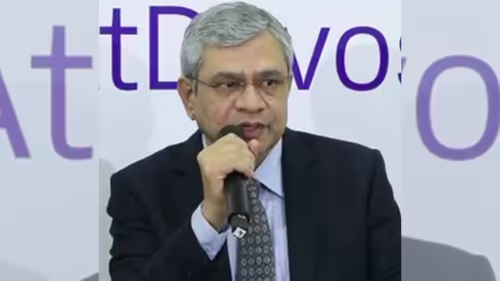
The snow-capped Swiss Alps are once again buzzing with global leaders, CEOs, and thinkers at the World Economic Forum (WEF) Annual Meeting in Davos. And this year, India’s delegation—led by Union Minister Ashwini Vaishnaw—is sending a clear, deliberate message: India at WEF Davos is here to exchange ideas, showcase progress, and build trust—not to sign trade deals on the sidelines .
This strategic positioning marks a nuanced shift in how New Delhi engages with multilateral forums. Rather than chasing headline-grabbing agreements, India is focusing on long-term narrative-building around its economic resilience and sustainability leadership.
India at WEF Davos: Setting the Record Straight
In a candid briefing to reporters, Minister Vaishnaw explicitly ruled out the possibility of formal trade negotiations taking place during the WEF summit. “Davos is a platform for dialogue, not a venue for trade talks,” he emphasized .
This clarification comes amid growing speculation that India might use the high-profile gathering to advance stalled trade discussions with the European Union or other major economies. By drawing this boundary early, the Indian government is managing expectations and reinforcing the WEF’s intended purpose as a “thought leadership” forum rather than a diplomatic backchannel.
Why WEF Is Not a Trade Negotiation Table
The WEF’s own charter defines its mission as “improving the state of the world by engaging business, political, academic, and other leaders of society to shape global, regional, and industry agendas” . Formal trade negotiations, by contrast, require structured legal frameworks, technical working groups, and parliamentary approvals—none of which can be achieved in the informal, fast-paced environment of Davos.
Minister Vaishnaw’s stance aligns with best practices observed by other major economies. The United States, Germany, and Japan also typically avoid announcing binding trade pacts at WEF, using it instead to signal intent, test policy ideas, and foster private-sector partnerships.
The Real Agenda: India’s Economic Growth and Renewables
So, if not trade, what is India championing at Davos 2026? According to Vaishnaw, two pillars dominate India’s narrative:
- Robust Economic Growth: With a projected GDP growth rate of over 6.5% in FY2026, India remains one of the world’s fastest-growing large economies. Ministers and business leaders are highlighting macroeconomic stability, digital public infrastructure (like UPI and Aadhaar), and manufacturing competitiveness under the “Make in India” initiative .
- Renewable Energy Leadership: India’s ambitious target of 500 GW of non-fossil fuel capacity by 2030 is a major talking point. The country is positioning itself as a reliable green energy partner, especially in solar and green hydrogen, attracting interest from European and American investors seeking sustainable supply chains .
These themes are resonating strongly in a global context marked by economic uncertainty and climate urgency.
India’s Broader Global Engagement Strategy
Vaishnaw’s comments reflect a larger recalibration in India’s foreign economic policy. Rather than relying on multilateral trade blocs alone, India is pursuing a multi-vector approach:
- Finalizing bilateral FTAs with the UK, EU, and GCC countries through dedicated negotiation tracks.
- Leveraging forums like WEF to attract FDI and showcase policy reforms.
- Using G20 presidency legacy to push for inclusive, development-oriented global governance .
This layered strategy allows India to separate high-level vision-setting (at Davos) from technical deal-making (in Geneva or Brussels).
What This Means for Investors and Partners
For global businesses, the takeaway is clear: India is open for collaboration—but on its own terms and timeline. The focus at Davos is on understanding India’s policy direction, regulatory environment, and market opportunities. For deeper commercial discussions, companies are encouraged to engage through official channels like Invest India or sector-specific summits.
For more on India’s investment climate, see our analysis on [INTERNAL_LINK:india-fdi-policy-2026].
Conclusion
India’s approach at the 2026 WEF—prioritizing strategic dialogue over transactional diplomacy—underscores its growing confidence as a global stakeholder. By clarifying that India at WEF Davos is not about signing trade deals but about shaping the future narrative of growth, sustainability, and innovation, Minister Vaishnaw has set a mature, forward-looking tone. In a world hungry for stable, scalable partners, India is making its case not with promises, but with performance.
Sources
- Times of India: Union minister rules out trade talks at WEF, assures India’s engagement on other fronts
- Various web search results on India’s WEF participation and economic messaging [[8], [12], [15]]
- World Economic Forum Official Website