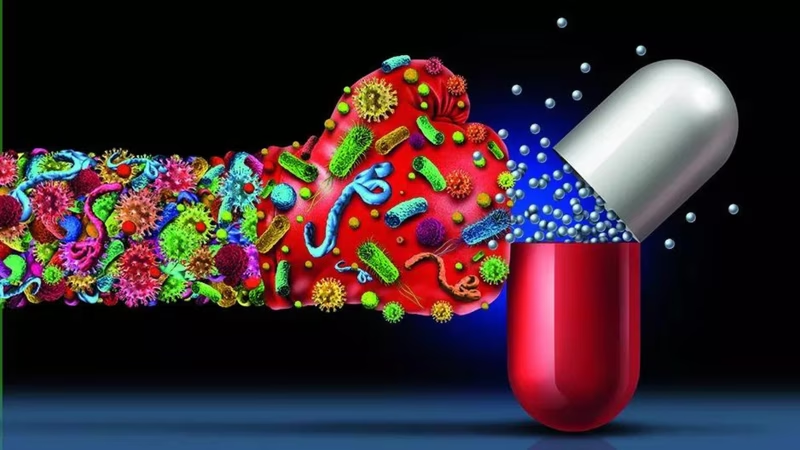
Imagine a simple cut leading to a life-threatening infection. Or a routine surgery becoming a death sentence. This isn’t dystopian fiction—it’s the terrifying future we’re hurtling toward due to one everyday habit: antibiotic misuse.
In his latest ‘Mann Ki Baat’ radio address, Prime Minister Narendra Modi issued a rare and urgent public health warning, citing a sobering report from the Indian Council of Medical Research (ICMR). The message was clear and direct: “Consult doctors, stay away from self-medication.” But behind this simple plea lies a national emergency that experts are calling “India’s silent pandemic” .
Table of Contents
- What Is Antibiotic Misuse—and Why PM Modi Is Sounding the Alarm
- The ICMR Report: The Shocking Data Behind the Warning
- How Self-Medication Is Fueling a Superbug Crisis
- Common Myths About Antibiotics—Debunked
- Global Context: How India Compares on Antibiotic Resistance
- What You Can Do to Fight Antibiotic Resistance
- Government Initiatives and the Way Forward
- Conclusion: A Call for Collective Responsibility
- Sources
What Is Antibiotic Misuse—and Why PM Modi Is Sounding the Alarm
Antibiotic misuse refers to the inappropriate use of antibiotics—taking them without a prescription, not completing the full course, or using them for viral infections like the common cold or flu (which antibiotics cannot treat). In India, this practice is rampant. From street-side pharmacies to family medicine cabinets, antibiotics are often treated like painkillers or antacids.
PM Modi’s intervention is significant because it elevates a complex medical issue into a matter of national priority. By using his influential ‘Mann Ki Baat’ platform, he’s not just sharing health advice—he’s attempting to shift a deeply ingrained cultural behavior.
The ICMR Report: The Shocking Data Behind the Warning
The Prime Minister’s warning is grounded in hard data. The ICMR’s 2025 Antimicrobial Resistance (AMR) Surveillance Report paints a grim picture:
- Over 60% of common bacterial infections in India now show resistance to at least one first-line antibiotic .
- Critical pathogens like Klebsiella pneumoniae and Acinetobacter baumannii are increasingly resistant to carbapenems—drugs of last resort.
- India accounts for nearly one in four global deaths linked to drug-resistant infections, according to a Lancet study cited by ICMR .
“This should worry all of us,” Modi said, urging citizens to recognize that antibiotic resistance isn’t just a hospital problem—it’s a community-wide threat.
How Self-Medication Is Fueling a Superbug Crisis
When you take an antibiotic unnecessarily or stop early because you “feel better,” you don’t kill all the bacteria. The survivors are the strongest—and they multiply, passing on their resistance genes. Over time, this creates “superbugs” that no existing drug can treat.
In India, the problem is amplified by:
- Easy over-the-counter access: Despite regulations, many pharmacies dispense antibiotics without prescriptions.
- Farm use: Antibiotics are widely used in livestock, entering the food chain and environment.
- Lack of public awareness: Many believe antibiotics are “general medicines” for any fever or infection.
Common Myths About Antibiotics—Debunked
Let’s clear the air on some dangerous misconceptions:
- Myth: “Antibiotics help with colds and flu.”
Truth: These are viral. Antibiotics only work on bacterial infections. - Myth: “If I feel better, I can stop the course.”
Truth: Stopping early breeds resistance. Always complete the full course. - Myth: “Stronger antibiotics are better.”
Truth: The right antibiotic for the right bug is what matters—not potency.
Global Context: How India Compares on Antibiotic Resistance
India is not alone, but it is a hotspot. According to the World Health Organization (WHO), low- and middle-income countries bear the brunt of AMR due to weaker health systems and regulatory gaps .
Countries like Sweden and the Netherlands have successfully reduced antibiotic consumption through strict prescribing guidelines and public campaigns. India’s National Action Plan on AMR (2017) aims for similar results, but implementation remains uneven.
What You Can Do to Fight Antibiotic Resistance
Change starts with you. Here’s how to be part of the solution:
- Never self-medicate with antibiotics. Always consult a qualified doctor.
- Ask: “Do I really need this antibiotic?” If it’s for a virus, say no.
- Complete the full course exactly as prescribed, even if you feel better.
- Never share or use leftover antibiotics.
- Practice good hygiene to prevent infections in the first place.
For more on responsible medication use, see our guide on [INTERNAL_LINK:safe-medicine-practices-in-india].
Government Initiatives and the Way Forward
Beyond PM Modi’s appeal, the government is taking steps:
- Red Line Campaign: Mandates a red line on antibiotic packaging to discourage over-the-counter sales.
- ICMR’s AMR Surveillance Network: Tracks resistance patterns across 40+ labs nationwide.
- Strengthening Pharmacy Regulations: Digitizing prescriptions and penalizing illegal sales.
Yet, experts say more is needed—especially in rural areas and the agricultural sector.
Conclusion: A Call for Collective Responsibility
PM Modi’s warning on antibiotic misuse isn’t just a public service announcement—it’s a wake-up call for a nation at a crossroads. The power of antibiotics is not infinite. Once lost, it may never return.
Every time we pop an antibiotic without a prescription, we’re not just risking our own health—we’re chipping away at a medical miracle that has saved billions of lives. The choice is ours: use antibiotics wisely today, or lose them forever tomorrow.
Sources
- The Times of India: “PM warns on antibiotic misuse: Modi urges restraint to curb resistance”
- The Lancet: “Global burden of bacterial antimicrobial resistance in 2019” (2022, cited in ICMR 2025 report)
- World Health Organization (WHO): “Antimicrobial Resistance Fact Sheet”
- Indian Council of Medical Research (ICMR): National AMR Surveillance Report 2025
- Ministry of Health and Family Welfare: National Action Plan on Antimicrobial Resistance (2017–2021, extended)