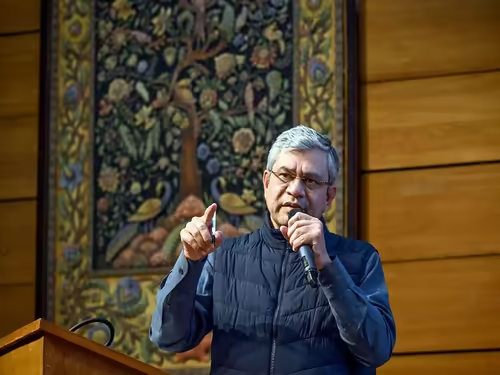
Introduction: A Strong Rebuttal from the Heart of India’s Tech Policy
When the head of the International Monetary Fund (IMF) recently labeled India as a “second-tier AI power,” it didn’t sit well with New Delhi. Union Minister Ashwini Vaishnaw—overseeing Railways, IT, and Communications—responded swiftly and decisively: “It’s actually in the first!” His statement wasn’t just patriotic rhetoric; it was a data-backed defense of India’s growing clout in the global artificial intelligence landscape. As debates over national AI rankings heat up, Vaishnaw’s comments spotlight India’s unique strategy: not just building AI, but democratizing it at scale. This isn’t about ego—it’s about economic opportunity, technological sovereignty, and global positioning. Let’s unpack what’s really behind this high-stakes exchange.
Table of Contents
- What Did the IMF Say About India’s AI Status?
- Vaishnaw’s Rebuttal: India Is a First-Tier AI Power
- The Five Layers of India’s AI Architecture
- Why AI Diffusion Matters More Than Just Innovation
- Stanford AI Index and India’s Global Standing
- Conclusion: India’s AI Future Is Not Second-Tier
- Sources
What Did the IMF Say About India’s AI Status?
During a recent policy address, IMF Managing Director Kristalina Georgieva grouped countries into tiers based on their AI capabilities. She placed the U.S. and China in the top tier, while categorizing India alongside nations like Brazil and Indonesia as “second-tier AI powers.” The classification reportedly focused on metrics like foundational model development, compute infrastructure, and private-sector R&D investment. While not dismissive, the label overlooked India’s distinct approach—one centered on deployment, accessibility, and public-good applications rather than just raw innovation output.
Vaishnaw’s Rebuttal: India Is a First-Tier AI Power
Speaking to reporters, Minister Vaishnaw pushed back hard. “It’s actually in the first!” he asserted, referencing the Stanford AI Index Report—a globally respected benchmark . He emphasized that India ranks among the top three globally in AI skill penetration and startup activity . More importantly, he argued that India’s strength lies in its end-to-end India AI power ecosystem, which spans hardware, algorithms, data, talent, and real-world application. “We are strong across all five layers of AI architecture,” Vaishnaw stated, positioning India not as a follower, but as a scalable solutions provider for the Global South.
The Five Layers of India’s AI Architecture
Vaishnaw’s framework breaks down India’s AI strategy into a cohesive stack:
- Compute Infrastructure: Initiatives like the IndiaAI Compute Portal aim to provide affordable GPU access to startups and researchers.
- Data Ecosystems: Public datasets from government platforms (e.g., Open Government Data) fuel non-commercial AI models.
- Algorithms & Models: Institutions like IITs and MeitY-supported labs are developing Indic-language LLMs (e.g., Bhashini).
- Talent Pipeline: Over 500,000 AI professionals and a booming edtech sector training millions more.
- Application Layer: Where India truly shines—deploying AI in agriculture, healthcare, education, and governance at massive scale.
According to Vaishnaw, it’s this last layer—the application—that offers India its biggest economic return and global service export potential. For more on India’s digital public infrastructure, see our deep dive on [INTERNAL_LINK:india-stack-and-ai].
Why AI Diffusion Matters More Than Just Innovation
While the U.S. and China lead in frontier AI research, India’s bet is on diffusion—getting AI tools into the hands of farmers, teachers, doctors, and small businesses. This philosophy aligns with India’s broader digital public infrastructure (DPI) success, from UPI to Aadhaar. As Vaishnaw noted, “Our focus is on widespread adoption, not just elite labs.” This approach has already yielded results:
- AI-powered crop advisories reaching 10 million+ farmers via apps like Kisan Suvidha.
- AI-driven tuberculosis detection in rural clinics using portable X-rays.
- Real-time translation of parliamentary proceedings into 22 Indian languages.
This practical, inclusive model may not generate flashy headlines like billion-parameter models, but it delivers tangible socio-economic impact—a metric often missing from traditional AI rankings.
Stanford AI Index and India’s Global Standing
Vaishnaw’s reference to the Stanford AI Index is key. The 2025 report shows India ranked:
- #2 globally in AI job postings growth.
- #3 in AI startup funding (after U.S. and China).
- #1 in AI skills penetration on LinkedIn (measured by share of AI-related skills among professionals).
These metrics reflect a vibrant, bottom-up AI ecosystem—very different from the top-down, capital-intensive models of other nations. The IMF’s “second-tier” label, critics argue, fails to capture this nuance. India isn’t trying to beat the U.S. at its own game; it’s playing a different one altogether.
Conclusion: India’s AI Future Is Not Second-Tier
Ashwini Vaishnaw’s forceful rejection of the IMF’s characterization isn’t mere posturing—it’s a declaration of strategic intent. By anchoring India’s India AI power narrative in real-world deployment, inclusive access, and layered architecture, the government is crafting a model suited to its demographic and developmental realities. In a world where AI ethics, equity, and scalability are becoming as important as raw capability, India’s approach may prove not just viable, but visionary. The real test? Turning this vision into sustained economic value—and proving, once and for all, that India belongs firmly in the first tier. Stay updated on India’s tech policy shifts with our coverage on [INTERNAL_LINK:indian-tech-policy-2026].
Sources
- Times of India: “It’s actually in the first!”: Ashwini Vaishnaw’s strong take on IMF chief calling India ‘second-tier AI power’
- Stanford University – AI Index Report 2025: https://aiindex.stanford.edu/
- Ministry of Electronics and Information Technology (MeitY): https://www.meity.gov.in/
- International Monetary Fund (IMF) – AI and the Future of Work: IMF Official Statement