Introduction
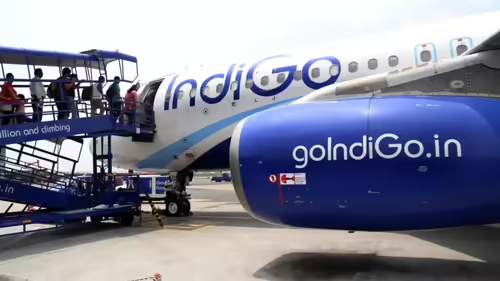
Passengers flying with India’s largest airline, IndiGo, should brace for potential disruptions starting **February 10, 2026**. That’s the day when a critical exemption from the Directorate General of Civil Aviation (DGCA) on revised flight duty norms officially ends. Without this regulatory relief, IndiGo may be forced to reduce its flight schedule—particularly on routes operated by its Airbus A320 fleet—to comply with stricter pilot rest and duty time limits. The airline has already signaled a “short-term network readjustment,” which could mean canceled flights, rescheduled itineraries, or even a strategic shift to smaller aircraft. If you have travel plans in the coming weeks, here’s what you need to know.
Table of Contents
- What Are the New Flight Duty Norms?
- Why Did DGCA Grant an Exemption?
- How IndiGo Plans to Adapt
- Which Passengers Will Be Affected?
- Broader Impact on Indian Aviation
- What Passengers Should Do Now
- Conclusion: Navigating Regulatory Turbulence
- Sources
What Are the New Flight Duty Norms?
In 2024, the DGCA introduced updated flight duty norms aligned with global standards set by the International Civil Aviation Organization (ICAO). These rules aim to enhance aviation safety by preventing pilot fatigue—a known factor in several international air incidents .
Key changes include:
- Reduced maximum daily flight duty period from 14 hours to **12–13 hours**, depending on start time and number of sectors.
- Stricter rest requirements: pilots must now get **at least 10 consecutive hours of rest** before reporting for duty.
- More conservative limits for early-morning or red-eye flights, where circadian rhythm disruption is highest.
While these rules are vital for safety, they also reduce operational flexibility—especially for airlines running high-frequency, point-to-point networks like IndiGo.
Why Did DGCA Grant an Exemption?
Recognizing the massive operational overhaul required, the DGCA granted a **temporary exemption** to all Indian carriers, allowing them to continue operating under the older, more lenient rules while they adjusted crew rosters, training schedules, and flight planning systems .
This grace period was always meant to be short-term. It gave airlines time to hire more pilots, reconfigure flight banks, and integrate new software for compliance tracking. However, with India’s aviation sector growing at over 15% annually, the pilot shortage remains acute—especially for narrow-body jets like the A320. IndiGo, which operates one of the world’s largest A320 fleets, has been hit hardest by this gap.
How IndiGo Plans to Adapt
Faced with the February 10 deadline, IndiGo is implementing a multi-pronged strategy to minimize passenger impact while staying compliant:
- Network Readjustment: Temporarily reducing frequency on select A320 routes, especially those with tight turnarounds or early/late departures that push duty limits.
- Aircraft Substitution: Shifting some routes from A320s to its smaller, more flexible ATR 72 turboprops, which require fewer crew and have different duty calculations.
- Crew Augmentation: Accelerating pilot recruitment and fast-tracking type conversions to build buffer capacity.
An IndiGo spokesperson confirmed that any affected passengers will be notified proactively and offered either a full refund or rebooking on alternative flights—including partner carriers if necessary .
Which Passengers Will Be Affected?
Not all travelers will see changes, but higher-risk routes include:
- Early morning departures (before 6 AM) from hubs like Delhi, Mumbai, and Bengaluru.
- Late-night arrivals (after 11 PM) on multi-sector flights.
- High-frequency shuttle routes (e.g., Delhi–Mumbai, Bengaluru–Hyderabad) where pilots operate 4–5 sectors per day.
- Newer or thinner routes with lower passenger loads, which may be temporarily suspended.
Business travelers and those with connecting international flights should monitor their itineraries closely.
Broader Impact on Indian Aviation
IndiGo isn’t alone. Other carriers like Vistara and Air India Express may also face scheduling challenges, though their smaller scale offers more flexibility. In the long run, however, these flight duty norms will benefit the entire ecosystem by raising safety standards and professionalizing crew management.
For more on how regulations shape air travel, see our guide on [INTERNAL_LINK:india-aviation-safety-reforms].
What Passengers Should Do Now
If you’re flying with IndiGo between February and April 2026:
- Check your booking status 72 hours before departure via the IndiGo app or website.
- Enable flight alerts to receive real-time updates on delays or cancellations.
- Avoid tight connections on critical travel days (e.g., weddings, business meetings).
- Consider travel insurance that covers schedule changes due to regulatory reasons.
Conclusion: Navigating Regulatory Turbulence
The end of the DGCA exemption marks a turning point for Indian aviation. While short-term pain in the form of reduced flights is likely, the long-term gain is a safer, more sustainable industry. For IndiGo, this is a test of operational agility. For passengers, it’s a reminder that even the most efficient low-cost carrier must bow to the non-negotiable priority of safety. As the February 10 deadline looms, stay informed, stay flexible—and keep your boarding pass handy.
Sources
- Times of India: Flight duty norms: DGCA exemptions end on Feb 10, IndiGo may cut more flights
- DGCA Civil Aviation Requirements (CAR) Section 7 – Flight Crew Standards: Official Guidelines on Flight Time Limitations
- IndiGo Corporate Communications Statement (January 2026)