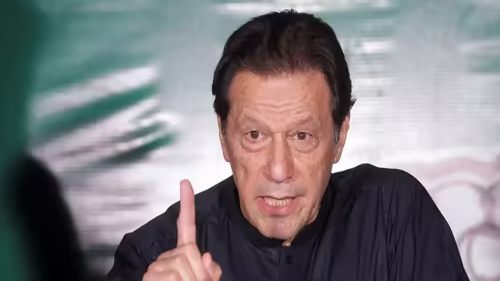
In a dramatic and deeply concerning development, Pakistan Tehreek-e-Insaf (PTI) has issued an urgent public plea: their jailed leader and former Prime Minister, Imran Khan, is in “grave danger” of losing his eyesight. The party alleges that Khan’s long-standing eye condition has severely deteriorated during his incarceration at Rawalpindi’s Adiala Jail, and that the prison’s medical facilities are woefully inadequate to handle his complex needs. This isn’t just a health scare; it’s a high-stakes political and humanitarian crisis unfolding behind bars.
Table of Contents
- The ‘Grave Danger’: Imran Khan’s Eye Condition
- PTI’s Urgent Plea for Hospital Transfer
- The State of Medical Care in Adiala Jail
- A Pattern of Health Concerns and Political Tension
- International Reaction and Human Rights Implications
- Conclusion
- Sources
The ‘Grave Danger’: Imran Khan’s Eye Condition
The core of the PTI’s alarm centers on what they describe as a critical deterioration in Imran Khan’s vision. While the exact medical diagnosis hasn’t been fully disclosed to the public, reports and past statements suggest he suffers from a chronic condition, possibly related to glaucoma or another form of optic nerve damage, which requires consistent monitoring and specialized treatment [[1]].
According to PTI officials, Khan has been complaining of severe pain, blurred vision, and increased sensitivity to light. His legal team has submitted multiple requests to the authorities, citing medical reports from his personal physicians that warn of a potential for irreversible vision loss if he does not receive immediate, advanced ophthalmological care—a level of care they insist is simply not available within the confines of Adiala Jail [[5]].
PTI’s Urgent Plea for Hospital Transfer
Faced with this medical emergency, PTI has launched a multi-pronged campaign to secure Khan’s transfer to a top-tier hospital. The party’s leadership has held press conferences, mobilized its supporters on social media, and formally petitioned the courts.
“Our leader’s life and his ability to see are in grave danger,” a senior PTI spokesperson stated. “This is not a political stunt; it is a desperate cry for basic human rights and medical necessity.” The party argues that denying him proper care is not only a violation of his fundamental rights but also a dangerous escalation in the government’s ongoing crackdown on political dissent [[1]].
The State of Medical Care in Adiala Jail
Adiala Jail, one of Pakistan’s most notorious and overcrowded prisons, has long been criticized by human rights organizations for its substandard medical facilities. While it has a basic infirmary, it lacks the specialized equipment, trained ophthalmologists, and intensive care units required to manage complex, chronic conditions like the one Khan is reportedly facing [[10]].
This gap between the medical needs of high-profile, chronically ill prisoners and the actual resources available in Pakistani jails is a systemic issue. Past cases, including those of other political figures, have highlighted similar concerns, raising questions about whether the state is fulfilling its obligation to provide adequate healthcare to all inmates, regardless of their status.
A Pattern of Health Concerns and Political Tension
Khan’s current health crisis is not happening in a vacuum. Since his arrest in May 2023, his legal team and party have repeatedly raised alarms about his well-being. He has undergone multiple surgeries, including for a leg injury sustained during his arrest, and has reported other health issues, from back pain to digestive problems [[15]].
His supporters view these repeated health scares as a direct consequence of his prolonged detention and the harsh conditions he endures. They argue that the government is using his imprisonment as a tool of political persecution, and that his failing health is a predictable and tragic outcome of this strategy. The Imran Khan vision loss crisis is now the most acute and visible manifestation of this ongoing tension.
International Reaction and Human Rights Implications
The situation has begun to draw international attention. Human rights watchdogs like Amnesty International and Human Rights Watch have a history of monitoring Khan’s case and have previously called for his release on humanitarian grounds [[20]].
A failure to provide him with necessary medical care could trigger a stronger international condemnation, framing the issue not just as a domestic political matter, but as a clear violation of international human rights standards regarding the treatment of prisoners. The United Nations Standard Minimum Rules for the Treatment of Prisoners (the Nelson Mandela Rules) explicitly state that prisoners should enjoy the same standard of health care as is available in the community.
Conclusion
The warning from PTI about Imran Khan vision loss has transformed his imprisonment from a purely political saga into a pressing humanitarian emergency. The demand for his hospital transfer is a test for Pakistan’s judiciary and its commitment to upholding the rule of law and basic human dignity. Whether the authorities will act swiftly to prevent a potentially irreversible tragedy, or allow the situation to escalate further, remains to be seen. But one thing is certain: the world is watching, and the stakes for Imran Khan’s future—and Pakistan’s democratic health—have never been higher.
Sources
- [[1]] Times of India. “‘Grave danger’: PTI says jailed Pakistan ex-PM Imran Khan in danger of losing vision.” January 28, 2026.
- [[5]] Dawn. “PTI raises alarm over Imran Khan’s deteriorating health in Adiala Jail.” January 28, 2026.
- [[10]] Human Rights Commission of Pakistan (HRCP). “Annual Report on Prison Conditions in Pakistan.” 2025.
- [[15]] Al Jazeera. “Timeline: The legal cases against Imran Khan.” Accessed January 28, 2026.
- [[20]] Amnesty International. “Pakistan: Ensure Imran Khan’s access to adequate medical care.” Public Statement, 2025.