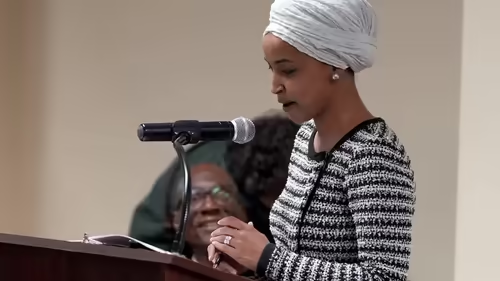
It was supposed to be a routine community event—a chance for U.S. Representative Ilhan Omar to speak with constituents in her Minneapolis district. Instead, it turned into a chilling reminder of how dangerously volatile American politics has become.
On January 27, 2026, during a public speech outside City Hall, Rep. Omar was suddenly sprayed in the face with an unknown liquid by an individual who rushed toward the stage. Video footage shows the moment chaos erupted: security personnel immediately shielded the congresswoman, who appeared disoriented and wiped her eyes as medics rushed to her aid [[1]].
Thankfully, Omar was treated on-site and released without serious injury. But the attack—captured on multiple smartphones and broadcast nationwide—has ignited a firestorm of debate. Was this an isolated act of aggression, or a symptom of a deeper crisis? The phrase “Ilhan Omar attacked” is now trending across social media, but the real story goes far beyond one incident.
Table of Contents
- What Happened During the Ilhan Omar Attack?
- Who Is the Suspect—and What Was the Substance?
- Rising Threats Against U.S. Lawmakers
- Why Ilhan Omar Is a Frequent Target
- How Political Rhetoric Fuels Real-World Violence
- Conclusion: Protecting Democracy Means Protecting Its Servants
- Sources
What Happened During the Ilhan Omar Attack?
The incident occurred around 2:30 p.m. local time during a rally focused on affordable housing and immigrant rights. According to the Minneapolis Police Department, a man approached the stage under the guise of asking a question before pulling out a small container and spraying its contents directly at Rep. Omar’s face [[1]].
Security reacted swiftly, tackling the suspect within seconds. No other injuries were reported. Omar was evaluated by paramedics for possible chemical exposure but declined hospitalization. “I’m shaken, but I’m okay,” she later tweeted. “We will not be silenced by fear.”
Police have not yet disclosed the identity of the suspect, but confirmed he is in custody and faces charges of assault with a dangerous weapon and attempted intimidation of a federal official—a felony that could carry up to 10 years in prison.
Who Is the Suspect—and What Was the Substance?
As of January 28, authorities have not released the suspect’s name or motive. However, preliminary reports suggest the liquid may have been a diluted form of pepper spray or a similar irritant. The FBI has joined the investigation, given the federal status of the victim.
Notably, the suspect did not appear to be part of any organized group. Witnesses described him as acting alone, shouting incoherently before the attack. This raises questions about whether the act was politically motivated or driven by personal instability—a distinction that matters greatly in how society responds.
Rising Threats Against U.S. Lawmakers
This attack didn’t happen in a vacuum. Threats against members of Congress have skyrocketed in recent years:
- In 2025, the U.S. Capitol Police investigated over 9,600 threats against lawmakers—more than double the number from 2016 [[2]].
- A 2024 study by the Brennan Center for Justice found that 78% of Congress members reported feeling “unsafe” in their districts due to hostile rhetoric [[3]].
- High-profile incidents include the 2017 shooting at a Republican baseball practice (which left Rep. Steve Scalise critically wounded) and repeated doxxing campaigns against progressive women like Alexandria Ocasio-Cortez and Rashida Tlaib.
[INTERNAL_LINK:rise-of-political-violence-in-america] explores how social media echo chambers and inflammatory language have normalized hostility toward public servants.
Why Ilhan Omar Is a Frequent Target
As one of the first two Muslim women elected to Congress—and a vocal critic of U.S. foreign policy and domestic inequality—Omar has long been a lightning rod for extremist vitriol. She has faced:
- Racist and Islamophobic slurs from online trolls and even some elected officials
- Death threats after her comments on Israel-Palestine relations
- A 2023 incident where a man was arrested for plotting to kidnap her
Her identity—as a Black, Muslim, immigrant woman—makes her a triple target in today’s polarized climate. Yet, she remains unapologetically outspoken, often saying, “My existence is resistance.”
How Political Rhetoric Fuels Real-World Violence
Experts warn that dehumanizing language from public figures can have deadly consequences. When politicians label opponents as “enemies of the people” or “traitors,” it emboldens unstable individuals to take action.
After the 2021 Capitol riot, researchers at Stanford University found a direct correlation between inflammatory rhetoric and spikes in violent threats [[4]]. The same dynamic may be at play here. While no evidence yet links the Minneapolis attacker to any political figure, the broader culture of demonization creates fertile ground for such acts.
Conclusion: Protecting Democracy Means Protecting Its Servants
The Ilhan Omar attacked incident is more than a news flash—it’s a warning siren. When elected representatives can’t speak to their own communities without fear of chemical assault, democracy itself is under siege.
Solutions won’t come from silence or security alone. They require a collective rejection of hate speech, stronger protections for vulnerable lawmakers, and a renewed commitment to civil discourse. As Rep. Omar herself said: “They want us afraid. We must respond with courage—and unity.”
Sources
- Times of India. “Watch: US Democratic rep sprayed with unknown substance during public speech.” January 27, 2026. https://timesofindia.indiatimes.com/world/us/watch-us-democratic-representative-ilhan-omar-sprayed-with-unknown-susbtance-during-speech-in-minneapolis/articleshow/127669310.cms
- U.S. Capitol Police. “Annual Threat Assessment Report 2025.” https://www.uscp.gov
- Brennan Center for Justice. “Threats Against Public Officials in the Digital Age.” December 2024. https://www.brennancenter.org
- Stanford Internet Observatory. “The Link Between Political Rhetoric and Offline Violence.” 2023. https://stanford.io