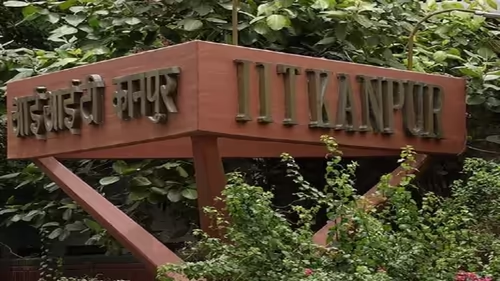
The news from the Indian Institute of Technology, Kanpur (IIT-K) is not just tragic; it’s a national alarm bell. In a span of just two years, this single campus has witnessed nine student deaths by suicide—a staggering figure that accounts for nearly 30% of all such tragedies across the entire network of 23 IITs during the same period . A recent incident on December 30, 2025, marks the latest in a heartbreaking series, pushing the total number of IIT student suicides to at least 65 between January 2021 and December 2025 . This isn’t a coincidence. It’s a symptom of a deep, festering crisis within India’s most elite educational institutions.
Table of Contents
- The Alarming Statistics Behind the IIT Kanpur Suicide Toll
- Why IIT Kanpur? Unpacking the Perfect Storm of Pressure
- Systemic Failures: More Than Just Academic Pressure
- The State of Mental Health Support at IIT Kanpur
- Calls for Reform: What Needs to Change Now
- Conclusion: From Crisis to Catalyst for Change
- Sources
The Alarming Statistics Behind the IIT Kanpur Suicide Toll
The numbers paint a grim picture. While every life lost is a profound tragedy, the concentration of these incidents at IIT Kanpur demands specific scrutiny. Of the 30 suicides recorded across all IITs in the last two years, nine occurred at IIT-K alone . This disproportionate toll raises critical questions about the unique environment on this campus. Alumni groups and independent researchers have been tracking these figures, revealing a pattern that suggests a systemic issue rather than isolated cases of personal struggle . The crisis appears to be escalating, with peaks noted in 2023 and 2024 .
Why IIT Kanpur? Unpacking the Perfect Storm of Pressure
What makes IIT Kanpur a focal point for this crisis? Experts and former students point to a confluence of intense factors:
- Extreme Academic Competition: The pressure to excel among peers who are all national toppers creates an environment of relentless stress. The fear of failure or even mediocrity can be paralyzing .
- PhD Scholar Vulnerability: A significant portion of the victims are PhD scholars. A study found that a shocking 80% of PhD scholars at IIT Kanpur screen positive for anxiety or depression, highlighting their unique vulnerability .
- Culture of Silence: Despite being surrounded by people, many students report feeling profoundly isolated. The stigma around seeking help for mental health issues often prevents them from reaching out until it’s too late .
- Backlog Burden: For undergraduate students, the inability to clear academic backlogs is a frequently cited reason for distress, creating a cycle of anxiety and hopelessness .
Systemic Failures: More Than Just Academic Pressure
While academic pressure is a major factor, the problem runs deeper into the institutional framework. Critics argue that the current system fails to treat student mental health as a structural and rights-based issue . The focus remains heavily on academic output and rankings, often at the expense of holistic student well-being. This creates a hierarchy where physical distress is addressed, but psychological distress is sidelined . The competitive nature of admissions and limited seats in these top institutions create a high-stakes environment that significantly impacts students’ mental health from day one .
The State of Mental Health Support at IIT Kanpur
IIT Kanpur does have a formal support structure in place: the Institute Counselling Service (ICS). On paper, the ICS is a robust team comprising professional counsellors, psychiatrists, empathetic student volunteers, and faculty advisors . They offer emotional, academic, and even financial assistance . The institute has also taken steps to strengthen its postgraduate counselling core for faster response times .
However, the persistent and high number of suicides suggests a stark disconnect between the existence of these services and their real-world effectiveness. Questions remain about accessibility, student trust in the system, and whether the support offered is sufficient to counter the immense pressures students face. Are these services proactive or merely reactive? Are they equipped to handle a crisis of this magnitude?
Calls for Reform: What Needs to Change Now
The growing outcry from alumni, faculty, and mental health advocates is demanding more than just condolences. They are calling for concrete, systemic reforms:
- Accountability from Leadership: There are urgent calls for the Union Education Ministry to hold IIT administrations accountable for student safety and well-being .
- Curriculum & Evaluation Overhaul: Reducing the sheer volume of coursework and moving away from hyper-competitive grading systems could alleviate immense pressure.
- Building a Supportive Culture: Fostering a campus culture that actively destigmatizes mental health struggles and encourages peer support is crucial. This goes beyond just having a counselling cell.
- Independent Oversight: An external, independent body may be needed to audit the mental health infrastructure and its implementation at IITs like Kanpur.
This crisis is not unique to IIT Kanpur but is reflective of a broader issue in India’s higher education landscape, from coaching hubs like Kota to other premier institutes . Addressing it requires a fundamental shift in how we value our students—not just as academic performers, but as human beings.
Conclusion: From Crisis to Catalyst for Change
The repeated tragedy of the IIT Kanpur suicide cases is a national shame and a call to action. It exposes the dark underbelly of an education system that celebrates success but fails its most vulnerable. The statistics are not just numbers; they are lives cut short, families shattered, and a generation of brilliant minds lost to a preventable crisis. The time for platitudes is over. It’s time for decisive, compassionate, and systemic change to ensure that India’s premier institutes become places of not just intellectual growth, but also emotional safety and human flourishing. For more on the broader challenges in India’s education system, see our analysis on [INTERNAL_LINK:student-wellbeing-in-indian-universities].
Sources
- Times of India: 9 deaths, 2 years, 1 campus: Why IIT Kanpur tops India’s IIT suicide toll
- Alumni Data on IIT Suicides (2021-2025): Various reports cited in web search results [[2], [3], [5], [7]]
- Gupta, D. (2025). Suicide Trends Among Indian Institutes of Technology Joint Entrance Exam Aspirants. [[4], [9], [13]]
- The Week: Opinion on the silent crisis in IITs
- IIT Kanpur Institute Counselling Service (ICS) official descriptions [[19], [20], [22], [23], [25], [26], [27]]
- National Institute of Mental Health and Neurosciences (NIMHANS): Resources on Student Mental Health