Table of Contents
- The Conference That Sparked a Firestorm
- From Seminar to Scrutiny: IIT Delhi’s Official Response
- Academic Freedom vs. Institutional Reputation: The Core Tension
- What This Means for IITs and Indian Higher Education
- Voices from Campus: Students, Faculty, and Alumni React
- Conclusion: A Defining Moment for India’s Knowledge Institutions
- Sources
The Conference That Sparked a Firestorm
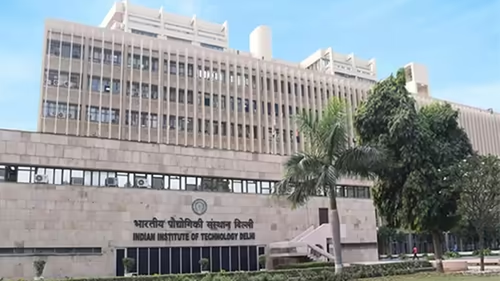
In early January 2026, IIT Delhi hosted an international conference titled “Caste and Race: Comparative Global Perspectives.” Organized by faculty from the Humanities and Social Sciences department, the event aimed to foster interdisciplinary dialogue on systemic inequality—a topic increasingly central to global academia.
But one session—featuring a political reading of caste dynamics in contemporary India—drew sharp criticism from external groups and sections of the media. Critics alleged the discussion crossed from scholarly analysis into “anti-national” rhetoric, though no formal complaints were filed by attendees [[1]].
Within days, social media amplified the controversy, with hashtags like #BoycottIITDelhi trending briefly. The backlash wasn’t about the entire conference—but about how a single panel was interpreted through a polarized political lens.
From Seminar to Scrutiny: IIT Delhi’s Official Response
Faced with mounting pressure, IIT Delhi’s administration took an unprecedented step: it constituted a fact-finding committee to investigate whether the event violated institutional norms or guidelines on public discourse [[2]].
This move marked a dramatic shift—from supporting academic inquiry to initiating institutional scrutiny. The committee, comprising senior faculty and administrative officials, was tasked with reviewing session recordings, speaker credentials, and approval protocols.
For many scholars, this response felt like a betrayal. “Conferences are meant to challenge ideas, not conform to them,” said Dr. Ananya Roy, a former IIT professor now at a European university. “Launching an inquiry sends a chilling message to researchers working on sensitive topics.”
Academic Freedom vs. Institutional Reputation: The Core Tension
The IIT Delhi caste conference controversy lays bare a growing tension in Indian higher education: How do elite institutions balance intellectual openness with perceived reputational risk?
On one side are those who argue that technical institutes like IITs must remain neutral, focusing on science and engineering—not “divisive” social debates. On the other are academics who insist that understanding caste is essential—even in STEM spaces—because it shapes access, opportunity, and innovation in India.
Key questions now being debated:
- Should IITs restrict topics deemed “politically sensitive”?
- Who decides what constitutes legitimate scholarship versus “propaganda”?
- Does institutional caution stifle critical thinking—the very foundation of education?
Notably, the University Grants Commission (UGC) and Ministry of Education have not issued directives, leaving IIT Delhi to navigate this alone—a sign of how decentralized (and vulnerable) academic autonomy has become [[4]].
What This Means for IITs and Indian Higher Education
This isn’t just about one conference. It’s about the future of intellectual life in India’s premier institutions.
Historically, IITs have prided themselves on meritocracy and technical excellence. But as campuses diversify—thanks to reservation policies and outreach programs—students and faculty are increasingly demanding that curricula reflect India’s complex social realities.
Yet, any mention of caste in elite spaces often triggers backlash, framed as “politicization” rather than pedagogy. The IIT Delhi caste conference fallout could set a precedent:
- If the committee censures the event, it may deter future critical scholarship.
- If it defends academic freedom, it could embolden similar initiatives across IITs and NITs.
Either way, the episode reveals how even the most insulated institutions are not immune to India’s broader culture wars.
Voices from Campus: Students, Faculty, and Alumni React
Reactions within IIT Delhi have been deeply divided. A group of PhD students in Social Sciences released a statement calling the fact-finding committee “an act of epistemic violence,” arguing it delegitimizes marginalized knowledge systems [[5]].
Conversely, some engineering students expressed concern that such events “distract from IIT’s core mission.” One anonymous alumnus told us: “We didn’t come here to debate ideology. We came to build rockets.”
Meanwhile, faculty unions have warned that administrative overreach could violate the autonomy granted under the Institutes of Technology Act. The All India Federation of IIT Alumni (AIFIA) has called for transparency in the committee’s proceedings, urging the institute to uphold its legacy of fearless inquiry.
Conclusion: A Defining Moment for India’s Knowledge Institutions
The IIT Delhi caste conference controversy is more than an internal dispute—it’s a litmus test for India’s commitment to academic freedom in the 21st century. As global universities grapple with similar tensions, IIT Delhi’s response will signal whether India’s top technical institutes see themselves as ivory towers—or as engaged, socially conscious communities.
One thing is clear: in an era where knowledge is power, the battle over who gets to speak, and on what terms, will define the soul of Indian higher education for years to come.
Sources
- Times of India: From academic debate to institutional scrutiny: Inside IIT Delhi’s caste conference fallout Link
- IIT Delhi Official Notice: Formation of Fact-Finding Committee (January 20, 2026)
- University Grants Commission (UGC) Guidelines on Academic Freedom – ugc.ac.in
- The Indian Express: Why Caste Studies Matter Even in Engineering Campuses (December 2025)
- Statement by IIT Delhi Doctoral Scholars Collective (Shared via Twitter/X, January 22, 2026)
- Ministry of Education, India: Autonomy of Institutes of National Importance – education.gov.in