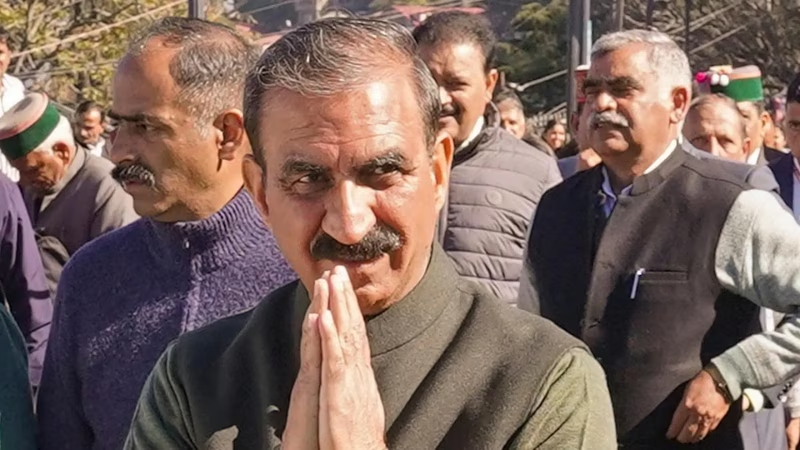
A major healthcare crisis in Himachal Pradesh has been averted—for now. After days of mounting public concern and disrupted medical services, resident doctors at Indira Gandhi Medical College (IGMC) in Shimla have ended their strike following a direct appeal and firm assurances from Chief Minister Sukhvinder Sukhu himself.
The strike, which brought non-emergency services at one of the state’s most critical hospitals to a standstill, was triggered by the controversial sacking of Dr. Raghav Narula, a respected senior resident doctor. The decision sparked outrage among his colleagues, who viewed it as arbitrary and unjust. But in a swift and rare display of crisis management, the CM stepped in personally—promising not just a review, but a full-fledged inquiry into the matter .
Table of Contents
- What Sparked the IGMC Shimla Doctors Strike?
- CM Sukhu’s Intervention and Key Assurances
- Impact of the IGMC Shimla Doctors Strike on Public Health
- The Case of Dr. Raghav Narula: What We Know
- Broader Issues: Medical Resident Working Conditions in India
- What Happens Next?
- Conclusion: A Fragile Truce with Deeper Lessons
- Sources
What Sparked the IGMC Shimla doctors strike?
The IGMC Shimla doctors strike began as an act of solidarity. Dr. Raghav Narula, a senior resident doctor known for his dedication and patient advocacy, was abruptly terminated from his post. While the official reason cited administrative or disciplinary grounds, the Resident Doctors Association (RDA) of IGMC alleged a lack of due process, transparency, and fair hearing.
“This wasn’t just about one doctor,” said an RDA representative. “It was about setting a precedent. If a hardworking colleague can be dismissed without explanation, none of us are safe.”
Frustrated by what they saw as institutional overreach, the resident doctors suspended all non-emergency duties—including outpatient services, elective surgeries, and routine check-ups—plunging thousands of patients into uncertainty.
CM Sukhu’s Intervention and Key Assurances
Facing mounting pressure from citizens and political opponents, Chief Minister Sukhvinder Sukhu held an emergency meeting with hospital administration and RDA leaders. In a move that underscored his administration’s responsiveness, he offered three clear commitments :
- Immediate Review: The government will re-examine the circumstances and documentation surrounding Dr. Narula’s termination.
- Independent Inquiry: A high-level committee will be formed to investigate the fairness and procedure of the sacking.
- Openness to Correction: “Government decisions are not infallible,” Sukhu stated. “If errors were made, they will be corrected.”
These assurances were enough to convince the doctors to resume their duties immediately, though they remain watchful over the inquiry’s outcome.
Impact of the IGMC Shimla Doctors Strike on Public Health
For a hill state like Himachal Pradesh—where access to advanced healthcare is already limited—the strike had severe ripple effects. IGMC Shimla is a referral hub for remote districts, and the suspension of services meant:
- Delays in critical diagnostics and treatments
- Cancellation of scheduled surgeries
- Overburdening of emergency services
- Increased travel burden for patients forced to seek care in Chandigarh or Delhi
Patient advocacy groups have long warned that such disruptions disproportionately affect the elderly, low-income families, and those with chronic conditions who rely on consistent care .
The Case of Dr. Raghav Narula: What We Know
Dr. Narula, whose sudden removal became the flashpoint for the protest, has not spoken publicly about the allegations against him. Sources within the hospital suggest the issue may relate to internal administrative disagreements or protocol violations—but no formal charges or findings have been made public.
What’s clear is that the lack of communication fueled distrust. “Even if the action was justified, the process matters,” said a senior medical educator from a neighboring state. “Doctors need to feel protected by systems, not threatened by them.”
Broader Issues: Medical Resident Working Conditions in India
This episode at IGMC Shimla is not isolated. Across India, resident doctors routinely face:
- Excessive work hours (often 80–100 hours per week)
- Inadequate staffing and infrastructure
- Limited grievance redressal mechanisms
- Low stipends compared to private sector peers
According to a 2023 study published in the Indian Journal of Medical Ethics, over 60% of resident doctors reported feeling “emotionally exhausted” and “undervalued” . The IGMC incident highlights how systemic neglect can boil over into collective action.
For more on healthcare challenges in hilly regions, see our coverage on [INTERNAL_LINK:healthcare-access-in-himalayan-states].
What Happens Next?
The truce is fragile but promising. The state government has 14 days to constitute the inquiry committee, as per standard administrative timelines. Meanwhile, the RDA has agreed to full cooperation—on the condition that Dr. Narula is reinstated provisionally if the initial review finds procedural flaws.
Public health experts urge that this moment be used not just to resolve one case, but to reform how medical institutions handle staff grievances. “Transparency and dialogue prevent strikes,” notes Dr. Anjali Sharma, a public health policy analyst .
Conclusion: A Fragile Truce with Deeper Lessons
The end of the IGMC Shimla doctors strike is a victory for dialogue—but it’s also a warning. When frontline healthcare workers feel unheard, the entire system suffers. Chief Minister Sukhu’s swift action prevented a worsening crisis, but sustainable peace requires more than crisis management.
It demands institutional reforms, respectful labor practices, and a culture where doctors are seen not as replaceable cogs, but as the backbone of public health. The inquiry into Dr. Narula’s case will be closely watched—not just for its verdict, but for what it signals about Himachal Pradesh’s commitment to its medical workforce.
Sources
- Times of India: Himachal Pradesh doctors end stir as CM Sukhvinder Sukhu assures sacking review
- National Health Mission Himachal Pradesh: Official Portal on Public Health Services
- Indian Journal of Medical Ethics: Workload and Well-being of Resident Doctors in India (2023)