Table of Contents
- The Moment the Harness Gave Way
- IDF Black Hawk Crash: What We Know So Far
- From Emergency Landing to Airlift Failure
- Why the Yanshuf Matters to Israel’s Defense
- Aviation Safety and the Risks of Helicopter Recovery
- Public Reaction and Official Response
- Conclusion
- Sources
A chilling video has gone viral across defense and news circles: an Israeli Defense Forces (IDF) **Black Hawk** helicopter—locally known as the *Yanshuf*—plummets from mid-air during a recovery operation in Gush Etzion, crashing just meters from a residential home. The cause? A critical failure in the lifting harness used to airlift the grounded aircraft. Incredibly, despite the violent impact, **no injuries were reported**. Now, the IDF has launched a formal investigation into what went wrong—and whether this near-disaster could have been prevented.
The Moment the Harness Gave Way
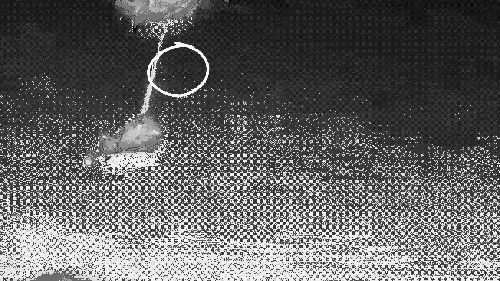
The footage, captured by a bystander and later verified by multiple outlets, shows a heavy-lift helicopter hovering above the grounded Black Hawk, which had made an emergency landing days earlier due to severe weather . As the recovery sling tightens and the aircraft begins to rise, the harness suddenly tears. In a split second, the 10-ton Yanshuf drops like a stone, slamming into the rocky terrain near a house in the West Bank settlement bloc of Gush Etzion.
Witnesses described the sound as “a thunderclap followed by silence.” One local resident told reporters, “It fell so fast—we thought someone must be dead. But miraculously, the cabin was empty, and no one was nearby.”
IDF Black Hawk Crash: What We Know So Far
According to official statements, the **IDF Black Hawk crash** occurred during a routine salvage operation following an unscheduled landing caused by extreme weather conditions earlier in the week . The helicopter had been deemed safe to recover but not to fly back under its own power.
Key facts confirmed by the IDF Spokesperson’s Unit:
- The Black Hawk was unoccupied at the time of the crash.
- The recovery operation involved a CH-53 Yas’ur heavy-lift helicopter.
- The failure point was identified as the external cargo harness/sling system.
- No civilians or soldiers were injured.
- A full technical and procedural investigation has been ordered.
This incident marks one of the most visually dramatic non-combat helicopter failures in recent IDF history—and it’s all caught on camera.
From Emergency Landing to Airlift Failure
The sequence of events began when the Yanshuf encountered severe wind shear or mechanical issues (details remain classified) during a training or logistical mission over the Judean Hills. The pilot executed a controlled emergency landing in Gush Etzion—a standard procedure that likely saved lives.
Days later, the IDF’s Air Force Recovery Unit moved in to extract the stranded aircraft using an external lift—a common practice for damaged or inoperable helicopters in remote areas. Such operations are complex and require precise coordination between ground crews and aerial teams. The harness failure suggests either a material defect, improper rigging, or miscalculation of weight distribution.
Why the Yanshuf Matters to Israel’s Defense
The Sikorsky UH-60 Black Hawk, designated *Yanshuf* (“Owl”) in Hebrew, is the backbone of the IDF’s tactical transport and special operations fleet. With over 48 units in service, these helicopters are used for everything from troop insertion and medical evacuation to counter-terrorism raids in Gaza and the West Bank .
Israel has heavily modified its Black Hawks with advanced avionics, armor, and electronic countermeasures, making them among the most sophisticated in the world. Any compromise in their operational integrity—or in the systems used to recover them—is a matter of national security concern.
Aviation Safety and the Risks of Helicopter Recovery
External lifts, while routine, carry inherent risks. According to the U.S. Federal Aviation Administration (FAA), sling-load operations account for a disproportionate number of non-combat aviation incidents due to variables like wind, load balance, and equipment fatigue .
Industry experts note that harnesses undergo rigorous inspection before use—but wear, UV degradation, or manufacturing flaws can still lead to catastrophic failure. “A torn harness at altitude is every recovery team’s nightmare,” said a former military aviation engineer (speaking anonymously). “It turns a controlled lift into an uncontrolled drop.”
The fact that this occurred in a populated area adds another layer of risk. Had the helicopter fallen just 20 meters west, it could have struck a home.
Public Reaction and Official Response
While social media buzzed with shock and speculation, the IDF maintained a calm but transparent posture. “We take all safety incidents seriously,” said an Air Force spokesperson. “An inquiry team has been formed to review procedures, equipment, and personnel actions.”
Defense analysts suggest the findings could lead to temporary changes in recovery protocols or even a fleet-wide inspection of lifting gear. For now, the focus remains on understanding how a system designed for reliability failed so visibly.
For more on military aviation safety standards, see our deep dive on [INTERNAL_LINK:military-helicopter-safety-protocols].
Conclusion
The **IDF Black Hawk crash** in Gush Etzion is a stark reminder that even the most advanced militaries operate on the edge of human and mechanical limits. While the outcome was miraculously injury-free, the incident exposes vulnerabilities in recovery operations that demand urgent scrutiny. As Israel continues to rely on its Yanshuf fleet for critical missions, ensuring the integrity of every component—from rotor blades to recovery slings—is not just about equipment. It’s about protecting lives, both in uniform and on the ground.
Sources
- Times of India. “Watch: Dramatic video shows IDF Black Hawk crashing after harness tore mid-lift; no injuries reported.” https://timesofindia.indiatimes.com/…
- IDF Official Website. “The Yanshuf (UH-60 Black Hawk) in IDF Service.” https://www.idf.il/en
- Federal Aviation Administration (FAA). “Sling Load Operations Safety Guidelines.” https://www.faa.gov/…