Table of Contents
- A Tragic Incident in Minneapolis
- Who Was Renee Nicole Good?
- The Heartbreaking Confession of Her Partner
- What Happened During the ICE Operation?
- Public and Official Reactions to the ICE Shooting Victim Case
- Broader Implications for Immigration Enforcement
- Conclusion: A Family Shattered, A Community Grieving
- Sources
A Tragic Incident in Minneapolis
The quiet streets of Minneapolis were shattered by gunfire on a recent morning, leaving a family devastated and a community demanding answers. The focal point of this tragedy is the death of Renee Nicole Good, who became the latest ICE shooting victim in a controversial encounter with U.S. Immigration and Customs Enforcement (ICE) agents .
The incident occurred during what was described as a routine immigration enforcement operation. However, the situation escalated rapidly, culminating in a fatal shooting that has reignited national debates about the tactics and transparency of federal immigration authorities.
Who Was Renee Nicole Good?
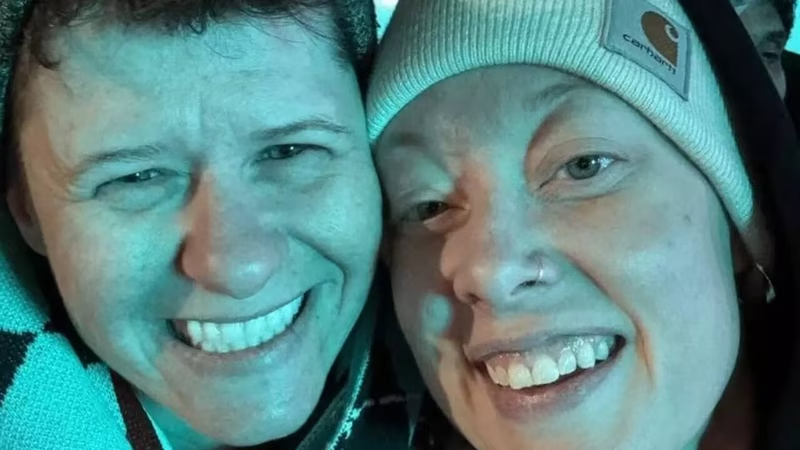
Renee Nicole Good was more than just a name in a news headline; she was a mother, a wife, and a new resident of Minneapolis. She and her partner, Rebecca Good, had recently moved from Kansas City to start a fresh chapter in their lives . Their young child was at school on the day of the shooting, blissfully unaware of the horror unfolding at home.
Friends and neighbors described Renee as a kind and loving person, deeply committed to her family. Her sudden and violent death has left a void that can never be filled, turning a hopeful new beginning into an unimaginable nightmare.
The Heartbreaking Confession of Her Partner
In the immediate, chaotic aftermath of the shooting, Rebecca Good was overcome with grief and guilt. According to reports, she sobbed uncontrollably, repeatedly saying, “It’s my fault” . This raw and emotional outburst has become a central, haunting element of the story, raising countless questions about the sequence of events that led to the tragedy.
While the exact context of her statement remains part of the ongoing investigation, it underscores the immense psychological trauma inflicted on the surviving family members. Rebecca’s words speak to a profound sense of personal responsibility, even in a situation where a federal agent made the ultimate decision to use lethal force.
What Happened During the ICE Operation?
According to official accounts from ICE and local law enforcement, agents arrived at the residence to execute an administrative warrant. The agency stated that during the operation, Renee Good got into a vehicle and drove it toward an officer, which they claim posed an imminent threat . In response to this perceived threat, the agent discharged his weapon, fatally striking her.
This narrative, however, is being met with intense scrutiny. Key details remain unclear, including:
- Whether the agents properly identified themselves before the confrontation began.
- The exact distance and speed at which the vehicle was moving toward the officer.
- Whether de-escalation protocols were followed in a residential neighborhood.
- The nature of the administrative warrant and why such a high-risk approach was deemed necessary.
The Department of Homeland Security’s Office of Inspector General has reportedly opened an investigation into the shooting, which is standard procedure in such cases .
Public and Official Reactions to the ICE Shooting Victim Case
The death of Renee Nicole Good has sparked outrage and protests in Minneapolis, a city already sensitive to issues of law enforcement accountability following the murder of George Floyd. Community activists and immigrant rights groups are calling for a full, independent investigation and greater transparency from ICE.
Local politicians have also weighed in. Some have demanded a moratorium on such high-risk ICE operations in residential areas, citing the danger they pose to innocent bystanders and families. The case has become a flashpoint in the larger national conversation about the role and power of federal immigration enforcement agencies.
Broader Implications for Immigration Enforcement
This incident is not isolated. It fits into a troubling pattern of aggressive ICE tactics that have drawn criticism for years. Operations often conducted at dawn, involving armed agents in unmarked vehicles, can create an atmosphere of fear and confusion, especially in communities of color [[INTERNAL_LINK:history-of-ice-enforcement-controversies]].
Critics argue that the use of lethal force in an immigration context—where the underlying offense is typically civil, not criminal—is a dangerous overreach of power. They point to this tragedy as evidence that a fundamental shift in policy is needed, one that prioritizes community safety and due process over aggressive apprehension quotas.
For many Americans, the image of a grieving partner blaming herself for her wife’s death at the hands of a federal agent is a powerful and disturbing symbol of a system in crisis.
Conclusion: A Family Shattered, A Community Grieving
The story of the ICE shooting victim, Renee Nicole Good, is a human tragedy with far-reaching consequences. Behind the legal and political debates is a young child who has lost a parent and a partner consumed by grief and guilt. As the investigation unfolds, the public deserves a clear, honest account of what happened that morning in Minneapolis. More importantly, policymakers must confront the systemic issues that allow such tragedies to occur, ensuring that the pursuit of immigration enforcement does not come at the cost of innocent lives and shattered families.