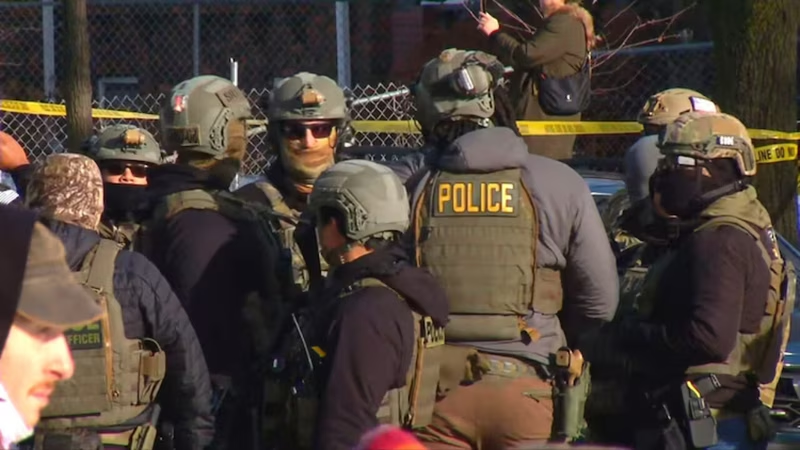
A routine immigration enforcement operation in Minneapolis took a tragic and violent turn, resulting in the death of a woman at the hands of a US Immigration and Customs Enforcement (ICE) officer. The Department of Homeland Security (DHS) has swiftly declared the shooting an act of self-defense, but the incident has ignited a firestorm of questions from the local community, civil rights advocates, and lawmakers demanding transparency .
This event, now widely known as the ICE shooting Minneapolis case, stands at the intersection of federal law enforcement, public safety, and the often-contentious debate surrounding immigration policy in the United States. As details slowly emerge, a complex and deeply troubling picture is beginning to form.
Table of Contents
- The Incident: What Happened in Minneapolis?
- The Official Story: DHS and the Self-Defense Claim
- Who Was the Woman at the Center of the ICE Shooting?
- Public and Political Reaction: Anger and Demands for Answers
- The Broader Context: ICE Enforcement and Community Trust
- The Investigation: What Happens Next?
- Conclusion: A Community Seeks Truth and Justice
- Sources
The Incident: What Happened in Minneapolis?
According to initial reports from DHS, the fatal encounter occurred during a targeted operation by its Enforcement and Removal Operations (ERO) division . ERO officers were attempting to serve a warrant or apprehend a specific individual when the situation escalated dramatically.
While the exact sequence of events is still under investigation, authorities state that the deceased woman was not the primary target of the operation. The circumstances that led to the officer discharging his weapon remain unclear to the public, but DHS maintains that the officer faced an imminent threat to his life or the lives of others, justifying the use of deadly force.
The Official Story: DHS and the Self-Defense Claim
In its official statement, the Department of Homeland Security was unequivocal: the ICE shooting Minneapolis incident was a clear case of an officer acting to protect himself. “The officer’s actions were in self-defense,” a DHS spokesperson said, framing the event as a tragic but necessary outcome of a dangerous law enforcement action .
This immediate declaration of self-defense is a common first step in officer-involved shootings, but it often precedes a more thorough and independent review. Critics argue that such pre-emptive statements can appear to be a rush to judgment that protects the officer before all the facts are known. The agency has confirmed that its Office of Professional Responsibility has launched an internal investigation, which is standard protocol .
Who Was the Woman at the Center of the ICE Shooting?
As of now, the identity of the deceased woman has not been officially released by authorities, a decision that has further frustrated community members and advocacy groups who are calling for immediate transparency. Local news outlets and community organizations are working to identify her and learn more about her background, but official channels have remained silent on this critical detail .
Knowing her identity is crucial to a full public understanding of the event. Was she a bystander? Was she a family member of the target? Did she have a history that might explain the escalation? These are all questions that cannot be properly addressed without this fundamental piece of information.
Public and Political Reaction: Anger and Demands for Answers
The news of a woman being killed by a federal immigration officer in their city has been met with outrage and deep concern in Minneapolis, a community with a long and painful history of police violence. Local activist groups have already begun organizing vigils and protests, demanding a full, independent investigation that is not conducted solely by the agency whose officer was involved.
Several members of Minnesota’s congressional delegation have also issued statements. They are calling on DHS to release all body camera footage (if it exists), the names of the involved officers, and the complete factual report of the incident. They argue that public trust, especially in federal law enforcement, can only be maintained through radical transparency [INTERNAL_LINK:minneapolis-police-reform-history].
The Broader Context: ICE Enforcement and Community Trust
This incident cannot be viewed in isolation. It occurs against a backdrop of intense national debate over the role and tactics of ICE. In many immigrant communities, ICE is viewed not as a law enforcement agency but as a source of fear and family separation. Operations like the one in Minneapolis, especially when they result in a fatality, are seen as validating those fears and further eroding any sense of trust between these communities and federal authorities.
A report from the American Civil Liberties Union (ACLU) has previously documented concerns about ICE’s enforcement practices, including the conduct of raids and the use of force. This latest event is likely to fuel calls for significant reform or even the abolition of the agency, a political flashpoint that shows no signs of cooling down.
The Investigation: What Happens Next?
The path forward is now in the hands of investigators. While DHS’s internal probe is a necessary first step, many are pushing for an external investigation by an impartial body, such as the Minnesota Bureau of Criminal Apprehension (BCA) or a special prosecutor.
Key elements that the investigation must address include:
- Body-worn camera footage: Did the ICE officer have a camera, and what does the footage show?
- Witness testimony: What did bystanders or other individuals present at the scene observe?
- The nature of the threat: What specific actions by the woman led the officer to believe his life was in imminent danger?
- Procedural compliance: Did the officers follow all relevant ICE protocols and use-of-force policies?
The findings of this investigation will be pivotal in determining whether charges will be filed against the officer and in shaping the public’s perception of the event for years to come.
Conclusion: A Community Seeks Truth and Justice
The ICE shooting Minneapolis incident is a stark reminder of the lethal potential of immigration enforcement actions. While the DHS’s claim of self-defense provides an initial, official narrative, it is far from the final word. A grieving community, a concerned public, and vigilant lawmakers are all demanding a full, transparent, and impartial accounting of what transpired. Until those demands are met, the shadow of this tragedy will continue to loom large over Minneapolis and the ongoing national conversation about law enforcement and justice.
Sources
- Times of India: ICE shooting in Minneapolis: Woman killed by officer in ‘self-defense’
- Department of Homeland Security (DHS): Official Website
- American Civil Liberties Union (ACLU): Immigration Enforcement Resources
- Minnesota Bureau of Criminal Apprehension (BCA): Official Website