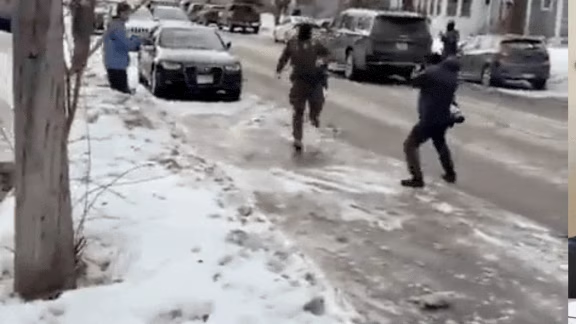
It started as a 10-second clip: an ICE officer in a dark uniform, walking confidently—then suddenly losing his footing on an icy sidewalk, arms flailing, before landing hard on his back. Under normal circumstances, it might’ve been a forgettable blooper. But in today’s climate? It exploded.
The video, now viewed millions of times across social media, has become far more than a moment of physical comedy. It’s a symbol—a meme, a metaphor, and for many, a moment of grim satisfaction—reflecting widespread public disillusionment with U.S. Immigration and Customs Enforcement (ICE) in the wake of the recent fatal shooting of Renee Good in Minnesota .
Table of Contents
- The Incident That Sparked a Firestorm
- Who Was Renee Good? The Tragedy Behind the Anger
- Why a Simple Fall Went Viral
- Public and Political Reactions to ICE
- ICE Under Scrutiny: A Pattern of Controversy
- What Happens Next? Accountability and Reform
- Conclusion: More Than a Meme
- Sources
The Incident That Sparked a Firestorm
Captured on a bystander’s phone in Minneapolis, the video shows an ICE officer slipping during what appears to be a routine patrol or operation. There’s no audio, no confrontation—just a man falling on ice. Yet within hours, the clip was shared with captions like “Karma on ice” and “When your agency has no footing.”
While the fall itself caused no injury, its timing couldn’t be worse. It emerged just days after ICE agents were involved in the controversial killing of Renee Good—an unarmed Black woman whose death has reignited debates about law enforcement conduct, racial bias, and federal overreach .
Who Was Renee Good? The Tragedy Behind the Anger
Renee Good, a 42-year-old mother and community advocate, was fatally shot during an early-morning raid at her home in St. Paul, Minnesota. According to initial reports, ICE agents were executing a search warrant related to a deportation case—but no one in the household was the target .
Witnesses say Good approached the door to ask questions when gunfire erupted. She was struck multiple times and died at the scene. The incident has drawn comparisons to other high-profile cases of mistaken identity and excessive force, prompting protests and calls for an independent investigation.
As of January 2026, the Department of Homeland Security has launched a review, but activists argue that internal probes are insufficient without structural reform [INTERNAL_LINK:ice-accountability-reforms].
Why a Simple Fall Went Viral
In isolation, the slip is trivial. But context is everything. Online, users didn’t just laugh—they projected their frustration onto the moment:
- “They can’t even walk straight, but they can shoot innocent people?”
- “This is the competence level of the agency we’re supposed to trust?”
- “Fell on ice… but never falls on accountability.”
Social media platforms like X (formerly Twitter) and TikTok amplified the clip with satirical edits, turning the ICE officer into an unwitting avatar of institutional fragility. The humor masks a deeper truth: a growing segment of the American public sees ICE not as a protective force, but as a source of fear and instability.
Public and Political Reactions to ICE
The backlash isn’t limited to online chatter. Prominent lawmakers have seized on the moment. Senator Bernie Sanders called the Good shooting “unacceptable” and demanded ICE be defunded . Meanwhile, progressive groups like Mijente and United We Dream have organized rallies in over 20 cities, linking the Minnesota tragedy to broader immigration policy failures.
Even traditionally moderate voices are shifting. A recent Pew Research poll shows that 58% of Americans now believe ICE needs “major reforms”—up from 41% in 2022 .
ICE Under Scrutiny: A Pattern of Controversy
This isn’t the first time ICE has faced intense criticism. From family separations at the border to workplace raids targeting vulnerable communities, the agency has long been a flashpoint in America’s immigration debate.
Key controversies include:
- 2018 Family Separation Policy: Over 5,000 children separated from parents under “zero tolerance.”
- Detention Center Conditions: Multiple reports of overcrowding, poor medical care, and deaths in custody.
- Lack of Transparency: ICE rarely releases bodycam footage or detailed operational data.
The Renee Good case—and the viral fall that followed—has crystallized these concerns into a single, shareable narrative: an agency perceived as both dangerous and incompetent.
What Happens Next? Accountability and Reform
Pressure is mounting for concrete action. Advocates are pushing for:
- Independent civilian oversight of ICE operations
- Mandatory de-escalation training for all agents
- Stricter rules on the use of lethal force during raids
- Greater transparency in warrant execution and targeting
Whether these demands gain traction in an election year remains uncertain. But one thing is clear: the public’s patience is wearing thin.
Conclusion: More Than a Meme
That ICE officer slipping on ice will likely get up, dust himself off, and return to work. But the viral moment he unwittingly created won’t be so easily dismissed. It’s a cultural Rorschach test—revealing deep fractures in how Americans view federal power, safety, and justice. In a nation increasingly divided, sometimes the smallest stumble speaks the loudest.
Sources
- Times of India: ICE slipping on ice: Video shows officer slip-and-fall amid heightened scrutiny
- Associated Press: ICE Agent Shoots Unarmed Woman in Minnesota Raid
- Pew Research Center: Public Opinion on U.S. Immigration Policy – Pew Research
- ACLU: ICE and Border Patrol Abuses – ACLU