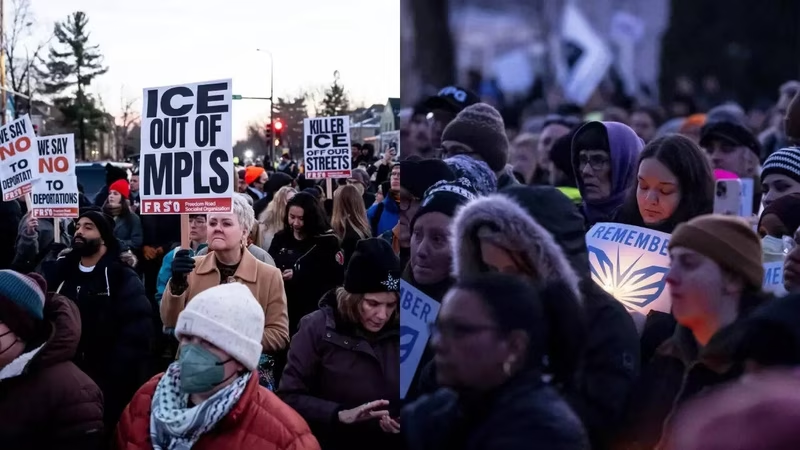
Minneapolis is reeling after a routine immigration operation turned deadly—and then explosive. In a chilling escalation that has reignited nationwide debates over federal power and immigrant rights, **an ICE officer fatally shot a woman** during a predawn raid, triggering immediate protests, violent clashes with law enforcement, and urgent calls for federal agents to leave the state entirely.
The phrase “**ICE kills woman**” is now echoing from city council chambers to social media feeds across America. But what really happened in that quiet Minneapolis neighborhood? And why has this incident struck such a raw nerve in a city still healing from past trauma?
Table of Contents
- What Happened During the ICE Raid?
- Conflicting Narratives: Officials vs. Eyewitnesses
- Protests Erupt, Federal Agents Clash with Crowds
- State Leaders Demand ICE Withdrawal
- Homeland Security’s Defiant Stance
- Why This Incident Matters Nationally
- Conclusion: A City—and a Country—at a Crossroads
- Sources
ICE Kills Woman: The Fatal Minneapolis Raid
According to U.S. Immigration and Customs Enforcement (ICE), agents were executing a targeted arrest warrant at a residential address in South Minneapolis early on January 7, 2026. The operation was part of a broader crackdown on individuals with final deportation orders .
But within minutes, chaos erupted. Witnesses report that as agents approached the home, a woman—later identified as 34-year-old Maria Lopez, a mother of two and longtime Minnesota resident—stepped onto the porch to ask what was happening. Seconds later, she was shot .
ICE claims the officer fired after perceiving an “immediate threat,” though no weapon was recovered from the scene. Local police and emergency responders arrived to find Lopez unresponsive; she was pronounced dead at Hennepin County Medical Center.
Conflicting Narratives: Officials vs. Eyewitnesses
The official ICE statement describes a “volatile situation” requiring use of force. Yet neighbors tell a starkly different story.
“She had her hands up,” said Jamal Carter, who lives across the street. “She just asked, ‘Who are you?’ Then—boom. No warning.” Another witness described hearing children screaming from inside the house immediately after the shot .
Adding to the confusion, local police initially stated they were not involved in the raid—a standard practice in so-called “sanctuary” jurisdictions like Minneapolis, which limits cooperation with federal immigration authorities [INTERNAL_LINK:minneapolis-sanctuary-city-policy]. This lack of coordination has raised serious questions about operational transparency and civilian safety.
Protests Erupt, Federal Agents Clash with Crowds
By midday, hundreds had gathered outside the ICE field office in downtown Minneapolis. Chants of “No justice, no peace!” and “ICE out of Minnesota!” filled the air. The demonstration remained peaceful for hours—until federal agents in tactical gear emerged, leading to a tense standoff.
According to the Minnesota State Patrol, three protesters were arrested after allegedly throwing bottles and attempting to breach a security cordon . Video footage shows officers using pepper spray and batons to disperse the crowd, further inflaming public anger.
Community organizers have since called for independent oversight of all future ICE operations in the state, citing fears of militarized enforcement in residential neighborhoods.
State Leaders Demand ICE Withdrawal
Minnesota Governor Tim Walz did not mince words. In a press conference on January 8, he declared: “Federal immigration agents are no longer welcome in Minnesota until a full, transparent investigation is completed.” He accused ICE of operating with “reckless disregard for human life” and vowed to explore all legal avenues to restrict their presence .
Minneapolis Mayor Jacob Frey echoed the sentiment, stating the city would “not be complicit in operations that terrorize our communities.” Both leaders emphasized that Lopez had no criminal record and was actively pursuing legal residency through pending family-based petitions.
Homeland Security’s Defiant Stance
Despite mounting pressure, the Department of Homeland Security (DHS) stood firm. In a terse statement, DHS spokesperson Marisa Rodriguez asserted: “ICE agents will continue to carry out their lawful duties in Minnesota and across the United States.” She added that the shooting is under internal review but defended the agency’s right to enforce federal immigration law anywhere in the country .
This hardline position has deepened the rift between federal authorities and progressive state governments—a tension that has defined U.S. immigration policy for over a decade.
Why This Incident Matters Nationally
This isn’t just a Minneapolis story. It’s a flashpoint in a much larger national crisis:
- Erosion of Trust: Communities are less likely to cooperate with any law enforcement if federal raids feel unpredictable or violent.
- Sanctuary Policies Under Threat: Cities like Minneapolis may face federal funding cuts or legal challenges for limiting ICE access.
- 2026 Election Implications: Immigration enforcement is already a top-tier issue in the upcoming presidential race.
As the ACLU notes, “When immigration enforcement turns deadly in someone’s front yard, it doesn’t just affect one family—it shatters the sense of safety for entire communities.”
Conclusion: A City—and a Country—at a Crossroads
The death of Maria Lopez has done more than spark protests—it has exposed the fragile fault lines between federal authority, local autonomy, and human rights. As investigations proceed and political battles intensify, one thing is clear: the phrase **“ICE kills woman”** will become a rallying cry for reform advocates and a cautionary tale for policymakers.
For Minneapolis, healing won’t come from silence—but from accountability, transparency, and a commitment to ensuring that no family lives in fear of a knock on the door turning fatal.