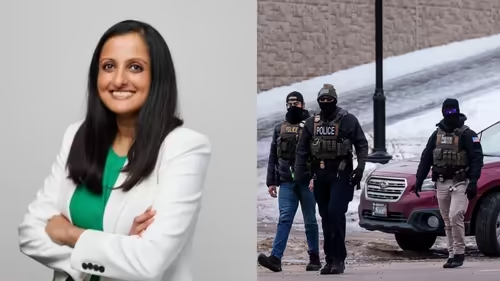
It was supposed to be a routine shopping trip. Instead, it turned into a terrifying ordeal that left a 70-year-old Indian-American woman shaken—and her daughter, a respected physician, demanding answers. In a powerful and deeply personal account, Dr. Anjali Rao (name changed for privacy) revealed how U.S. Immigration and Customs Enforcement (ICE) agents confronted her elderly mother in a Texas mall, interrogating her about her citizenship status simply because she “has an accent.” The incident, which occurred in early January 2026, has reignited national concerns about racial profiling, xenophobia, and the overreach of federal immigration enforcement in public spaces.
Table of Contents
- The Mall Encounter: What Happened?
- ICE Harassment of Indian Americans: A Pattern of Profiling?
- Why Accents Become Targets in America
- Your Legal Rights During ICE Encounters
- Community Response and Advocacy
- Conclusion: A Call for Accountability
- Sources
The Mall Encounter: What Happened?
According to Dr. Rao, her mother—a naturalized U.S. citizen for over two decades—was browsing a department store in a suburban Dallas-area mall when two men in plainclothes approached her. They identified themselves as ICE agents and began questioning her aggressively: “Where are you from? Are you here legally? Do you speak Spanish?”
Confused and frightened, the elderly woman explained she was from India, not a Spanish-speaking country, and produced her U.S. passport when asked. The agents reportedly grew defensive, muttered apologies, and walked away without further explanation or documentation .
“They assumed she was undocumented because she had an accent,” Dr. Rao told reporters. “She’s 70 years old. She’s a grandmother. She pays taxes. And yet, she was treated like a criminal in broad daylight—just because of how she sounds.”
ICE Harassment of Indian Americans: A Pattern of Profiling?
While this case may seem isolated, advocates say it reflects a broader trend of ICE harassment of Indian Americans and other South Asian, Middle Eastern, and Latino communities. Despite being one of the fastest-growing and most educated immigrant groups in the U.S., Indian Americans have increasingly reported being stopped, questioned, or detained based on appearance or accent—especially in states like Texas, Arizona, and Georgia.
The American Civil Liberties Union (ACLU) has documented dozens of similar incidents where ICE agents conduct warrantless stops in public places, often relying on linguistic or phenotypic bias rather than credible evidence of immigration violations .
What makes this case particularly alarming is the victim’s age and citizenship status. “Targeting elderly citizens sends a message: no one is safe if you ‘sound foreign,’” said Priya Nair, legal director at the South Asian Americans Leading Together (SAALT) organization .
Why Accents Become Targets in America
Accents are often misread as markers of illegality—a dangerous misconception rooted in xenophobia and linguistic discrimination. Studies from sociolinguists at the University of California show that non-native English speakers, particularly those with South Asian or African accents, are more likely to be perceived as “less American” or “less trustworthy,” even when they are citizens .
This bias is amplified in high-immigration states like Texas, where federal agencies operate with wide discretion. ICE’s own guidelines prohibit pretextual stops based solely on race, ethnicity, or language—but enforcement of these rules remains inconsistent.
As Dr. Rao put it: “My mother speaks English with an Indian accent. That doesn’t make her any less American than someone from Boston or Atlanta. But to these agents, it was enough to justify harassment.”
Your Legal Rights During ICE Encounters
If you or a loved one are approached by ICE in a public space, know your rights:
- You are not required to answer questions about your immigration status, birthplace, or citizenship.
- You have the right to remain silent and ask if you are free to leave.
- Do not consent to searches of your person, bags, or phone without a warrant.
- Record the encounter safely if possible—video can be crucial evidence.
- Contact an immigration attorney immediately or call the ACLU hotline at 1-888-533-2722.
Organizations like [INTERNAL_LINK:immigrant-rights-resources] offer free toolkits and multilingual guides for navigating such situations.
Community Response and Advocacy
Since Dr. Rao shared her mother’s story on social media, it has been viewed over 2 million times, sparking outrage and solidarity across immigrant communities. Local chapters of the Indian American Muslim Council (IAMC) and the Hindu American Foundation (HAF) have called for a formal investigation into the agents’ conduct.
Meanwhile, Texas State Representative Jasmine Patel has announced plans to introduce a bill requiring ICE to report all public encounters involving U.S. citizens—a move aimed at increasing transparency and deterring abuse.
“This isn’t just about one woman,” Patel said in a press statement. “It’s about protecting the dignity of every naturalized citizen who calls America home.”
Conclusion: A Call for Accountability
The incident in Texas is more than a personal injustice—it’s a symptom of a system that too often equates foreignness with suspicion. For Indian Americans and other immigrant communities, stories like Dr. Rao’s mother’s are a painful reminder that citizenship alone doesn’t guarantee safety from state scrutiny.
As public pressure mounts, the Department of Homeland Security has acknowledged the complaint but has not yet launched a formal inquiry. Until then, advocates urge vigilance, documentation, and collective action. Because in a nation built by immigrants, no one should be made to feel like a stranger in their own country—especially not a 70-year-old grandmother shopping for socks.