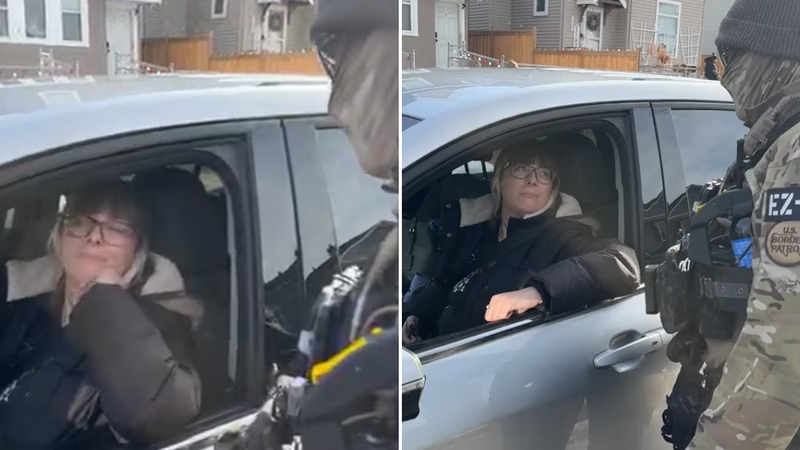
In a city still reeling from tragedy, a tense new confrontation has thrust U.S. Immigration and Customs Enforcement (ICE) back into the national spotlight. Just days after the fatal shooting of protester **Renee Nicole Good**, a viral video captured an **ICE agent Minneapolis** encounter that has sparked widespread alarm and renewed calls for transparency .
The footage, recorded by bystanders, shows a group of women seated in a parked car near an ICE facility, reportedly taunting federal agents. In response, an armed ICE officer approaches the vehicle, points his weapon, and delivers a stark ultimatum: “Don’t make a bad decision.” The woman in the passenger seat defiantly replies, “You already made a bad decision,” referencing Good’s death. The exchange, lasting less than a minute, encapsulates the deep mistrust and volatility surrounding federal immigration enforcement in America today.
Table of Contents
- The Backdrop: The Killing of Renee Nicole Good
- The Viral Confrontation: What the Video Shows
- ICE agent Minneapolis: Official Statements vs. Public Outcry
- Legal and Ethical Implications of Pointing Firearms at Civilians
- Broader Context: ICE’s Role and Controversies in Urban Policing
- Conclusion
- Sources
The Backdrop: The Killing of Renee Nicole Good
On January 3, 2026, during a protest outside an ICE detention center in Minneapolis, 34-year-old Renee Nicole Good was shot and killed by a federal agent . According to ICE, Good allegedly attempted to breach a secure perimeter and ignored repeated commands to stop. However, local witnesses and protest organizers claim she was peacefully demonstrating and posed no threat .
The Hennepin County Sheriff’s Office launched an independent investigation, but as of January 10, no bodycam footage has been released, and the agent involved remains unidentified. This lack of transparency has fueled community anger and suspicion, setting the stage for the subsequent confrontation.
The Viral Confrontation: What the Video Shows
The newly circulated video, verified by multiple news outlets, depicts a scene of high tension:
- Two women are seated in a sedan, windows down, shouting slogans like “ICE kills!”
- Several uniformed ICE agents approach the vehicle, one drawing his sidearm.
- The lead agent, standing just feet from the car, states: “Don’t make a bad decision.”
- The passenger responds: “You already made a bad decision when you killed that woman.”
- After a brief standoff, the agents retreat without making an arrest.
While no shots were fired, the act of pointing a firearm at unarmed civilians—even in a perceived protest scenario—has drawn sharp criticism from civil rights groups and legal experts [INTERNAL_LINK:use-of-force-policies-us-law-enforcement].
ICE agent Minneapolis: Official Statements vs. Public Outcry
ICE defended its agents’ actions, stating they were “responding to aggressive and potentially threatening behavior” and operating under standard protocols for crowd control and officer safety . A spokesperson emphasized that agents are trained to “assess threats in real-time” and that displaying a weapon is a “de-escalation tactic” in certain contexts.
However, this explanation has done little to quell public outrage. Minnesota Attorney General Keith Ellison called the incident “deeply concerning” and demanded a full review of ICE’s engagement policies in civilian spaces. Community leaders argue that such displays of force only escalate fear and erode trust, particularly in neighborhoods already traumatized by Good’s death.
Legal and Ethical Implications of Pointing Firearms at Civilians
Legally, the threshold for brandishing a firearm varies by jurisdiction, but most U.S. courts agree it constitutes a “seizure” under the Fourth Amendment if a reasonable person would feel they are not free to leave . Pointing a gun at someone who is not actively threatening lethal harm can be deemed excessive force.
Ethically, the incident raises questions about the militarization of immigration enforcement. Critics argue that ICE, originally designed for administrative functions, is increasingly operating like a paramilitary police force—especially in urban protest settings where de-escalation should be prioritized over intimidation.
Broader Context: ICE’s Role and Controversies in Urban Policing
This Minneapolis episode is not isolated. Over the past decade, ICE has faced mounting scrutiny for its tactics during raids, protests, and routine operations:
- In 2023, an ICE raid in New York led to the wrongful detention of a U.S. citizen.
- During the 2020 George Floyd protests, ICE deployed agents to cities without local consent, drawing bipartisan criticism.
- Multiple watchdog reports have cited inadequate training in de-escalation and cultural sensitivity .
The agency’s expanding role beyond border enforcement into domestic surveillance and crowd control has alarmed civil liberties advocates, who warn of a slippery slope toward normalized state violence against marginalized communities.
Conclusion
The confrontation between an ICE agent Minneapolis and local women is more than a viral moment—it’s a symptom of a deeper crisis in federal law enforcement accountability. Coming on the heels of Renee Nicole Good’s unresolved killing, it underscores an urgent need for clear rules of engagement, independent oversight, and meaningful community dialogue. As protests continue and investigations stall, one thing is clear: without transparency and reform, such volatile standoffs will keep repeating.