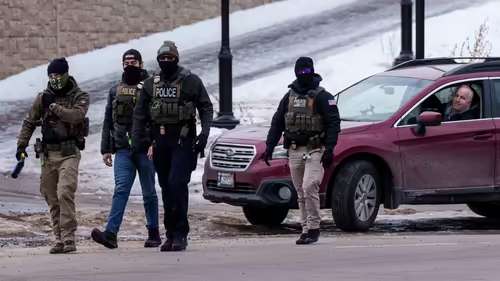
A chilling encounter captured on video has sent shockwaves across the nation, laying bare the raw nerves of a long-simmering debate: can the way you speak be enough to get you detained by federal agents? In a now-viral clip, an Immigration and Customs Enforcement (ICE) officer is heard telling a man he’s being stopped specifically “because of his accent.” What unfolds next is a tense, chaotic scene that has millions questioning the line between law enforcement and discrimination .
Table of Contents
- The Viral Incident: What Happened?
- Public Outcry and Accusations of Racial Profiling
- ICE Policies and the History of Profiling
- Your Legal Rights During an ICE Encounter
- Conclusion: A Nation on Edge
- Sources
The Viral Incident: What Happened?
The footage, which appears to have been recorded in Minnesota, shows a group of at least four ICE agents confronting a young man . The situation escalates rapidly when the lead agent, when pressed for a reason for the stop, bluntly states it’s due to the man’s accent . This single statement transformed a routine (though aggressive) law enforcement action into a potential case study in discriminatory policing.
The man, visibly confused and frustrated, challenges the agent’s reasoning, arguing that an accent is not probable cause for detention. His resistance quickly leads to a physical scuffle as agents move to apprehend him . The video’s raw, unfiltered nature has made it a powerful piece of evidence for critics who argue that immigration enforcement often targets individuals based on their appearance or speech rather than concrete legal violations.
Public Outcry and Accusations of Racial Profiling
The internet’s reaction was swift and furious. Social media platforms were flooded with accusations of racial profiling by ICE, with many users calling the incident “state-sponsored ethnic profiling” . The core of the outrage lies in the agent’s own words—he provided the justification himself, linking a linguistic trait directly to suspected undocumented status.
This case is not isolated. Reports of U.S. citizens being racially profiled by immigration agents, particularly those of Hispanic descent, have been documented in cities like Chicago . Critics argue that such practices create a climate of fear within immigrant communities, where simply speaking with an accent can make one a target. As one analysis put it, these sweeps are a “classic” example of racial profiling, undermining trust in law enforcement and civil institutions .
ICE Policies and the History of Profiling
While the Department of Homeland Security (DHS) has publicly denied allegations of systemic racial profiling by its officers , internal policies and historical context tell a more complex story. Official Standard Operating Procedures for programs like Secure Communities explicitly prohibit the use of systems “for the purposes of racial and/or ethnic profiling” . However, academic research and watchdog groups have long argued that the practical application of these policies often falls short, with process violations and profiling being common critiques of ICE’s 287(g) programs .
The history of U.S. immigration policy is fraught with examples of exclusion based on nationality and ethnicity. Today’s controversies, where an ICE agent accent becomes the basis for suspicion, echo these past injustices and raise serious questions about the equitable application of the law .
Your Legal Rights During an ICE Encounter
In the wake of this viral video, many are asking: what are my rights if I’m stopped by ICE? Understanding these rights is crucial for everyone, regardless of immigration status.
Know Your Rights: A Quick Guide
- You have the right to remain silent. You do not have to answer questions about your immigration status or where you were born .
- You have the right to ask for identification. Always ask to see the officer’s badge and credentials .
- If you have valid immigration documents, you must show them if asked. However, if you do not have them, you should not lie or present false documents, as this can lead to criminal charges [[19], [24]].
- You have the right to speak to an attorney. Do not sign any documents without consulting a lawyer first [[18], [22]].
- Do not physically resist. Even if you believe the stop is unjust, physically resisting can escalate the situation and lead to additional charges. Document the encounter as best you can afterward .
For more detailed guidance on navigating these stressful situations, resources from organizations like the American Civil Liberties Union (ACLU) provide invaluable support [[INTERNAL_LINK:know-your-immigration-rights]].
Conclusion: A Nation on Edge
The viral video of an ICE agent accent-based detention is more than just a disturbing clip; it’s a flashpoint in America’s ongoing struggle with identity, security, and civil liberties. It forces a critical question: in a nation of immigrants, when does vigilance cross the line into prejudice? While ICE maintains its mission is to enforce the law, incidents like this erode public trust and highlight the urgent need for clear, unbiased, and humane enforcement protocols. Until then, videos like this will continue to fuel a national conversation that is as necessary as it is painful.
Sources
- Times of India: Racial profiling: ICE agent demands man’s documents ‘because of his accent’ in viral video
- Legal Aid Society: Your Rights with ICE
- American Civil Liberties Union (ACLU): Know Your Rights: If ICE Stops You in Public
- DHS Official Statements on ICE Practices