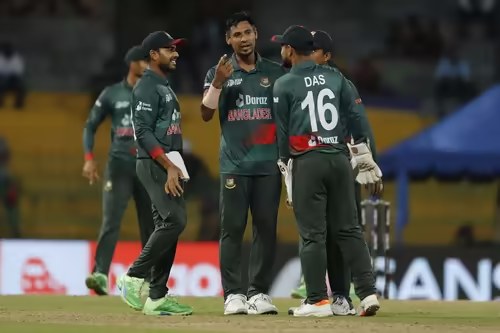
Cricket is often called a religion, but its global tournaments are far from immune to the messy realities of geopolitics and security fears. The dream of a truly unified world championship has been repeatedly shattered by the stark words: ‘We’re not going.’ These ICC tournament withdrawals aren’t just logistical headaches; they are seismic events that alter the course of the game, rewrite records, and leave lasting scars on the spirit of competition. As the latest potential refusal—India’s stance on touring Pakistan for the 2025 Champions Trophy—hangs in the balance, it’s crucial to look back at the turbulent history that got us here.
Table of Contents
- The 1996 World Cup: The First Major Fracture
- The 2003 Debacle: Security Fears and a Tainted Tournament
- Zimbabwe 2009 and Australia 2016: Later Chapters in a Recurring Story
- The Shadow Over 2025: India, Pakistan, and the Champions Trophy
- Why ICC Tournament Withdrawals Matter Beyond the Scoreboard
- Conclusion: Can Cricket Ever Be Truly Global?
- Sources
The 1996 World Cup: The First Major Fracture
The 1996 Cricket World Cup, co-hosted by India, Pakistan, and Sri Lanka, was meant to be a celebration of the sport’s growing global appeal. Instead, it became infamous for the first major instance of ICC tournament withdrawals. Just weeks before their scheduled matches in Colombo, both Australia and the West Indies refused to travel to Sri Lanka, citing security concerns following a devastating bomb blast in the capital .
Their decision was unilateral and against the advice of the ICC, which had deemed the conditions safe. The result? Sri Lanka was awarded two walkover victories, a massive boost that propelled them through the group stage with minimal resistance. Many historians and fans argue that this unexpected advantage was a critical factor in Sri Lanka’s eventual, historic World Cup triumph. It was a stark lesson: a team’s absence can be as impactful as its presence.
The 2003 Debacle: Security Fears and a Tainted Tournament
Seven years later, history repeated itself in an even more dramatic fashion. The 2003 World Cup was set to be hosted in Zimbabwe, but the country was embroiled in a severe political and economic crisis. Citing credible threats to player safety, England and New Zealand made the difficult decision to forfeit their matches in Harare .
This wasn’t just about two teams skipping a couple of games. Their withdrawal created a massive scheduling and competitive imbalance. The ICC’s handling of the situation was widely criticized, and the tournament’s integrity was permanently stained. The incident highlighted a fundamental flaw in the global structure: the ICC’s limited power to enforce participation or guarantee security in politically volatile host nations.
Zimbabwe 2009 and Australia 2016: Later Chapters in a Recurring Story
The pattern continued. In 2009, during an ODI tri-series in Zimbabwe, the Australian team cut short its tour and left the country after a security scare involving one of its players, adding another chapter to the long list of cricket’s security-related disruptions .
More recently, in 2016, Australia again cited security concerns as the reason for refusing to send its team to Pakistan for a series of T20 matches. While not a full ICC event, this refusal was a clear signal that the underlying issues of trust and safety in certain regions had not been resolved. These incidents, though smaller in scale, kept the conversation alive and demonstrated that the problem was systemic, not isolated to World Cups alone.
The Shadow Over 2025: India, Pakistan, and the Champions Trophy
Now, the cricketing world faces its most significant standoff in decades. The 2025 ICC Champions Trophy is scheduled to be held in Pakistan. However, India, citing long-standing political tensions and security protocols, has made it clear that its team will not travel to its arch-rival for the tournament . This isn’t just another team pulling out; it’s the sport’s biggest market and one of its top teams refusing to participate in a marquee event.
The potential fallout is enormous. A Champions Trophy without India would be a commercial disaster for the ICC and a massive blow to the tournament’s prestige. It forces the ICC into an impossible position: uphold the hosting rights of a full member or risk the financial and competitive viability of its own event. This situation is the ultimate test of whether cricket’s governing body can navigate the treacherous waters of international politics. [INTERNAL_LINK:india-pakistan-cricket-diplomacy] explores the deep historical ties between the two nations’ rivalry and diplomacy.
Why ICC Tournament Withdrawals Matter Beyond the Scoreboard
These withdrawals are never just about the matches lost. They have profound ripple effects:
- Competitive Integrity: As seen in 1996, walkovers can unfairly advantage other teams, distorting the true meritocracy of the sport.
- Financial Losses: Broadcasters, sponsors, and local economies suffer massive losses when major teams pull out, especially a market giant like India.
- Erosion of Trust: Repeated withdrawals undermine the authority of the ICC and create a precedent where powerful boards can dictate terms based on their own agendas.
- Player Impact: Athletes are denied the chance to compete on the biggest stages, which can affect their careers and legacies.
Conclusion: Can Cricket Ever Be Truly Global?
The history of ICC tournament withdrawals is a sobering reminder that cricket, for all its global fanfare, remains deeply entangled with the world’s geopolitical fault lines. Until the ICC can establish a more robust, neutral, and enforceable framework for security and hosting—one that balances the rights of host nations with the legitimate concerns of participating teams—the specter of last-minute refusals will continue to haunt its flagship events. The 2025 Champions Trophy may well be the moment of truth for the future of a genuinely unified world game.
Sources
- Times of India: When teams said no: A look at ICC tournaments hit by refusals and withdrawals
- ESPNcricinfo Archives: Coverage of the 1996 and 2003 World Cups.
- International Cricket Council (ICC): ICC History and Regulations
- Various reputable news reports on India’s stance regarding the 2025 Champions Trophy (2024-2025).