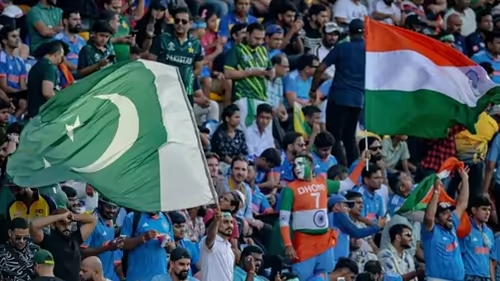
The cricketing world is reeling from a seismic political earthquake. In a move that has sent shockwaves through the International Cricket Council (ICC), the Government of Pakistan has officially mandated that its national team will boycott its scheduled T20 World Cup 2026 match against India on February 15th [[1]]. This isn’t just a missed game; it’s a direct challenge to the very foundation of international sport.
The ICC, the sport’s global governing body, has reacted with unprecedented concern, framing Pakistan’s selective participation as a dangerous precedent that could unravel the fabric of future tournaments. For fans who have waited years for this marquee clash, the disappointment is palpable. But the stakes are far higher than a single match.
Table of Contents
- The ICC’s Official Statement: A Warning Shot
- Why Did Pakistan Boycott the India Match?
- ICC Regulations and the Looming Consequences
- The Broader Impact on Global Cricket
- Summary: A Defining Moment for the Sport
- Sources
The ICC’s Official Statement: A Warning Shot
The ICC did not mince words in its official response. It stated that its tournaments are “built on sporting integrity, competitiveness, consistency and fairness, and selective participation undermines the spirit of a global competition” [[19]]. This is a clear and direct rebuke of Pakistan’s decision.
While the ICC acknowledged the complex role governments can play, it stressed that such political interference directly harms the sport and, crucially, the fans—including millions in Pakistan who were eagerly awaiting the contest [[9]]. The council is now in a difficult position, balancing respect for sovereign decisions against its duty to protect the integrity of its flagship event.
Why Did Pakistan Boycott the India Match?
The decision appears to be rooted in a chain reaction of geopolitical tensions within the tournament itself. The crisis began when Bangladesh, citing security concerns, requested that the ICC move its matches out of India. When the ICC denied this request, Bangladesh subsequently withdrew from the entire T20 World Cup 2026 [[17]].
In a show of solidarity with Bangladesh and amidst its own longstanding political friction with India, the Pakistani government stepped in. It declared that while the Pakistan team would participate in the rest of the tournament, they would not take the field for the specific match against India [[8]]. This makes their participation “selective,” a concept the ICC finds fundamentally incompatible with a world cup format.
Pakistan boycott T20 World Cup: What Are the Rules and Penalties?
So, what happens next? The ICC’s playing conditions are clear on this matter. If a team refuses to play a scheduled match, they are deemed to have forfeited it. This means:
- India will be awarded a win by default.
- Pakistan will receive zero points from the match.
- Pakistan’s net run rate will be severely penalized, likely eliminating them from contention for the knockout stages [[5]].
However, the more significant threat is long-term. The ICC has explicitly warned the Pakistan Cricket Board (PCB) to consider the “long-term implications for cricket in its own country” [[7]]. This could translate into future sanctions, including potential exclusion from hosting rights or even participation in future ICC events if such government interference becomes a pattern. The ICC’s authority hinges on all members adhering to the agreed-upon rules, and a state-mandated boycott directly challenges that authority.
A Legal Grey Area?
Some argue there’s a grey area, pointing to ICC regulations that prevent the council from penalizing a board if its government prevents a team from touring a specific country for political reasons [[26]]. However, this situation is distinct. This is not about a bilateral series but a pre-agreed, multi-nation global tournament where all participants commit to playing every scheduled match as a condition of entry. By choosing to enter the tournament but then refusing one fixture, Pakistan may have exposed itself to penalties that a simple refusal to tour might not incur.
The Broader Impact on Global Cricket
The ramifications of this standoff extend far beyond the points table.
First, it sets a dangerous precedent. If one nation can pick and choose its opponents in a World Cup based on political whims, what stops others from doing the same in the future? This could lead to a fragmented, politicized version of international cricket, which is the antithesis of what a global tournament should represent.
Second, it deeply disappoints a massive global fanbase. The India-Pakistan rivalry is arguably the biggest in cricket, generating unparalleled viewership and passion. Denying fans this spectacle, especially in a World Cup setting, is a significant blow to the sport’s commercial and emotional appeal.
Finally, it puts immense pressure on the PCB, which is caught between its government and its international governing body. This internal conflict could destabilize cricket administration in Pakistan for years to come. For more on the history of India-Pakistan cricket diplomacy, see our deep dive on [INTERNAL_LINK:india-pakistan-cricket-history].
Summary: A Defining Moment for the Sport
The Pakistan boycott T20 World Cup match against India is far more than a scheduling conflict. It is a critical test of the ICC’s authority and the principle that sport should, at its highest level, transcend politics. While Pakistan will likely face immediate sporting penalties like a forfeit and a damaged net run rate, the long-term consequences for the unity and integrity of international cricket are the true cost of this decision. The ICC’s firm stance is a necessary defense of its core values, but the path forward remains fraught with diplomatic and sporting challenges. The world will be watching to see how this defining crisis is resolved.
Sources
- Al Jazeera. “Pakistan to boycott T20 World Cup match against India on February 15.” https://www.aljazeera.com/sports/2026/2/1/pakistan-to-boycott-t20-world-cup-match-against-india
- ICC. “ICC Statement on ICC Men’s T20 World Cup 2026.” https://www.icc-cricket.com/media-releases/icc-statement-on-icc-men-s-t20-world-cup-2026
- Times of India. “ICC reacts to Pakistan’s decision of boycotting T20 World Cup match vs India.” https://timesofindia.indiatimes.com/sports/cricket/icc-mens-t20-world-cup/icc-reacts-to-pakistans-decision-of-boycotting-t20-world-cup-match-vs-india/articleshow/127846014.cms
- ESPN Cricinfo. “ICC warns PCB of consequences of boycotting India match at T20 World Cup.” https://www.espncricinfo.com/story/icc-warns-pcb-of-consequences-of-boycotting-india-match-at-t20-world-cup-1521957
- NDTV Sports. “Pakistan To Boycott T20 World Cup 2026 Match Against India But Play In Tournament.” https://sports.ndtv.com/t20-world-cup-2026/pakistan-to-boycott-t20-world-cup-2026-match-against-india-but-play-in-tournament-10927083