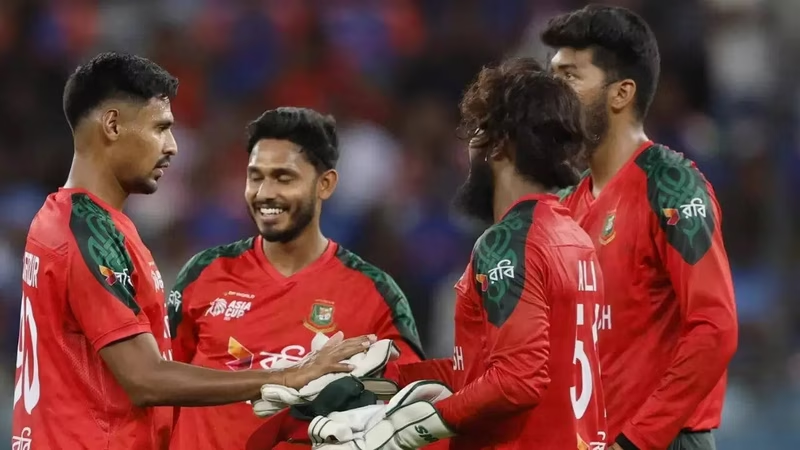
Cricket diplomacy just got messy. In a rare public rebuke, the International Cricket Council (ICC) has slammed Bangladesh’s recent assertion that it formally flagged security risks in India related to player selection and national jersey protocols ahead of the T20 World Cup. Calling the claim a “complete lie,” the ICC has thrown cold water on what many feared could escalate into a full-blown political and sporting crisis—especially with star pacer Mustafizur Rahman reportedly at the center of the controversy.
The drama unfolded after Bangladesh’s Sports Advisor, Mahbubul Anam, stated that the ICC had acknowledged “security vulnerabilities” for Bangladeshi players in India, citing concerns about who gets selected and whether wearing the national jersey could pose threats. The implication? That certain players—possibly those critical of India or vocal on social media—might be targeted. But the ICC’s swift denial has left experts questioning: What’s really going on behind the scenes?
Table of Contents
- What Did Bangladesh Claim?
- ICC India Security Risks: The Official Denial
- Was Mustafizur Rahman the Real Issue?
- Bangladesh’s Request to Move Matches
- Geopolitical Tensions and Cricket
- What This Means for the T20 World Cup
- Summary
- Sources
What Did Bangladesh Claim?
According to Bangladesh’s Sports Advisor Mahbubul Anam, during pre-tournament discussions, the ICC allegedly conveyed that “player selection and wearing the national jersey in India could present security challenges.” He suggested that the global body had validated Dhaka’s internal concerns—prompting Bangladesh to formally request that its T20 World Cup matches be relocated from India to Sri Lanka.
This claim sent shockwaves through the cricketing world. If true, it would mark one of the most serious security escalations in recent ICC history—especially since India is hosting the tournament jointly with other nations and has invested heavily in fan engagement and infrastructure.
ICC India Security Risks: The Official Denial
The ICC didn’t mince words. In a strongly worded statement, it declared: “These claims are a complete lie. At no point has the ICC communicated to Bangladesh—or any other member—that player selection or the wearing of national team kits poses a security risk in India.”
Crucially, the ICC emphasized that while all host nations undergo standard security assessments by independent experts, **no formal communication** has ever linked individual player choices to safety threats in India. The body reaffirmed its full confidence in India’s ability to host a safe and secure tournament.
This isn’t just bureaucratic pushback—it’s a direct challenge to Bangladesh’s narrative. And it raises serious questions about why Dhaka would make such a claim without documented backing.
Was Mustafizur Rahman the Real Issue?
Rumors have swirled that fast bowler Mustafizur Rahman—a fan favorite known for his lethal cutters—might be the unspoken reason behind Bangladesh’s anxiety. Why?
Mustafizur has played extensively in Indian domestic leagues like the IPL, but he’s also been outspoken on regional issues, including Palestine and minority rights. Some speculate that his social media activity or past comments may have triggered internal concerns within Bangladesh’s cricket board (BCB) about potential backlash or targeting during the World Cup.
However, there’s zero evidence the ICC ever flagged him—or any player—as a security liability. In fact, Mustafizur is expected to be a key part of Bangladesh’s T20 squad, and the BCB has not publicly confirmed his exclusion or any special restrictions.
As one senior ICC insider told reporters off the record: “This smells more like internal politics than real security planning.”
Bangladesh’s Request to Move Matches
Separate from the ICC controversy, Bangladesh did submit a formal request to shift its group-stage matches from India to Sri Lanka—a neutral venue where it has a strong fan base and logistical familiarity.
Reasons cited included:
- Perceived fan hostility in certain Indian venues
- Logistical challenges for support staff and families
- A desire for “neutral ground” amid rising bilateral tensions
But the ICC has so far rejected the request, stating that all teams must play in designated host countries unless there’s a verified, imminent threat—which, according to their assessment, does not exist.
Geopolitical Tensions and Cricket
Let’s not ignore the elephant in the room: India-Bangladesh relations have cooled in recent months over trade disputes, water-sharing disagreements, and diplomatic spats. Cricket often becomes a proxy for these larger frictions.
Recall how Pakistan hasn’t toured India since 2012 due to political tensions—yet both teams still meet in ICC events. Now, Bangladesh appears to be testing similar boundaries, using “security” as a shield for deeper geopolitical discomfort.
But unlike Pakistan, Bangladesh doesn’t have the same historical baggage with India. So this move feels more tactical than necessary—and the ICC seems unwilling to indulge it.
For context on how politics shapes cricket, see our deep dive on [INTERNAL_LINK:how-geopolitics-affects-international-cricket].
What This Means for the T20 World Cup
The fallout could be significant:
- Team Morale: Public infighting may distract Bangladesh’s players ahead of a crucial tournament.
- Fan Sentiment: Indian fans might view Bangladesh’s stance as ungrateful, leading to increased hostility in stadiums.
- ICC Authority: The global body is drawing a hard line to prevent precedent—no country can unilaterally demand venue changes based on unsubstantiated claims.
All eyes will now be on whether Bangladesh fields a full-strength team, including Mustafizur, when they take the field in India. Any last-minute withdrawals could reignite the controversy.
Summary
The ICC’s forceful denial of Bangladesh’s claims about ICC India security risks has exposed a rift rooted more in perception than reality. While Dhaka’s concerns may stem from genuine internal anxieties—possibly involving players like Mustafizur Rahman—the absence of any formal ICC warning undermines their position. As the T20 World Cup approaches, the episode serves as a stark reminder: in modern cricket, every ball bowled is watched not just by fans, but by diplomats, media, and global institutions. For now, the message is clear—play the game, not the politics.
Sources
- Times of India, “’Complete lie’: ICC refutes Dhaka’s claims on India security risks”: https://timesofindia.indiatimes.com/sports/cricket/news/if-mustafizur-rahman-is-in-team-bangladesh-claims-icc-flagged-security-risks-in-india-global-body-calls-it-a-complete-lie/articleshow/126486574.cms
- International Cricket Council (ICC) Official Statement: https://www.icc-cricket.com
- Ministry of External Affairs, India – Sports Diplomacy Guidelines: https://mea.gov.in