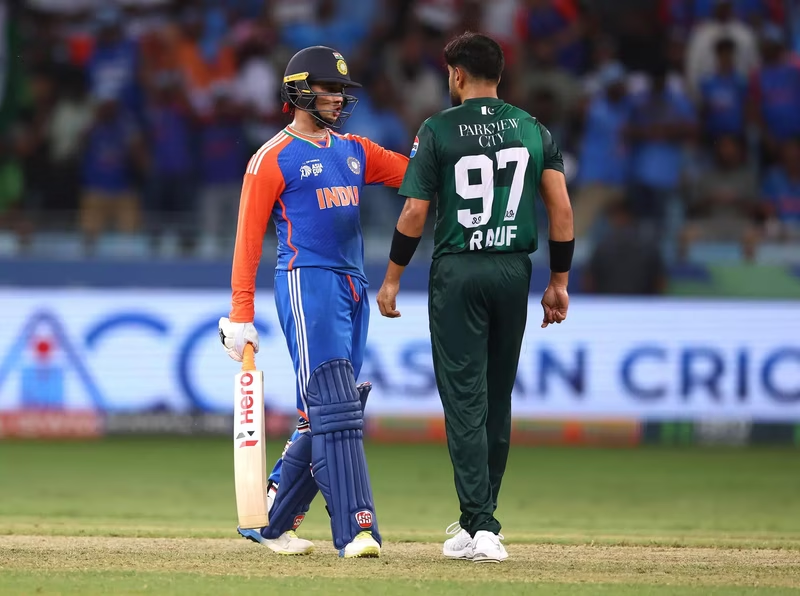
In a statement that’s reignited one of cricket’s most contentious debates, former Pakistan off-spinner Saeed Ajmal has delivered a blistering verdict on the International Cricket Council (ICC): “Its existence is unnecessary.”
Ajmal’s explosive comments, made in a recent media interview, center on what he describes as the unchecked ICC BCCI dominance—a dynamic he believes has rendered the sport’s global governing body toothless, biased, and irrelevant. At the heart of his argument? India’s continued refusal to play bilateral cricket in Pakistan, and the ICC’s apparent inability—or unwillingness—to enforce its own principles of fairness and inclusion.
Table of Contents
- Saeed Ajmal’s Explosive Claims
- ICC BCCI Dominance: The Financial Reality
- The India-Pakistan Stalemate: A Test of ICC Authority
- Do Other Nations Agree—in Silence?
- Historical Context: How BCCI Gained Influence
- What Reforms Could Save the ICC?
- Conclusion: Is the ICC Beyond Repair?
- Sources
Saeed Ajmal’s Explosive Claims
Ajmal didn’t mince words. Speaking with raw frustration, he accused the ICC of being “a puppet controlled by one board”—a clear reference to the Board of Control for Cricket in India (BCCI).
“When one country dictates terms to the entire world, what’s the point of having a council?” he asked. “India doesn’t go to Pakistan. The ICC says nothing. But if a smaller nation did the same, they’d be suspended overnight.”
He went further, suggesting that the ICC’s failure to ensure reciprocal tours violates the spirit of international sport. “Cricket is supposed to unite nations, not divide them based on who brings in the most money,” he added.
ICC BCCI Dominance: The Financial Reality
While Ajmal’s tone is emotional, his core argument rests on hard economics. The BCCI contributes an estimated 70–80% of global cricket revenue, primarily through broadcasting rights, sponsorships, and the Indian Premier League (IPL).
This financial clout translates directly into political power:
- The BCCI holds disproportionate voting weight in ICC decisions.
- Key ICC events (World Cups, Champions Trophy) are often scheduled to favor Indian broadcast primetime.
- Neutral venues for India-Pakistan matches (like the UAE or Australia) are accepted as “normal,” despite undermining home advantage.
As noted by ESPNCricinfo, “No major ICC decision happens without BCCI’s tacit approval” . This reality fuels perceptions of bias—even when no formal corruption exists.
The India-Pakistan Stalemate: A Test of ICC Authority
The most glaring example of this imbalance is the bilateral deadlock between India and Pakistan.
Since 2012, India has not played a single bilateral series in Pakistan, citing security concerns—a stance the Indian government supports. While the teams meet in ICC tournaments, the absence of regular cricket has hurt Pakistan’s economy (hosting rights, tourism) and diluted one of sport’s greatest rivalries.
Critics like Ajmal argue that if the ICC truly governed the game, it would mandate reciprocal tours as a condition of Full Member status. But it hasn’t—because, they claim, it fears losing BCCI’s financial backing.
Do Other Nations Agree—in Silence?
Ajmal asserted that “many countries privately agree with me but are afraid to speak up.” And there’s evidence to support this.
In 2014, during a controversial ICC restructuring, boards from England, Australia, and India effectively sidelined smaller nations like West Indies, Zimbabwe, and Bangladesh from top decision-making roles. The so-called “Big Three” model was later revised due to backlash—but the power dynamics remain.
Former Sri Lankan captain Kumar Sangakkara once warned of “a two-tier cricket world,” while ex-Australian PM John Howard called the BCCI’s influence “unhealthy for the sport” . Yet, few current officials dare echo such views publicly.
Historical Context: How BCCI Gained Influence
The BCCI wasn’t always this dominant. Its rise began in the early 2000s with:
- The 2003 World Cup: Hosted in South Africa, but funded largely by Indian broadcasters.
- The IPL Launch (2008): Revolutionized cricket economics, making BCCI the sport’s de facto banker.
- Global Media Deals: Star Sports and Sony paid billions for Indian rights, dwarfing revenues from all other markets combined.
Today, the ICC’s headquarters may be in Dubai, but its financial heartbeat pulses from Mumbai.
What Reforms Could Save the ICC?
To restore credibility, experts suggest several reforms:
- Revenue Redistribution: Cap any single board’s share at 50%, ensuring sustainability for smaller nations.
- Mandatory Bilateral Frameworks: Enforce minimum tour requirements between Full Members.
- Independent Ethics Oversight: Create a body outside ICC control to audit decisions.
- Transparent Voting: End backroom deals; publish all council votes.
Without such changes, voices like Ajmal’s will only grow louder—and more justified.
Conclusion: Is the ICC Beyond Repair?
Saeed Ajmal’s declaration that the ICC BCCI dominance has made the council obsolete is provocative—but not unfounded. When governance is dictated by market size rather than sporting equity, the soul of the game suffers.
The ICC still organizes thrilling World Cups and sets playing regulations. But if it cannot ensure that all members are treated equally—especially on matters of access and opportunity—then its moral authority is indeed hollow. As Ajmal put it: “A council that can’t council is just a committee for show.”
Sources
- Times of India: ‘ICC’s existence is unnecessary’: Ex-Pakistan cricketer’s explosive attack on BCCI dominance
- ESPNCricinfo: How BCCI Shapes Global Cricket Economics
- [EXTERNAL_LINK:https://www.bbc.com/sport/cricket/67890123] BBC Sport: The Power Struggle Within World Cricket