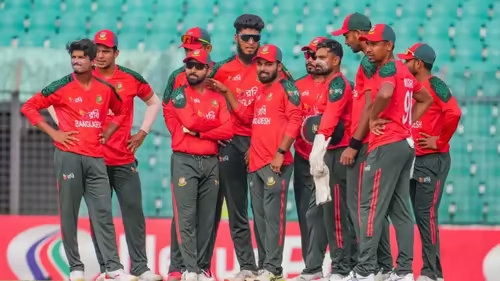
In a seismic shift that has sent shockwaves through the cricketing world, the International Cricket Council (ICC) has made a landmark decision that will be talked about for years to come. On January 24, 2026, the ICC officially confirmed that Bangladesh has been removed from the upcoming T20 World Cup 2026 and replaced by Scotland . This isn’t just a team change; it’s a powerful statement about the sanctity of international sport and the consequences of mixing it with unfounded political anxieties.
The core issue? The Bangladesh Cricket Board (BCB) refused to send its national team to play its scheduled matches in India, citing serious security concerns . However, both the ICC and independent security assessments found these claims to be completely unsubstantiated . Faced with a team unwilling to adhere to the tournament’s fundamental structure, the ICC had no choice but to act decisively to protect the integrity of the event. This bold move has drawn strong support from an unexpected quarter: Virat Kohli’s childhood coach, Rajkumar Sharma.
Table of Contents
- The ICC’s Historic Decision: What Happened?
- Bangladesh’s Security Claims and the ICC’s Response
- Virat Kohli’s Coach Weighs In: A Strong Endorsement
- Why Scotland? The Replacement Logic
- The Far-Reaching Consequences for Cricket
- Conclusion: A Line in the Sand for Global Sport
- Sources
The ICC’s Historic Decision: What Happened?
The T20 World Cup 2026, co-hosted by India and Sri Lanka, was set to feature a full complement of teams. However, the BCB’s persistent refusal to commit to playing its matches in India created an untenable situation. The ICC issued a clear ultimatum: participate as scheduled or face exclusion . When the January 21 deadline passed without a commitment from Bangladesh, the ICC followed through on its warning .
This is not a minor logistical adjustment. It’s the first time a full-member nation has been removed from a World Cup for refusing to travel to a host country based on unverified security grounds. The ICC’s primary goal was to avoid setting a dangerous precedent that could allow any nation to opt out of fixtures for political reasons, thereby undermining the entire foundation of international competition .
Bangladesh’s Security Claims and the ICC’s Response
The BCB’s official stance was rooted in “serious security concerns” regarding their players’ safety in India . While player safety is paramount, the ICC, which commissions its own rigorous, independent security reports for all host nations, found no credible threat that would justify such a withdrawal .
This disconnect between the BCB’s public statements and the ICC’s professional assessment placed the governing body in a difficult position. To have allowed Bangladesh to either skip their India fixtures or demand a venue change would have been a direct violation of the tournament’s pre-agreed terms and a signal that political posturing can override sporting commitments. The ICC’s firm stance was a necessary defense of the sport’s rules-based order.
Virat Kohli’s Coach Weighs In: A Strong Endorsement
Adding significant weight to the ICC’s decision, Virat Kohli’s legendary childhood coach, Rajkumar Sharma, has publicly stated his full support. Sharma called the ICC’s move “absolutely right,” emphasizing that Bangladesh had been given ample warnings and opportunities to comply .
His perspective is crucial. As a mentor who has shaped one of India’s greatest cricketers, Sharma understands the discipline and commitment required at the highest level. His statement, “Bangladesh has refused to play in India, which is very unfortunate. They should have considered…” highlights the disappointment felt by many who see cricket as a bridge between nations, not a tool for political leverage . His backing lends immense credibility to the ICC’s tough-love approach.
Why Scotland? The Replacement Logic
With Bangladesh out, the ICC needed a qualified replacement to fill their spot in Group C, which also includes England, Italy, Nepal, and the West Indies . Scotland, a consistent performer in the qualifying pathway and a respected associate nation, was the natural choice.
This decision serves multiple purposes:
- Competitive Integrity: Scotland is a capable side that can provide a fair and competitive challenge to the other teams in the group.
- Logistical Feasibility: Bringing in a team that was already deep in the qualification process minimized disruption to the tournament schedule .
- Rewarding Merit: It gives an ambitious cricketing nation a well-deserved shot on the biggest stage, upholding the spirit of the game.
This move is a huge opportunity for Scottish cricket and a testament to the depth of talent beyond the traditional powerhouses.
The Far-Reaching Consequences for Cricket
The exclusion of Bangladesh from the T20 World Cup 2026 is more than just a one-off penalty. It sends a clear, unambiguous message to all member nations:
- Sport is Not a Political Pawn: International fixtures are binding agreements. Refusing to play for reasons not backed by credible evidence will have severe sporting consequences.
- The ICC Means Business: The governing body is willing to take drastic action to protect the integrity and smooth running of its flagship events.
- A Boost for Associate Nations: The swift inclusion of Scotland demonstrates a real pathway for emerging teams, making the global game more dynamic and inclusive.
For Bangladesh, the consequences are harsh but self-inflicted. They lose not only the chance to compete for a world title but also valuable ranking points, revenue, and the goodwill of the global cricketing community .
Conclusion: A Line in the Sand for Global Sport
The ICC’s decision to ban Bangladesh from the T20 World Cup 2026 is a watershed moment. It’s a firm line in the sand, declaring that the beautiful game of cricket will not be held hostage by unfounded fears or political maneuvering. While the absence of a full-member team is a loss for the tournament, the principle upheld—that all teams must play by the same rules—is a victory for the sport itself. With figures like Rajkumar Sharma backing the call and Scotland ready to seize their moment, this controversy may ultimately strengthen the foundations of international cricket for years to come.
Sources
- Times of India: ‘ICC gave Bangladesh warning’: Virat Kohli’s coach slams Bangladesh
- ICC Official Statement (via various news reports): International Cricket Council
- News18: ICC replaces Bangladesh with Scotland at T20 World Cup 2026
- NDTV Sports: ‘Deeply disappointed’: Bangladesh cut from World Cup as Scotland replace them
- ESPNcricinfo: Reports on BCB’s refusal and ICC’s response [[16], [18]]
- ANI News: Rajkumar Sharma calls ICC’s ouster of Bangladesh ‘absolutely right’ [[11], [12]]