Table of Contents
- The Controversy That Sparked a Diplomatic Cricket Debate
- Did ICC Really Suggest Hyderabad and Chennai?
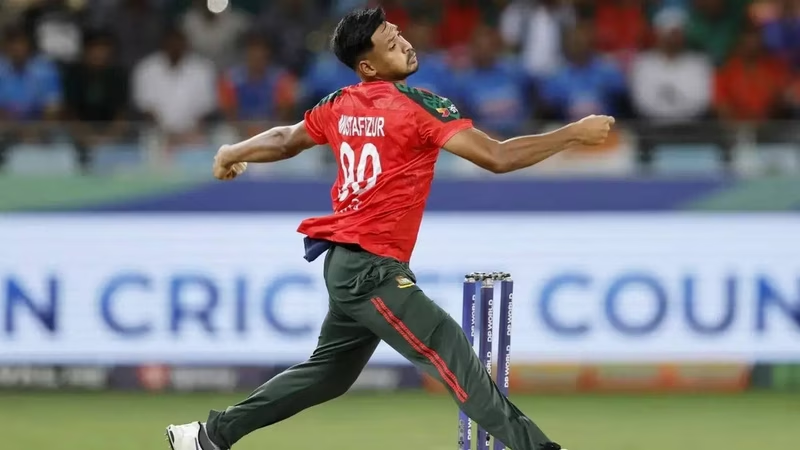
- The Mustafizur Rahman–KKR Exit: What Happened?
- Security Concerns and the Bigger Geopolitical Picture
- How Hosting Works in ICC Tournaments
- Conclusion: Balancing Cricket, Diplomacy, and Player Safety
- Sources
The Controversy That Sparked a Diplomatic Cricket Debate
Cricket is rarely just about the game anymore—and the lead-up to the 2026 T20 World Cup is proving no exception. A diplomatic storm has erupted after reports emerged that the International Cricket Council (ICC) suggested moving Bangladesh’s scheduled matches in India to “alternate venues” like Hyderabad and Chennai due to security concerns.
The Bangladesh Cricket Board (BCB) has now confirmed that such discussions did take place, bringing the phrase “ICC alternate venues Bangladesh” into the global cricketing lexicon. This development follows the sudden and controversial release of star pacer Mustafizur Rahman from his Kolkata Knight Riders (KKR) IPL contract—an action widely believed to be orchestrated by the BCCI over unspecified “security and sensitivity” issues linked to recent unrest in Bangladesh .
Did ICC Really Suggest Hyderabad and Chennai?
According to senior BCB officials, the ICC proactively reached out to assess contingency plans in case the security situation in Bangladesh—or perceptions thereof—jeopardized the team’s participation in India.
“Yes, the ICC did float the idea of using alternate venues within India, specifically mentioning Hyderabad and Chennai, should Bangladesh express discomfort playing in certain locations,” a BCB source told reporters .
Both cities are logical choices: they have world-class stadiums (Rajiv Gandhi International and M.A. Chidambaram), strong security infrastructure, and experience hosting high-profile international matches. More importantly, they are geographically distant from Kolkata—the epicenter of the current controversy—potentially reducing political friction.
However, it’s crucial to note: **no formal relocation has been ordered**. The ICC’s move appears to be precautionary, part of its standard risk-assessment protocol for all participating nations.
The Mustafizur Rahman–KKR Exit: What Happened?
The entire saga traces back to Mustafizur Rahman’s abrupt departure from KKR. Despite being retained for the 2026 IPL season, the left-arm seamer was “released on mutual consent” just weeks before the auction—a highly unusual step for an established international star.
Multiple sources, including ESPNcricinfo, reported that the decision came at the behest of the BCCI, citing “broader sensitivities” . These sensitivities are widely interpreted as relating to recent attacks on religious minorities in Bangladesh, which sparked protests in parts of India, particularly West Bengal.
For KKR—a franchise owned by Bollywood celebrities and deeply embedded in Bengal’s cultural fabric—the optics of fielding a Bangladeshi player became politically fraught. The BCCI, keen to avoid domestic backlash, reportedly advised KKR to let Mustafizur go.
This move drew sharp criticism from across the cricketing world, with many accusing the BCCI of mixing politics with sport. Mustafizur himself remained silent, but the incident clearly rattled the BCB, prompting them to seek assurances from the ICC about their team’s safety during the upcoming World Cup.
Security Concerns and the Bigger Geopolitical Picture
While the ICC’s venue suggestions are framed as routine, they reflect deeper geopolitical anxieties:
- Player welfare: Teams have the right to request neutral venues if they perceive credible threats to their safety.
- Diplomatic spillover: Domestic unrest in one country can quickly impact bilateral sporting ties, as seen in past India-Pakistan standoffs.
- Host nation responsibility: As co-hosts (with Sri Lanka), India bears the primary duty to guarantee a safe environment for all 20 teams.
The BCB’s public acknowledgment of the ICC’s alternate venue plan is itself significant—it signals that Bangladesh is taking the threat perception seriously, even if no actual threat has been documented against its players in India.
How Hosting Works in ICC Tournaments
Under ICC regulations, the host nation must provide “adequate security, accommodation, and logistical support” for all participating teams. If a team expresses genuine concern, the ICC can invoke its contingency protocols, which include:
- Relocating matches to alternative cities within the host country.
- Moving games to a neutral third country (e.g., UAE or Oman).
- In extreme cases, awarding walkovers or rescheduling.
Historically, such measures have been rare but not unprecedented. During the 2019 ODI World Cup, Afghanistan’s match against England was moved to a different venue due to fan safety concerns. Similarly, Pakistan’s “home” matches have been played in the UAE for over a decade due to terrorism risks.
According to the ICC’s official tournament guidelines, “the safety and well-being of players, officials, and spectators is non-negotiable” .
Conclusion: Balancing Cricket, Diplomacy, and Player Safety
The confirmation of the ICC alternate venues Bangladesh discussion is a stark reminder that modern cricket operates at the intersection of sport, politics, and security. While fans hope the T20 World Cup proceeds without disruption, the mere fact that contingency plans are being activated shows how fragile the ecosystem can be.
For Bangladesh, the priority is ensuring their players can compete without fear. For India, it’s about upholding its reputation as a capable and welcoming host. And for the ICC, it’s about preserving the integrity of the game in an increasingly complex world.
One thing is clear: as the tournament draws near, all eyes will be on whether diplomacy can keep cricket above the fray. Stay updated on all T20 World Cup developments at [INTERNAL_LINK:t20-world-cup-2026-preview].
Sources
- Times of India: Did ICC suggest Hyderabad, Chennai as alternate venues to Bangladesh? BCB reveals
- Web Search Results: , , ,
- ICC Official Website: https://www.icc-cricket.com/
- ESPNcricinfo: https://www.espncricinfo.com/