Table of Contents
- The Sky is the Limit: A New Era for the Republic Day Flypast
- What is the ‘Sindoor’ Formation?
- The Full IAF Lineup for Republic Day 2026
- A Pilot’s-Eye View of History
- The Evolution of the Republic Day Flypast
- Conclusion: A Soaring Tribute
- Sources
The Sky is the Limit: A New Era for the Republic Day Flypast
Every year, the Republic Day flypast is a moment that unites the nation in awe and pride. But the 2026 parade wasn’t just another show of strength; it was a historic, emotional, and visually stunning tribute that left millions speechless. This year, the Indian Air Force (IAF) didn’t just fly over Kartavya Path—they told a story from the sky.
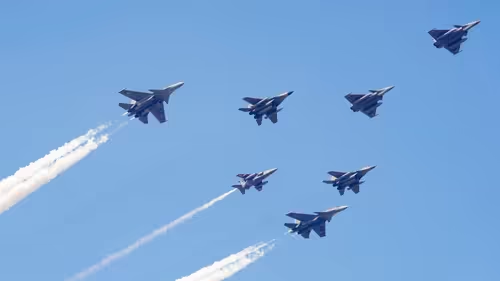
The centerpiece of this year’s aerial spectacle was the debut of the ‘Sindoor’ formation, a powerful homage to the heroes of Operation Sindoor. For the first time, the public could witness this incredible display not just from the ground, but from the very cockpit of the fighter jets themselves. The IAF released exclusive videos that offer a heart-pounding, immersive perspective of the entire event .
What is the ‘Sindoor’ Formation?
The ‘Sindoor’ formation is more than just a flight pattern; it’s a symbol of India’s resolve and cutting-edge military prowess. This special formation was meticulously designed to honor the strategic precision and success of Operation Sindoor.
It comprised a potent mix of India’s most advanced fighter aircraft, flying in perfect synchrony:
- 2 x Dassault Rafale
- 2 x MiG-29
- 2 x Su-30 MKI
- 1 x SEPECAT Jaguar
This seven-aircraft spearhead was the highlight of a larger 29-aircraft display that roared across the capital’s skies . The choice of these specific aircraft is significant, as they represent the backbone of the IAF’s offensive and defensive capabilities, showcasing a message of deterrence and national security to the world.
The Full IAF Lineup for Republic Day 2026
Beyond the ‘Sindoor’ formation, the entire Republic Day flypast was a comprehensive showcase of the IAF’s diverse fleet. The event kicked off with the traditional ‘Dhwaj’ formation, where four Mi-17 IV helicopters carried the National Flag and the flags of the Army, Navy, and Air Force, setting a solemn and patriotic tone for the proceedings .
The full aerial display included a total of 29 aircraft, weaving through the sky in various formations that demonstrated their agility, power, and the IAF’s unmatched operational readiness . From the thunderous roar of the heavy-lift transport aircraft to the graceful maneuvers of the lighter jets, the flypast was a complete testament to India’s air dominance.
A Pilot’s-Eye View of History
What truly set the 2026 parade apart was the release of official footage shot directly from the cockpits of the participating aircraft. These videos, shared by the Indian Air Force on its official social media channels, provide an unprecedented, immersive experience .
Imagine seeing the iconic Rajpath (now Kartavya Path) from thousands of feet in the air, with your wingman perfectly in formation beside you. The videos capture the intense focus of the pilots, the vast expanse of the city below, and the sheer scale of the event in a way that ground-level cameras never could. It’s a perspective that transforms the viewer from a spectator into a participant in this historic moment.
This move by the IAF not only offers a unique piece of content for aviation enthusiasts and patriots alike but also serves as a powerful tool for public engagement and transparency, giving citizens a direct window into the skill and discipline of their air warriors.
The Evolution of the Republic Day Flypast
The Republic Day flypast has come a long way since its inception. From the early days featuring propeller-driven Liberators to today’s supersonic jets like the Rafale, the flypast has always been a mirror to India’s growing defence capabilities and technological advancements .
Each decade has introduced new aircraft and more complex formations, reflecting the changing nature of aerial warfare and India’s commitment to maintaining a world-class air force. The introduction of the ‘Sindoor’ formation in 2026 is the latest chapter in this rich legacy, marking a shift towards formations that are not just displays of might, but also carriers of specific historical and strategic narratives.
For those interested in the history of India’s military parades, [INTERNAL_LINK:history-of-indian-military-parades] offers a deep dive into its evolution.
Conclusion: A Soaring Tribute
The 2026 Republic Day flypast was a masterclass in aerial choreography and a deeply moving tribute to India’s armed forces. The debut of the ‘Sindoor’ formation, combined with the release of the pilot’s-eye-view videos, created a landmark event that will be remembered for years to come. It was more than a display; it was a statement of national pride, a celebration of indigenous and acquired technological strength, and a heartfelt salute to the brave men and women who protect our skies. The IAF didn’t just participate in the parade; they owned the sky above it.