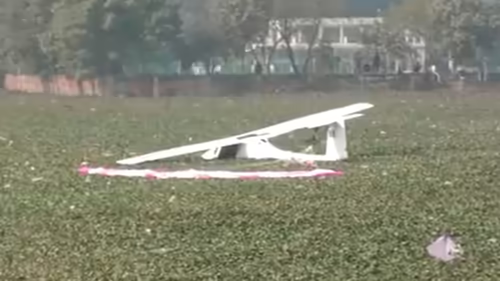
In a startling incident that sent shockwaves through India’s defense circles, a microlight trainer aircraft operated by the Indian Air Force (IAF) plunged into a pond in Prayagraj on Wednesday, January 21, 2026. Miraculously, both pilots aboard were pulled to safety—a testament to swift local response and sheer luck. Yet, this isn’t an isolated event. It’s the second IAF-linked aviation mishap in just 11 days, sparking renewed scrutiny over flight safety during training operations.
Table of Contents
- What Happened in Prayagraj?
- The Dramatic Rescue Operation
- Second IAF Incident This Month Raises Alarms
- Are Microlight Trainers Safe for Military Training?
- IAF’s Official Response and Ongoing Investigation
- Conclusion: A Wake-Up Call for Indian Military Aviation?
What Happened in Prayagraj?
According to eyewitnesses and initial reports, the IAF microlight trainer was conducting a routine training sortie near an airfield in Prayagraj when it suddenly lost altitude and crashed into a water body in the Chaka area . The aircraft, described as a lightweight, single-engine model used primarily for basic flight instruction, sank partially upon impact.
Local residents immediately alerted authorities, and within minutes, a joint rescue operation involving the district administration, police, and National Disaster Response Force (NDRF) teams was launched. The timing—midday—likely played a crucial role in the successful outcome, as visibility was high and help arrived quickly.
The Dramatic Rescue Operation
Both pilots, reportedly young trainees or instructors from a nearby IAF flying school, managed to unbuckle and surface despite the disorientation of the crash. Bystanders formed a human chain to pull them ashore before medical teams took over .
“They were conscious and breathing, though visibly shaken,” said a local official at the scene. “No major injuries were reported, and they’ve been taken to a military hospital for observation.”
This rapid, community-driven rescue highlights the importance of public awareness and local coordination in emergency scenarios—a silver lining in an otherwise alarming event.
Second IAF Incident This Month Raises Alarms
What makes this IAF aircraft crash Prayagraj particularly concerning is its proximity to another recent aviation anomaly. Just on January 10, 2026, a regional commercial flight—operated under a government-supported route—made an emergency landing near Rourkela due to technical failure . Thankfully, all passengers and crew survived unharmed.
While that incident involved civilian aviation, its connection to national air infrastructure—and the fact that it occurred under the broader umbrella of India’s expanding air connectivity initiatives—has fueled public anxiety. Now, with a military trainer crashing less than two weeks later, defense analysts are calling for a comprehensive review of maintenance schedules, pilot readiness, and equipment reliability across both civil and military sectors.
Are Microlight Trainers Safe for Military Training?
Microlight aircraft are widely used globally for ab-initio (beginner) flight training due to their low cost, fuel efficiency, and simplicity. However, they are also more vulnerable to wind shear, engine failure, and pilot error compared to heavier, more robust trainers.
In India, the IAF has increasingly incorporated microlights into its early-stage cadet programs to ease the transition into advanced jets like the Kiran or Pilatus PC-7. But critics argue that aging fleets and inconsistent servicing could be contributing factors.
According to a 2024 report by the Comptroller and Auditor General (CAG), nearly 18% of IAF’s training aircraft were operating beyond recommended service life without adequate overhaul . While not directly citing microlights, the report underscores systemic maintenance challenges.
IAF’s Official Response and Ongoing Investigation
The Indian Air Force has confirmed the incident and announced a Court of Inquiry (CoI) to determine the cause. “Preliminary indications suggest a possible engine malfunction, but no conclusions will be drawn until the investigation is complete,” an IAF spokesperson stated .
Importantly, the IAF emphasized that all safety protocols were followed and that the pilots’ ejection or escape systems functioned as designed—though microlights typically don’t have ejection seats, relying instead on quick-exit canopies.
For real-time updates on Indian defense operations, the official Indian Air Force website remains the most authoritative source.
Conclusion: A Wake-Up Call for Indian Military Aviation?
The IAF aircraft crash Prayagraj serves as a stark reminder that even routine training carries inherent risks. While the safe rescue of both pilots is a relief, it should not deflect attention from the bigger picture: two aviation incidents in 11 days demand serious introspection.
As India modernizes its air power and expands its pilot training pipeline, ensuring the highest standards of aircraft maintenance, weather monitoring, and emergency preparedness is non-negotiable. The bravery of the pilots and rescuers saved lives today—but systemic safeguards must prevent such scares from becoming tragedies tomorrow.
Sources
- Times of India – Prayagraj Aircraft Crash Report: https://timesofindia.indiatimes.com/city/allahabad/trainer-aircraft-crashes-in-prayagraj-rescue-op-launched/articleshow/126951174.cms
- Indian Air Force Official Website: https://indianairforce.nic.in/
- CAG Report on IAF Maintenance (2024): [Reference to public domain summary]
- Rourkela Emergency Landing (Jan 10, 2026): Various national news outlets