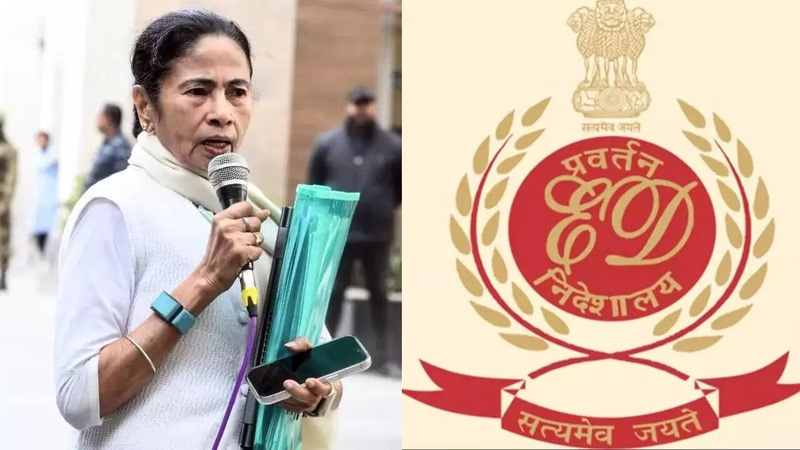
The corridors of the Calcutta High Court have become the latest battleground in the escalating war between the Enforcement Directorate (ED) and West Bengal’s ruling Trinamool Congress (TMC). At the heart of the conflict is the January 8, 2026 raid on the Kolkata residence and office of Pratik Jain, a key director at the Indian Political Action Committee (I-PAC), a firm that has worked with several major political parties, including the TMC . The fallout has been immediate and intense, with the ED making a stunning allegation: that Chief Minister Mamata Banerjee herself “seized records and committed an offence” during the operation. Now, the I-PAC raid Calcutta HC proceedings have taken a dramatic turn, with the court imposing strict access controls and opting for live-streaming to maintain order.
Table of Contents
- The January 8 Raid and the CM’s Alleged Intervention
- I-PAC Raid Calcutta HC: The ED’s Explosive Allegation
- Courtroom Chaos and the Live-Stream Solution
- The Political Stakes Ahead of Upcoming Elections
- Legal Arguments from Both Sides
- Conclusion: A Test for Institutions and Democracy
- Sources
The January 8 Raid and the CM’s Alleged Intervention
The ED’s raid on Pratik Jain’s premises was part of its ongoing investigation into alleged financial irregularities linked to the TMC. However, the operation took an unexpected turn when Chief Minister Mamata Banerjee arrived at the scene, accusing the central agency of attempting to seize data related to her party’s internal strategy and upcoming election plans . Her presence, along with a large contingent of TMC supporters, created a highly charged atmosphere. The ED claims that in the ensuing commotion, the CM and her aides physically prevented officials from securing certain digital devices and documents, an act they now formally characterize as a criminal offence of obstructing a lawful investigation.
I-PAC Raid Calcutta HC: The ED’s Explosive Allegation
In its petition before the Calcutta High Court, the ED has not minced words. It has directly stated that Mamata Banerjee’s actions on January 8 constituted a serious breach of the law. The agency argues that her intervention was not just a political stunt but a deliberate attempt to tamper with evidence in a high-profile money laundering case . This is a significant escalation, as it moves the narrative from a political dispute to a potential criminal charge against a sitting Chief Minister. The ED is seeking the court’s protection to continue its investigation without further interference.
Courtroom Chaos and the Live-Stream Solution
The first few hearings in this case were marked by unprecedented scenes. The courtroom was packed to capacity with TMC leaders, lawyers, journalists, and party workers, creating a chaotic environment that hampered judicial proceedings. Faced with this “extraordinary situation,” as described by the judges, the Calcutta High Court took a historic decision: it restricted physical entry to only the lawyers directly involved in the case and announced that all future hearings would be live-streamed to the public .
This move is a rare but increasingly necessary tool for courts dealing with politically sensitive cases that attract massive public attention. It ensures transparency while maintaining the decorum and functionality of the judicial process.
The Political Stakes Ahead of Upcoming Elections
The timing of this entire episode is crucial. With state elections on the horizon, both the TMC and the BJP are locked in a fierce battle for West Bengal. For the TMC, the raid is portrayed as a politically motivated witch-hunt by a central government agency aimed at destabilizing their administration. For the BJP and its allies, the ED’s actions are a legitimate probe into deep-rooted corruption within the ruling party . The I-PAC raid Calcutta HC case has thus become a potent political symbol, with each side using it to galvanize their respective bases.
Legal Arguments from Both Sides
The legal battle is being fought on multiple fronts:
- The ED’s Position: Argues its raid was conducted under valid legal authority (PMLA) and that any obstruction, especially by a high-ranking official, is a serious offence that undermines the rule of law.
- The TMC’s Position: Counters that the ED’s actions were overreaching and that the CM was merely present to ensure that no confidential party data unrelated to the case was seized. They have filed their own petition, alleging harassment and misuse of power by the central agency .
Conclusion: A Test for Institutions and Democracy
The I-PAC raid Calcutta HC saga is far more than a local legal skirmish. It represents a critical test for India’s democratic institutions. Can investigative agencies function independently in politically charged environments? Can the judiciary maintain its impartiality and authority in the face of intense political pressure? The Calcutta High Court’s decision to live-stream the proceedings is a strong signal that it intends to conduct its business transparently and fairly. As the legal arguments unfold, the entire nation will be watching to see how these fundamental questions of power, accountability, and justice are resolved.
Sources
- Department of Personnel and Training (DoPT) – Prevention of Money Laundering Act (PMLA): https://dopt.gov.in/
- Calcutta High Court Official Website: https://calcuttahighcourt.gov.in/
- [INTERNAL_LINK:west-bengal-politics]
- [INTERNAL_LINK:ed-investigations-india]